Event submissions
Published

This submission belongs to the session S7. Poster of the event 1st International Electronic Conference on Toxins
Published date
13 Jan, 2021
Citation
Oscar sanchez, Montamas Suntravat, Elda E. Sanchez, Functional characterization of a novel rCRiSP (recombinant cysteine-rich secretory protein) from Crotalus oreganus helleri, in Proceedings of 1st International Electronic Conference on Toxins, 16 January–31 January 2021, MDPI: Basel, Switzerland, doi: 10.3390/IECT2021-09115
Share
Email
Facebook
Twitter
LinkedIn
Functional characterization of a novel rCRiSP (recombinant cysteine-rich secretory protein) from Crotalus oreganus helleri
'%3e%3cpath%20d='M12.6647%2010.9104C12.4176%2010.325%2012.0589%209.7933%2011.6088%209.34485C11.16%208.89511%2010.6283%208.53653%2010.0432%208.28891C10.038%208.28629%2010.0327%208.28498%2010.0275%208.28236C10.8437%207.69282%2011.3743%206.73252%2011.3743%205.64907C11.3743%203.85423%209.92005%202.40002%208.12522%202.40002C6.33038%202.40002%204.87618%203.85423%204.87618%205.64907C4.87618%206.73252%205.40677%207.69282%206.22296%208.28367C6.21772%208.28629%206.21248%208.2876%206.20724%208.29022C5.62031%208.53783%205.09365%208.89287%204.64167%209.34616C4.19192%209.79496%203.83334%2010.3266%203.58573%2010.9117C3.34247%2011.4846%203.21128%2012.0987%203.19925%2012.721C3.1989%2012.735%203.20135%2012.7489%203.20646%2012.7619C3.21157%2012.7749%203.21924%2012.7868%203.22901%2012.7968C3.23877%2012.8068%203.25045%2012.8148%203.26334%2012.8202C3.27623%2012.8256%203.29007%2012.8284%203.30406%2012.8284H4.09012C4.14776%2012.8284%204.19362%2012.7825%204.19493%2012.7262C4.22113%2011.7148%204.62726%2010.7676%205.34519%2010.0497C6.08802%209.30686%207.07452%208.89811%208.12522%208.89811C9.17592%208.89811%2010.1624%209.30686%2010.9052%2010.0497C11.6232%2010.7676%2012.0293%2011.7148%2012.0555%2012.7262C12.0568%2012.7839%2012.1027%2012.8284%2012.1603%2012.8284H12.9464C12.9604%2012.8284%2012.9742%2012.8256%2012.9871%2012.8202C13%2012.8148%2013.0117%2012.8068%2013.0214%2012.7968C13.0312%2012.7868%2013.0389%2012.7749%2013.044%2012.7619C13.0491%2012.7489%2013.0515%2012.735%2013.0512%2012.721C13.0381%2012.0947%2012.9084%2011.4856%2012.6647%2010.9104ZM8.12522%207.90243C7.52388%207.90243%206.95792%207.66793%206.53214%207.24215C6.10636%206.81636%205.87185%206.2504%205.87185%205.64907C5.87185%205.04773%206.10636%204.48177%206.53214%204.05599C6.95792%203.63021%207.52388%203.3957%208.12522%203.3957C8.72655%203.3957%209.29252%203.63021%209.7183%204.05599C10.1441%204.48177%2010.3786%205.04773%2010.3786%205.64907C10.3786%206.2504%2010.1441%206.81636%209.7183%207.24215C9.29252%207.66793%208.72655%207.90243%208.12522%207.90243Z'%20fill='%235D1EE1'/%3e%3c/g%3e%3c/svg%3e)
Oscar sanchez 1
Montamas Suntravat 1
Elda E. Sanchez 1,2
1. National Natural Toxins Research Center, Texas A&M University-Kingsville, Kingsville, TX
2. Department of Chemistry, Texas A&M University-Kingsville, MSC 161, Kingsville, TX
Abstract
Snake venom is a highly complex and diverse cocktail of different proteins and peptides that cause a wide range of biological disturbances in an envenomated victim. While many snake venom toxins have been comprehensively characterized, other toxins such as cysteine-rich secretory proteins (CRiSPs) remain largely unexplored. CRiSPs are ubiquitous non-enzymatic toxins found in many species of snakes worldwide. Several CRiSPs isolated from Asian and Australian snake venoms have been shown to inhibit ion channel/smooth muscle contraction. We have recently reported that Hellerin, a svCRiSP that we have isolated from the venom of the Southern Pacific Rattlesnake, C. oreganus helleri, directly increases vascular permeability in vivo and in vitro. These observations may be parallel to Bj-CRP’s local effects, a CRiSP isolated from the venom of Bothrops jararaca, that has been shown to induce profound inflammatory responses in local tissues through the recruitment of neutrophils and the production of IL-6. To shed new light on svCRiSPs’ molecular targets and inflammatory responses, a recombinant CRiSP from C. o. helleri (named rHellerin) was cloned and tested for vascular and cellular permeability and pro-inflammatory responses. rHellerin was able to induce vascular leakage in vivo and cellular permeability similar to that of native CRiSP. rHellerin was also able to induce increased production of the cytokines IL-8 and IL-6 in human blood and lymphatic endothelial cells. These findings can provide a straightforward method of obtaining biologically viable svCRiSPs identical to the native form, which can accelerate research into further understanding the molecular biology of svCRiSPs by elucidating functionally active residues and subsequent molecular targets/interactions. rHellerin can represent potential in the development of new therapeutic strategies to prevent death and disability from snakebite.
Keywords
recombinant protein
rHellerin
inflammatory responses
cysteine-rich secretory proteins (CRiSP)
Manuscript
041132.pdf
Poster
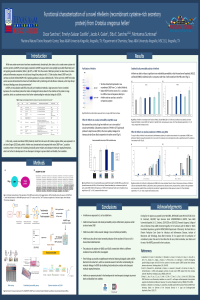
Toxins poster_Oscar_MS_ESS final.pdf
Activation of anion channels in human cells after long term exposure to the marine toxin azaspiracid
Evaluation of in vitro muscle regeneration after myonecrosis induced by Bothrops alternatus and Bothrops diporus venoms from Northeastern Argentina