Event submissions
Published

This submission belongs to the session S7. Poster of the event 1st International Electronic Conference on Toxins
Published date
13 Jan, 2021
Citation
Steven Ascoët, Nathan Tene, Axel Touchard, Valentine Barasse, Jérôme Leprince, Arnaud Billet, Elsa Bonnafe, Michel Treilhou, Analogous venom peptides acting on different pathways: a study of Bicarinalin and U₉-MYRTX-Tb1a from T. bicarinatum venom, in Proceedings of 1st International Electronic Conference on Toxins, 16 January–31 January 2021, MDPI: Basel, Switzerland, doi: 10.3390/IECT2021-09121
Share
Email
Facebook
Twitter
LinkedIn
Analogous venom peptides acting on different pathways: a study of Bicarinalin and U9-MYRTX-Tb1a from T. bicarinatum venom
'%3e%3cpath%20d='M12.6647%2010.9104C12.4176%2010.325%2012.0589%209.7933%2011.6088%209.34485C11.16%208.89511%2010.6283%208.53653%2010.0432%208.28891C10.038%208.28629%2010.0327%208.28498%2010.0275%208.28236C10.8437%207.69282%2011.3743%206.73252%2011.3743%205.64907C11.3743%203.85423%209.92005%202.40002%208.12522%202.40002C6.33038%202.40002%204.87618%203.85423%204.87618%205.64907C4.87618%206.73252%205.40677%207.69282%206.22296%208.28367C6.21772%208.28629%206.21248%208.2876%206.20724%208.29022C5.62031%208.53783%205.09365%208.89287%204.64167%209.34616C4.19192%209.79496%203.83334%2010.3266%203.58573%2010.9117C3.34247%2011.4846%203.21128%2012.0987%203.19925%2012.721C3.1989%2012.735%203.20135%2012.7489%203.20646%2012.7619C3.21157%2012.7749%203.21924%2012.7868%203.22901%2012.7968C3.23877%2012.8068%203.25045%2012.8148%203.26334%2012.8202C3.27623%2012.8256%203.29007%2012.8284%203.30406%2012.8284H4.09012C4.14776%2012.8284%204.19362%2012.7825%204.19493%2012.7262C4.22113%2011.7148%204.62726%2010.7676%205.34519%2010.0497C6.08802%209.30686%207.07452%208.89811%208.12522%208.89811C9.17592%208.89811%2010.1624%209.30686%2010.9052%2010.0497C11.6232%2010.7676%2012.0293%2011.7148%2012.0555%2012.7262C12.0568%2012.7839%2012.1027%2012.8284%2012.1603%2012.8284H12.9464C12.9604%2012.8284%2012.9742%2012.8256%2012.9871%2012.8202C13%2012.8148%2013.0117%2012.8068%2013.0214%2012.7968C13.0312%2012.7868%2013.0389%2012.7749%2013.044%2012.7619C13.0491%2012.7489%2013.0515%2012.735%2013.0512%2012.721C13.0381%2012.0947%2012.9084%2011.4856%2012.6647%2010.9104ZM8.12522%207.90243C7.52388%207.90243%206.95792%207.66793%206.53214%207.24215C6.10636%206.81636%205.87185%206.2504%205.87185%205.64907C5.87185%205.04773%206.10636%204.48177%206.53214%204.05599C6.95792%203.63021%207.52388%203.3957%208.12522%203.3957C8.72655%203.3957%209.29252%203.63021%209.7183%204.05599C10.1441%204.48177%2010.3786%205.04773%2010.3786%205.64907C10.3786%206.2504%2010.1441%206.81636%209.7183%207.24215C9.29252%207.66793%208.72655%207.90243%208.12522%207.90243Z'%20fill='%235D1EE1'/%3e%3c/g%3e%3c/svg%3e)
Steven Ascoët 1

Nathan Tene 1
Axel Touchard 1
Valentine Barasse 2
Jérôme Leprince 3
Arnaud Billet 1
Elsa Bonnafe 1

Michel Treilhou 1
1. EA-7417, Institut National Universitaire Champollion, Place de Verdun, 81012 Albi, France.
2. Equipe BTSB-EA7417, Université de Toulouse, Institut National Universitaire Jean-François Champollion, Place de Verdun, 81012, Albi, France
3. InsermU1239,NormandieUniv,UNIROUEN,Plate-forme de Recherche en Imagerie Cellulaire Normandie (PRIMACEN), 76000 Rouen, France
Abstract
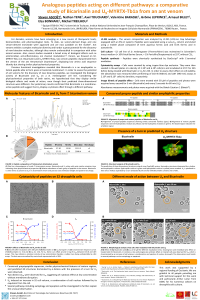
For decades venom were studied for various applications as agriculture, therapeutics or as pharmacological tools. Currently, six venom-derived drugs and one venom-derived insecticide are available on market. Ant venoms exhibit a high diversity of peptides, similarly to other arthropod venoms. The first studies shown many in vitro and in vivo biological effects such as anti-microbial, anti-inflammatory, anti-viral or even ion channel modulators. Our study focused on M-MYRTX-Tb1a (Bicarinalin) and U9-MYRTX-Tb1a, two peptides from Tetramorium bicarinatum venom exhibiting similar sequences. Bicarinalin is an amphipatic α-helical peptide, which was found to forms pores in cell membranes. As the sequence of U9-MYRTX-Tb1a suggests a similar structure with identical physico-chemical properties, we hypothesized a similar biological function. In this study we investigated the biological effect of U9-MYRTX-Tb1a. We tested the two peptides on Drosophila melanogaster embryonic cells to evaluate their cytotoxicity. As predicted, the Drosophila cells lysis was observed with the addition of both peptides. However, the cell morphology after peptide incubation and the time-effect was different between U9-MYRTX-Tb1a and Bicarinalin suggesting different mechanisms of action. First, incubation with U9-MYRTX-Tb1a leads to cell growing, and blebs forming with a potential condensation of the nucleus. Then, the cytotoxicity effect of Bicarinalin is faster than the U9-MYRTX-Tb1a. These first results, suggest that pro-apoptotic and/or autophagic pathways could be involved in biological activity of U9-MYRTX-Tb1a. By confirming this hypothesis, we could update the first peptide from ant venom with a pro-apoptotic and/or autophagic effect and the various associated applications.
Keywords
ant
venom
peptide
bicarinalin
cytotoxicity
apoptose
autophagy
Manuscript
IECT2021_Poster_ASCOET.pdf
Poster
IECT2021_Poster_ASCOET.pdf
Paraspecific neutralization of the venom form adults and young Crotalus atrox by paraspecific South American Antivenoms.
Biological activities of phosphodiesterase from Crotalus durissus terrificus venom