Event submissions
Published

This submission belongs to the session S7. Poster of the event 1st International Electronic Conference on Toxins
Published date
13 Jan, 2021
Citation
Francielle Almeida Cordeiro, Fernanda Gobbi Amorim, Johara Boldrini-França, Ernesto Lopes Pinheiro-Junior, Iara Aimê Cardoso, Steve Peigneur, Jan Tytgat, Eliane Candiani Arantes, Heterologous expression of a neurotoxin from Tityus serrulatus scorpion venom in Pichia pastoris yeast and the evaluation of its glycosylation patterns, in Proceedings of 1st International Electronic Conference on Toxins, 16 January–31 January 2021, MDPI: Basel, Switzerland, doi: 10.3390/IECT2021-09129
Share
Email
Facebook
Twitter
LinkedIn
Heterologous expression of a neurotoxin from Tityus serrulatus scorpion venom in Pichia pastoris yeast and the evaluation of its glycosylation patterns
'%3e%3cpath%20d='M12.6647%2010.9104C12.4176%2010.325%2012.0589%209.7933%2011.6088%209.34485C11.16%208.89511%2010.6283%208.53653%2010.0432%208.28891C10.038%208.28629%2010.0327%208.28498%2010.0275%208.28236C10.8437%207.69282%2011.3743%206.73252%2011.3743%205.64907C11.3743%203.85423%209.92005%202.40002%208.12522%202.40002C6.33038%202.40002%204.87618%203.85423%204.87618%205.64907C4.87618%206.73252%205.40677%207.69282%206.22296%208.28367C6.21772%208.28629%206.21248%208.2876%206.20724%208.29022C5.62031%208.53783%205.09365%208.89287%204.64167%209.34616C4.19192%209.79496%203.83334%2010.3266%203.58573%2010.9117C3.34247%2011.4846%203.21128%2012.0987%203.19925%2012.721C3.1989%2012.735%203.20135%2012.7489%203.20646%2012.7619C3.21157%2012.7749%203.21924%2012.7868%203.22901%2012.7968C3.23877%2012.8068%203.25045%2012.8148%203.26334%2012.8202C3.27623%2012.8256%203.29007%2012.8284%203.30406%2012.8284H4.09012C4.14776%2012.8284%204.19362%2012.7825%204.19493%2012.7262C4.22113%2011.7148%204.62726%2010.7676%205.34519%2010.0497C6.08802%209.30686%207.07452%208.89811%208.12522%208.89811C9.17592%208.89811%2010.1624%209.30686%2010.9052%2010.0497C11.6232%2010.7676%2012.0293%2011.7148%2012.0555%2012.7262C12.0568%2012.7839%2012.1027%2012.8284%2012.1603%2012.8284H12.9464C12.9604%2012.8284%2012.9742%2012.8256%2012.9871%2012.8202C13%2012.8148%2013.0117%2012.8068%2013.0214%2012.7968C13.0312%2012.7868%2013.0389%2012.7749%2013.044%2012.7619C13.0491%2012.7489%2013.0515%2012.735%2013.0512%2012.721C13.0381%2012.0947%2012.9084%2011.4856%2012.6647%2010.9104ZM8.12522%207.90243C7.52388%207.90243%206.95792%207.66793%206.53214%207.24215C6.10636%206.81636%205.87185%206.2504%205.87185%205.64907C5.87185%205.04773%206.10636%204.48177%206.53214%204.05599C6.95792%203.63021%207.52388%203.3957%208.12522%203.3957C8.72655%203.3957%209.29252%203.63021%209.7183%204.05599C10.1441%204.48177%2010.3786%205.04773%2010.3786%205.64907C10.3786%206.2504%2010.1441%206.81636%209.7183%207.24215C9.29252%207.66793%208.72655%207.90243%208.12522%207.90243Z'%20fill='%235D1EE1'/%3e%3c/g%3e%3c/svg%3e)
Francielle Almeida Cordeiro 1
Fernanda Gobbi Amorim 2
Johara Boldrini-França 3
Ernesto Lopes Pinheiro-Junior 4
Iara Aimê Cardoso 1

Steve Peigneur 4
Jan Tytgat 4

Eliane Candiani Arantes 1
1. Department of BioMolecular Sciences, School of Pharmaceutical Sciences of Ribeirão Preto, University of São Paulo, Ribeirão Preto, SP, Brazil
2. Laboratory of Mass Spectrometry, Department of Chemistry, University of Liège, Liège, Belgium
3. Postgraduate Program in Ecosystem Ecology, Vila Velha University, Vila Velha, Brazil
4. Toxicology and Pharmacology, University of Leuven, Leuven, Belgium
Abstract
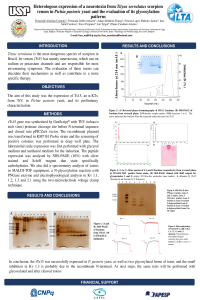
Tityus serrulatus is the most dangerous species of scorpion in Brazil. Its venom (TsV) has mainly neurotoxins, which can on sodium or potassium channels and are responsible for most envenoming symptoms. The evaluation of these toxins can elucidate their mechanisms as well as contribute to a more specific therapy. The aim of this study was the expression of Ts15, an α-KTx from TsV, in Pichia pastoris and its characterization. rTs15 gene was synthetized by GenScript® with TEV (tobacco etch virus) protease cleavage site before N-terminal sequence and cloned into pPICZαA vector. The recombinant plasmid was transformed in KM71H Pichia strain and the screening of positive colonies was performed in deep well plate. The laboratorial scale expression was first performed with glycerol medium and methanol medium for the induction. The peptide expression was analysed by SDS-PAGE (16%) with silver stained and Schiff reagent that stain specifically carbohydrates. We also did a spectrometry analysis of toxins in MALDI-TOF equipment, a N-glycosylation reaction with PNGase enzyme and electrophysiological analysis in Kv 1.1, 1.2, 1.3 and 2.1 using the two-microelectrode voltage clamp technique. The SDS-PAGE revealed three bands and their molecular masses by spectrometry analysis were 7.76, 7.5 and 5.5 kDa. The Schiff stain revealed that the toxins with 7.76 and 7.5 kDa are glycosylated and the reaction with PNGase was able to remove part of this glycosylation, indicating that P. pastoris is making N-glycosylation. A preliminary electrophysiological screening with non-glycosylated toxin showed a small inhibition in Kv 1.3. In conclusion, the rTs15 was successfully expressed in P. pastoris yeast, as well as two glycosylated forms of toxin, and the small inhibition in Kv 1.3 is probably due to the recombinant N-terminal. As next steps, the same tests will be performed with glycosylated and after cleaved toxins.
Keywords
Tityus serrulatus venom
α-KTx
Ts15
heterologous expression
glycosylation.
Manuscript
Poster IECT- FAC .pdf
Poster
Poster IECT- FAC .pdf
Expression and purification of rTs7, a recombinant toxin from Tityus serrulatus scorpion venom
Cloning and expression of a Hemocyanin isolated from the centipede Cryptops iheringi