Event submissions
Published

This submission belongs to the session S7. Poster of the event 1st International Electronic Conference on Toxins
Published date
13 Jan, 2021
Citation
Kariny Cruz, Milton Y. Nishiyama Jr, Inácio de Loiola Meirelles Junqueira de Azevedo, Geraldo Magalhães, Lhiri Hanna Alves De Lucca Shimokawa-Falcão, Cloning and expression of a Hemocyanin isolated from the centipede Cryptops iheringi, in Proceedings of 1st International Electronic Conference on Toxins, 16 January–31 January 2021, MDPI: Basel, Switzerland, doi: 10.3390/IECT2021-09130
Share
Email
Facebook
Twitter
LinkedIn
Cloning and expression of a Hemocyanin isolated from the centipede Cryptops iheringi
'%3e%3cpath%20d='M12.6647%2010.9104C12.4176%2010.325%2012.0589%209.7933%2011.6088%209.34485C11.16%208.89511%2010.6283%208.53653%2010.0432%208.28891C10.038%208.28629%2010.0327%208.28498%2010.0275%208.28236C10.8437%207.69282%2011.3743%206.73252%2011.3743%205.64907C11.3743%203.85423%209.92005%202.40002%208.12522%202.40002C6.33038%202.40002%204.87618%203.85423%204.87618%205.64907C4.87618%206.73252%205.40677%207.69282%206.22296%208.28367C6.21772%208.28629%206.21248%208.2876%206.20724%208.29022C5.62031%208.53783%205.09365%208.89287%204.64167%209.34616C4.19192%209.79496%203.83334%2010.3266%203.58573%2010.9117C3.34247%2011.4846%203.21128%2012.0987%203.19925%2012.721C3.1989%2012.735%203.20135%2012.7489%203.20646%2012.7619C3.21157%2012.7749%203.21924%2012.7868%203.22901%2012.7968C3.23877%2012.8068%203.25045%2012.8148%203.26334%2012.8202C3.27623%2012.8256%203.29007%2012.8284%203.30406%2012.8284H4.09012C4.14776%2012.8284%204.19362%2012.7825%204.19493%2012.7262C4.22113%2011.7148%204.62726%2010.7676%205.34519%2010.0497C6.08802%209.30686%207.07452%208.89811%208.12522%208.89811C9.17592%208.89811%2010.1624%209.30686%2010.9052%2010.0497C11.6232%2010.7676%2012.0293%2011.7148%2012.0555%2012.7262C12.0568%2012.7839%2012.1027%2012.8284%2012.1603%2012.8284H12.9464C12.9604%2012.8284%2012.9742%2012.8256%2012.9871%2012.8202C13%2012.8148%2013.0117%2012.8068%2013.0214%2012.7968C13.0312%2012.7868%2013.0389%2012.7749%2013.044%2012.7619C13.0491%2012.7489%2013.0515%2012.735%2013.0512%2012.721C13.0381%2012.0947%2012.9084%2011.4856%2012.6647%2010.9104ZM8.12522%207.90243C7.52388%207.90243%206.95792%207.66793%206.53214%207.24215C6.10636%206.81636%205.87185%206.2504%205.87185%205.64907C5.87185%205.04773%206.10636%204.48177%206.53214%204.05599C6.95792%203.63021%207.52388%203.3957%208.12522%203.3957C8.72655%203.3957%209.29252%203.63021%209.7183%204.05599C10.1441%204.48177%2010.3786%205.04773%2010.3786%205.64907C10.3786%206.2504%2010.1441%206.81636%209.7183%207.24215C9.29252%207.66793%208.72655%207.90243%208.12522%207.90243Z'%20fill='%235D1EE1'/%3e%3c/g%3e%3c/svg%3e)
Kariny Cruz 1
Milton Y. Nishiyama Jr 2
Inácio de Loiola Meirelles Junqueira de Azevedo 2
Geraldo Magalhães 1
Lhiri Hanna Alves De Lucca Shimokawa-Falcão 1
1. Immunopathology Laboratory, Instituto Butantan, Brazil
2. Special Laboratory to Applied Toxinology , Instituto Butantan, Brazil
Abstract
Among the centipede of the chilopode Myriapoda class, the Cryptops genus is one of the most associated with accidents in humans in the metropolitan region of the state of São Paulo. To date, there is no study in the literature about Cryptops iheringi toxins. Thus, in this work a transcriptomic analysis of the C. iheringi venom gland was performed to obtain a profile of the toxins of this species. In addition, the crude venom was subjected to mass spectrometry analysis to establish an association between unknown sequences. These approaches for the construction of a general profile of the venom gland expression of this species led to the he identification of a Hemocyanin (Hc) subunit.
Hemocyanins are copper-containing, respiratory proteins that occur in the haemolymph of many arthropod species. Here, we report the presence of Hc in the chilopode Myriapoda C. iheringi. Such respiratory proteins have long been considered unnecessary in Myriapoda, due to its tracheal systems.
These respiratory proteins are potent immunogens, which induce the synthesis of large amounts of specific antibodies. Studies pointed out its interaction with polymorphonuclear monocytes and lymphocytes and in vitro tests have shown a potential anticancer activit, with in vitro significant inhibition of the growth of cancerous strains of the breast, pancreas and prostate. Currently scientific data is mostly limited to the study of native Hc of M. crenulata molluscs, therefore, the biotechnological potential of Hcs isolated from centipedes is still unexplored.
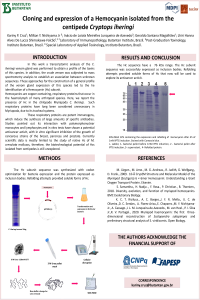
Herein, the Hc sequence that was present in both proteome and transcriptome analysis have signal peptide and 76 kDa range. The Hc subunit sequence was synthesized with codon optimization for bacteria expression and the protein expressed as inclusion bodies. Refolding attempts provided soluble forms of Hc. At the moment efforts to access your biological activities are being carried out.
Keywords
Cryptops iheringi
centipede
hemocyanin
haemocyanin
Manuscript
Banner Congresso OK .pdf
Poster
Banner Congresso OK .pdf
Heterologous expression of a neurotoxin from Tityus serrulatus scorpion venom in Pichia pastoris yeast and the evaluation of its glycosylation patterns
Flavonoids play a key role in resistance to accumulation of aflatoxin in corn.