Event submissions
Published

This submission belongs to the session S7. Poster of the event 1st International Electronic Conference on Toxins
Published date
13 Jan, 2021
Citation
Fernanda Gobbi Amorim, Johara Boldrini França, Francielle Almeida Cordeiro, Felipe Augusto Cerni, Manuela Berto Pucca, Steve Peigneur, Jan Tytgat, Julien Echterbille, Loïc Quinton, Eliane Candiani Arantes, Shedding new lights on the recombinant β-KTx neurotoxin from Tityus serrulatus: heterologous expression, structural and functional characterization., in Proceedings of 1st International Electronic Conference on Toxins, 16 January–31 January 2021, MDPI: Basel, Switzerland, doi: 10.3390/IECT2021-09132
Share
Email
Facebook
Twitter
LinkedIn
Shedding new lights on the recombinant β-KTx neurotoxin from Tityus serrulatus: heterologous expression, structural and functional characterization.
'%3e%3cpath%20d='M12.6647%2010.9104C12.4176%2010.325%2012.0589%209.7933%2011.6088%209.34485C11.16%208.89511%2010.6283%208.53653%2010.0432%208.28891C10.038%208.28629%2010.0327%208.28498%2010.0275%208.28236C10.8437%207.69282%2011.3743%206.73252%2011.3743%205.64907C11.3743%203.85423%209.92005%202.40002%208.12522%202.40002C6.33038%202.40002%204.87618%203.85423%204.87618%205.64907C4.87618%206.73252%205.40677%207.69282%206.22296%208.28367C6.21772%208.28629%206.21248%208.2876%206.20724%208.29022C5.62031%208.53783%205.09365%208.89287%204.64167%209.34616C4.19192%209.79496%203.83334%2010.3266%203.58573%2010.9117C3.34247%2011.4846%203.21128%2012.0987%203.19925%2012.721C3.1989%2012.735%203.20135%2012.7489%203.20646%2012.7619C3.21157%2012.7749%203.21924%2012.7868%203.22901%2012.7968C3.23877%2012.8068%203.25045%2012.8148%203.26334%2012.8202C3.27623%2012.8256%203.29007%2012.8284%203.30406%2012.8284H4.09012C4.14776%2012.8284%204.19362%2012.7825%204.19493%2012.7262C4.22113%2011.7148%204.62726%2010.7676%205.34519%2010.0497C6.08802%209.30686%207.07452%208.89811%208.12522%208.89811C9.17592%208.89811%2010.1624%209.30686%2010.9052%2010.0497C11.6232%2010.7676%2012.0293%2011.7148%2012.0555%2012.7262C12.0568%2012.7839%2012.1027%2012.8284%2012.1603%2012.8284H12.9464C12.9604%2012.8284%2012.9742%2012.8256%2012.9871%2012.8202C13%2012.8148%2013.0117%2012.8068%2013.0214%2012.7968C13.0312%2012.7868%2013.0389%2012.7749%2013.044%2012.7619C13.0491%2012.7489%2013.0515%2012.735%2013.0512%2012.721C13.0381%2012.0947%2012.9084%2011.4856%2012.6647%2010.9104ZM8.12522%207.90243C7.52388%207.90243%206.95792%207.66793%206.53214%207.24215C6.10636%206.81636%205.87185%206.2504%205.87185%205.64907C5.87185%205.04773%206.10636%204.48177%206.53214%204.05599C6.95792%203.63021%207.52388%203.3957%208.12522%203.3957C8.72655%203.3957%209.29252%203.63021%209.7183%204.05599C10.1441%204.48177%2010.3786%205.04773%2010.3786%205.64907C10.3786%206.2504%2010.1441%206.81636%209.7183%207.24215C9.29252%207.66793%208.72655%207.90243%208.12522%207.90243Z'%20fill='%235D1EE1'/%3e%3c/g%3e%3c/svg%3e)
Fernanda Gobbi Amorim 1
Johara Boldrini França 2
Francielle Almeida Cordeiro 3
Felipe Augusto Cerni 3

Manuela Berto Pucca 4

Steve Peigneur 5
Jan Tytgat 5
Julien Echterbille 1

Loïc Quinton 1

Eliane Candiani Arantes 3
1. Laboratory of Mass Spectrometry, Department of Chemistry, University of Liège, Liège, Belgium
2. Postgraduate Program in Ecosystem Ecology, Vila Velha University, Vila Velha, Brazil
3. School of Pharmaceutical Sciences of Ribeirão Preto, University of São Paulo, Ribeirão Preto, Brazil
4. Medical School, Federal University of Roraima, Boa Vista, Brazil
5. Toxicology and Pharmacology, University of Leuven, Leuven, Belgium
Abstract
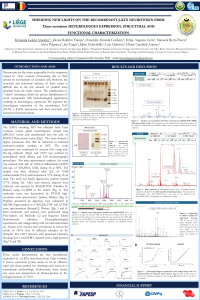
Neurotoxins are the major responsible for the symptoms caused by Tityus serrulatus envenoming due to their actions on ion-channels of excitable cells. However, the structural and functional analyses of these toxins is difficult due to the low amount of purified toxin obtained from the crude venom. The combination of “-omics” techniques allows the precise identification of novel components with biotechnological applications enabling its heterologous expression. We reported the heterologous expression of the recombinant Ts19 (rTs19), a β-KTx neurotoxin, and their structural and functional characterizations. The cDNA encoding rTs19 was obtained from Tityus serrulatus venom gland transcriptome, cloned into pPICZαA plasmid and transformed into cells of KM71H Pichia pastoris strain. rTs19 was purified by immobilized metal affinity and C18 chromatography procedures and showed a higher expression after 96h of induction in buffered methanol-complex medium at 30°C. The expression of the toxin was confirmed by western blot using anti-His-tag antibody. In addition, rTs19 showed a molar mass of 6555.05 Da confirmed by FT-ICR high-resolution mass spectrometry (Solarix, Bruker). After reduction and alkylation, MALDI-TOF analyses (Ultraflex II, Bruker) confirmed the three disulfide bridges of the toxin. rTs19 was sequenced by enzymatic digestion using trypsin and MS/MS fragmentation in a Q-TOF mass spectrometer (SynaptG2, Waters). Electrophysiological experiments and voltage-clamp with two microelectrodes on Xenopus laevis oocytes were performed to screen the action of rTs19 over 16 different subtypes of Kv channels. The rTs19 interacts with potassium channels, blocking Kv1.4 and hERG channels with a high potency. These results demonstrated the first recombinant expression of a β-KTx neurotoxin from Tityus serrulatus. P. pastoris expression system seems to be an efficient, rapid and cheap method for obtaining such toxins in a recombinant methodology. Furthermore, these results may open new perspectives of bioprospection of the biological actions of rTs19.
Keywords
Tityus serrulatus venom
heterologous expression
neurotoxin
Manuscript
2020-Poster Toxins Online.pdf
Poster
2020-Poster Toxins Online.pdf
Flavonoids play a key role in resistance to accumulation of aflatoxin in corn.
Bothrops moojeni venom: a new tool to investigate osteoclasts differentiation