Event submissions
Published

This submission belongs to the session S7. Poster of the event 1st International Electronic Conference on Toxins
Published date
14 Jan, 2021
Citation
Laura Carbonell-Rozas, Francisco J. Lara, Laura Gámiz-Gracia, Ana M. García-Campaña, VALIDATION OF A METHOD FOR THE CONTROL OF ERGOT ALKALOIDS IN OAT-BASED FUNCTIONAL FOODS, in Proceedings of 1st International Electronic Conference on Toxins, 16 January–31 January 2021, MDPI: Basel, Switzerland, doi: 10.3390/IECT2021-09151
Share
Email
Facebook
Twitter
LinkedIn
VALIDATION OF A METHOD FOR THE CONTROL OF ERGOT ALKALOIDS IN OAT-BASED FUNCTIONAL FOODS
'%3e%3cpath%20d='M12.6647%2010.9104C12.4176%2010.325%2012.0589%209.7933%2011.6088%209.34485C11.16%208.89511%2010.6283%208.53653%2010.0432%208.28891C10.038%208.28629%2010.0327%208.28498%2010.0275%208.28236C10.8437%207.69282%2011.3743%206.73252%2011.3743%205.64907C11.3743%203.85423%209.92005%202.40002%208.12522%202.40002C6.33038%202.40002%204.87618%203.85423%204.87618%205.64907C4.87618%206.73252%205.40677%207.69282%206.22296%208.28367C6.21772%208.28629%206.21248%208.2876%206.20724%208.29022C5.62031%208.53783%205.09365%208.89287%204.64167%209.34616C4.19192%209.79496%203.83334%2010.3266%203.58573%2010.9117C3.34247%2011.4846%203.21128%2012.0987%203.19925%2012.721C3.1989%2012.735%203.20135%2012.7489%203.20646%2012.7619C3.21157%2012.7749%203.21924%2012.7868%203.22901%2012.7968C3.23877%2012.8068%203.25045%2012.8148%203.26334%2012.8202C3.27623%2012.8256%203.29007%2012.8284%203.30406%2012.8284H4.09012C4.14776%2012.8284%204.19362%2012.7825%204.19493%2012.7262C4.22113%2011.7148%204.62726%2010.7676%205.34519%2010.0497C6.08802%209.30686%207.07452%208.89811%208.12522%208.89811C9.17592%208.89811%2010.1624%209.30686%2010.9052%2010.0497C11.6232%2010.7676%2012.0293%2011.7148%2012.0555%2012.7262C12.0568%2012.7839%2012.1027%2012.8284%2012.1603%2012.8284H12.9464C12.9604%2012.8284%2012.9742%2012.8256%2012.9871%2012.8202C13%2012.8148%2013.0117%2012.8068%2013.0214%2012.7968C13.0312%2012.7868%2013.0389%2012.7749%2013.044%2012.7619C13.0491%2012.7489%2013.0515%2012.735%2013.0512%2012.721C13.0381%2012.0947%2012.9084%2011.4856%2012.6647%2010.9104ZM8.12522%207.90243C7.52388%207.90243%206.95792%207.66793%206.53214%207.24215C6.10636%206.81636%205.87185%206.2504%205.87185%205.64907C5.87185%205.04773%206.10636%204.48177%206.53214%204.05599C6.95792%203.63021%207.52388%203.3957%208.12522%203.3957C8.72655%203.3957%209.29252%203.63021%209.7183%204.05599C10.1441%204.48177%2010.3786%205.04773%2010.3786%205.64907C10.3786%206.2504%2010.1441%206.81636%209.7183%207.24215C9.29252%207.66793%208.72655%207.90243%208.12522%207.90243Z'%20fill='%235D1EE1'/%3e%3c/g%3e%3c/svg%3e)
Laura Carbonell-Rozas 1

Francisco J. Lara 2
Laura Gámiz-Gracia 1
Ana M. García-Campaña 1
1. Department of Analytical Chemistry, Faculty of Sciences, University of Granada, Avda. Fuente Nueva s/n, 18071, Granada, Spain
2. Department of Analytical Chemistry, Faculty of Sciences, University of Granada, Avda. Fuente Nueva s/n, 18071, Granada
Abstract
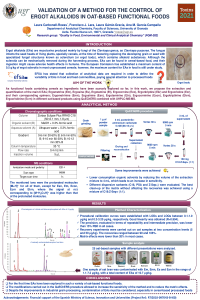
Ergot alkaloids (EAs) are mycotoxins produced mainly by fungi of the Claviceps genus, as Claviceps purpurea. The fungus infects the seed heads of living plants, specially cereals, at the time of flowering replacing the developing grain or seed with specialized fungal structures known as sclerotium (or ergot body), which contains alkaloid substances. More than 50 different EAs have been identified, being the major compounds: ergometrine (Em), ergosine (Es), ergotamine (Et), ergocornine (Eco), ergokryptine (Ekr), ergocristine (Ecr), and their corresponding epimers, ergometrinine (Emn), ergosinine (Esn), ergotaminine (Etn), ergocorninine (Econ), ergokryptinine (Ekrn) and ergocristinine (Ecrn). Although the sclerotia can be mechanically removed during the harvesting process, EAs can be found in cereal-based food and feed, and their ingestion might cause adverse health effects in humans and animals. The European Commission has established a maximum content of 0.5 g/kg of ergot sclerotia in most unprocessed cereals; however, the maximum content for EAs in food is still under study. In this work, we propose the extraction and quantification of the main EAs and their epimers in different oat-based products by QuEChERS extraction followed by UHPLC-MS/MS. The recoveries ranged between 89 and 106%, with a matrix effect lower than 20% in most cases and precision (intra- and interday), expressed as relative standard deviation (RSD), lower than 15%. Procedural calibration curves were established and limits of detection and quantification were below 1.0 μg/kg and 3.2 μg/kg, respectively. Finally, 25 oat-based samples (including bran, flakes, juices, hydroalcoholic extracts, flours, tablets and grass) were analyzed. One of the samples of oat bran was contaminated with Em, Emn, Es and Esn in the range of 1.1-7.2 μg/kg, with a total content of EAs of 10.7 μg/kg.
Acknowledgements: Financial support of the Spanish Ministry of Science, Innovation and Universities (Project Ref.: RTI2018-097043-B-I00).
Keywords
ergot alkaloids
functional foods
liquid chromatography
tandem mass spectrometry
Manuscript
sciforum-040993 Toxins2021_LCR.pdf
Poster
sciforum-040993 Toxins2021_LCR.pdf
Engineering of Ribosome-inactivating Proteins for Improving the anti-HIV Efficacy
Occurrence of principal ergot alkaloids in swine feeding