Event submissions
Published

This submission belongs to the session S7. Poster of the event 1st International Electronic Conference on Toxins
Published date
14 Jan, 2021
Citation
Andrea Boente-Juncal, Sandra Raposo-García, Celia Costas, M Carmen Louzao, Paz Otero, Carmen Vale, Luis Botana, Acute and chronic in vivo toxicity of the marine toxin palytoxin, in Proceedings of 1st International Electronic Conference on Toxins, 16 January–31 January 2021, MDPI: Basel, Switzerland, doi: 10.3390/IECT2021-09154
Share
Email
Facebook
Twitter
LinkedIn
Acute and chronic in vivo toxicity of the marine toxin palytoxin
'%3e%3cpath%20d='M12.6647%2010.9104C12.4176%2010.325%2012.0589%209.7933%2011.6088%209.34485C11.16%208.89511%2010.6283%208.53653%2010.0432%208.28891C10.038%208.28629%2010.0327%208.28498%2010.0275%208.28236C10.8437%207.69282%2011.3743%206.73252%2011.3743%205.64907C11.3743%203.85423%209.92005%202.40002%208.12522%202.40002C6.33038%202.40002%204.87618%203.85423%204.87618%205.64907C4.87618%206.73252%205.40677%207.69282%206.22296%208.28367C6.21772%208.28629%206.21248%208.2876%206.20724%208.29022C5.62031%208.53783%205.09365%208.89287%204.64167%209.34616C4.19192%209.79496%203.83334%2010.3266%203.58573%2010.9117C3.34247%2011.4846%203.21128%2012.0987%203.19925%2012.721C3.1989%2012.735%203.20135%2012.7489%203.20646%2012.7619C3.21157%2012.7749%203.21924%2012.7868%203.22901%2012.7968C3.23877%2012.8068%203.25045%2012.8148%203.26334%2012.8202C3.27623%2012.8256%203.29007%2012.8284%203.30406%2012.8284H4.09012C4.14776%2012.8284%204.19362%2012.7825%204.19493%2012.7262C4.22113%2011.7148%204.62726%2010.7676%205.34519%2010.0497C6.08802%209.30686%207.07452%208.89811%208.12522%208.89811C9.17592%208.89811%2010.1624%209.30686%2010.9052%2010.0497C11.6232%2010.7676%2012.0293%2011.7148%2012.0555%2012.7262C12.0568%2012.7839%2012.1027%2012.8284%2012.1603%2012.8284H12.9464C12.9604%2012.8284%2012.9742%2012.8256%2012.9871%2012.8202C13%2012.8148%2013.0117%2012.8068%2013.0214%2012.7968C13.0312%2012.7868%2013.0389%2012.7749%2013.044%2012.7619C13.0491%2012.7489%2013.0515%2012.735%2013.0512%2012.721C13.0381%2012.0947%2012.9084%2011.4856%2012.6647%2010.9104ZM8.12522%207.90243C7.52388%207.90243%206.95792%207.66793%206.53214%207.24215C6.10636%206.81636%205.87185%206.2504%205.87185%205.64907C5.87185%205.04773%206.10636%204.48177%206.53214%204.05599C6.95792%203.63021%207.52388%203.3957%208.12522%203.3957C8.72655%203.3957%209.29252%203.63021%209.7183%204.05599C10.1441%204.48177%2010.3786%205.04773%2010.3786%205.64907C10.3786%206.2504%2010.1441%206.81636%209.7183%207.24215C9.29252%207.66793%208.72655%207.90243%208.12522%207.90243Z'%20fill='%235D1EE1'/%3e%3c/g%3e%3c/svg%3e)
Andrea Boente-Juncal 1
Sandra Raposo-García 1
Celia Costas 1
M Carmen Louzao 1

Paz Otero 1
Carmen Vale 2

Luis Botana 1
1. Departamento de Farmacología, Farmacia y Tecnología Farmacéutica, Facultad de Veterinaria, Universidad de Santiago de Compostela, Lugo, Spain.
2. Departamento de Farmacología, Farmacia y Tecnología Farmacéutica, Facultad de Veterinaria, Universidad de Santiago de Compostela, Lugo, Spain
Abstract
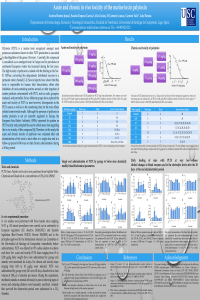
Palytoxin (PLTX) is a marine toxin that nowadays is recognized amongst the most toxic compounds isolated from natural products. Originally, the toxin was only identified in a single tidal pool of the island of Maui (Hawaii). Currently, this compound is considered as an emergent toxin in Europe and its prevalence in continental European waters has increased during the last years. The high toxicity of palytoxin is related with the binding to the Na+-K+ ATPase, converting this ubiquitously distributed enzyme in a permeant cation channel [1-3]. Several reports have shown that this toxin is responsible for human fatal intoxications, either after inhalation of toxin-containing marine aerosols or after ingestion of marine products contaminated with PLTX, such as crabs, groupers, mackerel, and parrotfish. So far, different groups have explored the acute oral toxicity of PLTX in mice however, discrepancies in the PLTX source as well as in the monitoring time for the toxic effects yielded controversial results. Although the presence of palytoxin in marine products is not yet currently regulated in Europe, the European Food Safety Authority (EFSA) expressed its opinion on PLTX toxicity and prompted the need to obtain more data regarding the in vivo toxicity of this compound [4]. Therefore, in this study, the acute and chronic toxicity of palytoxin was evaluated after oral administration of the toxin to mice either in a single dose and in a follow-up period of 96 hours or after chronic administration during a 28-day period. After chronic exposure of mice to the toxin, a lethal dose 50 (LD50) of 0.44 µg/kg of PLTX, much lower than that observed in the acute experiments, and a No-Observed-Adverse-Effect Level (NOAEL) of 0.03 µg/kg for repeated daily oral administration of PLTX were determined. Therefore, these data indicate a much higher chronic toxicity of PLTX and a lower NOAEL than that previously described in shorter treatment periods remarking the need to further evaluate the potential teratogenic effects of this emerging marine toxin in mammals.
References
- Artigas, P.; Gadsby, D.C. Ion occlusion/deocclusion partial reactions in individual palytoxin-modified Na+/K+ pumps. Ann N Y Acad Sci 2003, 986, 116-126.
- Artigas, P.; Gadsby, D.C. Na+/K+-pump ligands modulate gating of palytoxin-induced ion channels. Proc Natl Acad Sci U S A 2003, 100, 501-505.
- Artigas, P.; Gadsby, D.C. Large diameter of palytoxin-induced Na+/K+ pump channels and modulation of palytoxin interaction by Na+/K+ pump ligands. J Gen Physiol 2004, 123, 357-376.
- EFSA. Panel on contaminants in the food chain (CONTAM). Scientific Opinion on marine biotoxins in shellfish–Palytoxin group. EFSA Journal, 2009; Vol. 7, p 1393.
Keywords
Palytoxin
toxicity
in vivo
food safety.
Manuscript
Acute and chronic in vivo toxicity of the marine toxin palytoxin.pdf
Poster
Acute and chronic in vivo toxicity of the marine toxin palytoxin.pdf
Quantitative Determination of Aflatoxin B1 Level in Rice Grans Using Enzyme-Linked Immunosorbent Assay validated method in Kenya.
Effects of synthetic ciguatoxin CTX3C and 44-methylgambierone (MTX3) on voltage-gated sodium channels and their in vivo toxicity