Event submissions
Published

This submission belongs to the session S7. Poster of the event 1st International Electronic Conference on Toxins
Published date
14 Jan, 2021
Citation
Sandra Raposo-García, Andrea Boente-Juncal, Celia Costas, M Carmen Louzao, Paz Otero, Carmen Vale, Luis Botana, Oral chronic toxicity of the marine toxin tetrodotoxin, in Proceedings of 1st International Electronic Conference on Toxins, 16 January–31 January 2021, MDPI: Basel, Switzerland, doi: 10.3390/IECT2021-09156
Share
Email
Facebook
Twitter
LinkedIn
Oral chronic toxicity of the marine toxin tetrodotoxin
'%3e%3cpath%20d='M12.6647%2010.9104C12.4176%2010.325%2012.0589%209.7933%2011.6088%209.34485C11.16%208.89511%2010.6283%208.53653%2010.0432%208.28891C10.038%208.28629%2010.0327%208.28498%2010.0275%208.28236C10.8437%207.69282%2011.3743%206.73252%2011.3743%205.64907C11.3743%203.85423%209.92005%202.40002%208.12522%202.40002C6.33038%202.40002%204.87618%203.85423%204.87618%205.64907C4.87618%206.73252%205.40677%207.69282%206.22296%208.28367C6.21772%208.28629%206.21248%208.2876%206.20724%208.29022C5.62031%208.53783%205.09365%208.89287%204.64167%209.34616C4.19192%209.79496%203.83334%2010.3266%203.58573%2010.9117C3.34247%2011.4846%203.21128%2012.0987%203.19925%2012.721C3.1989%2012.735%203.20135%2012.7489%203.20646%2012.7619C3.21157%2012.7749%203.21924%2012.7868%203.22901%2012.7968C3.23877%2012.8068%203.25045%2012.8148%203.26334%2012.8202C3.27623%2012.8256%203.29007%2012.8284%203.30406%2012.8284H4.09012C4.14776%2012.8284%204.19362%2012.7825%204.19493%2012.7262C4.22113%2011.7148%204.62726%2010.7676%205.34519%2010.0497C6.08802%209.30686%207.07452%208.89811%208.12522%208.89811C9.17592%208.89811%2010.1624%209.30686%2010.9052%2010.0497C11.6232%2010.7676%2012.0293%2011.7148%2012.0555%2012.7262C12.0568%2012.7839%2012.1027%2012.8284%2012.1603%2012.8284H12.9464C12.9604%2012.8284%2012.9742%2012.8256%2012.9871%2012.8202C13%2012.8148%2013.0117%2012.8068%2013.0214%2012.7968C13.0312%2012.7868%2013.0389%2012.7749%2013.044%2012.7619C13.0491%2012.7489%2013.0515%2012.735%2013.0512%2012.721C13.0381%2012.0947%2012.9084%2011.4856%2012.6647%2010.9104ZM8.12522%207.90243C7.52388%207.90243%206.95792%207.66793%206.53214%207.24215C6.10636%206.81636%205.87185%206.2504%205.87185%205.64907C5.87185%205.04773%206.10636%204.48177%206.53214%204.05599C6.95792%203.63021%207.52388%203.3957%208.12522%203.3957C8.72655%203.3957%209.29252%203.63021%209.7183%204.05599C10.1441%204.48177%2010.3786%205.04773%2010.3786%205.64907C10.3786%206.2504%2010.1441%206.81636%209.7183%207.24215C9.29252%207.66793%208.72655%207.90243%208.12522%207.90243Z'%20fill='%235D1EE1'/%3e%3c/g%3e%3c/svg%3e)
Sandra Raposo-García 1
Andrea Boente-Juncal 1
Celia Costas 1
M Carmen Louzao 1

Paz Otero 1
Carmen Vale 2

Luis Botana 1
1. Departamento de Farmacología, Farmacia y Tecnología Farmacéutica, Facultad de Veterinaria, Universidad de Santiago de Compostela, Lugo, Spain.
2. Departamento de Farmacología, Farmacia y Tecnología Farmacéutica, Facultad de Veterinaria, Universidad de Santiago de Compostela, Lugo, Spain
Abstract
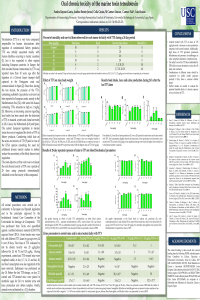
Tetrodotoxin (TTX) is a very toxic compound responsible for human intoxications after ingestion of contaminated fishery products. Although TTX was initially associated mainly with human fatalities occurring in Asiatic countries[1], nowadays has expanded to other regions including European countries. In Europe, the first non-fatal human intoxications by TTX was reported more than 10 years ago after the ingestion of a Charonia lampas trumpet shell captured in the Portuguese coast and commercialized in Spain[2]. Since then, during the last decade, the presence of the TTX-containing pufferfish Lagocephalus sceleratus has been reported in European coasts, mainly in the Mediterranean Sea[3,4] with some fish tissues containing TTXs amounts as high as 2 mg/kg[5]. Moreover, an increasing concern regarding food safety has been raised after the detection of TTX in mussels, oysters and clams harvested in UK, Greece, the Netherlands[6-8] and Spain. The current European legislation in marine toxins did not yet regulated the levels of TTX in fishery products, and nowadays the presence of the toxin is only regularly monitored in the Netherlands although the European Food Safety Authority (EFSA) has recommended the level of 44 µg/kg TTXs for routine monitoring since, at this dose, no adverse effects were observed in humans. Considering initial data on the acute oral toxicity of TTX and in view of the EFSA opinion remarking the need for additional chronic toxicity studies to further reduce the uncertainty of the likely future toxin regulation. In this work, the oral chronic toxicity of TTX using doses of 25, 44, 75 and 125 µg/kg and an observation period of 28 days was explored in female mice using protocols internationally validated to test the toxicity of chemicals. The data presented here indicated that 25 and 44 µg/kg of TTX did not cause neither blood biochemical nor behavioral alterations in mice, while at the dose of 125 µg/kg kidney and heart alterations were observed under electron microscopy analysis. Therefore, the data presented here indicate that the safety TTX dose proposed by EFSA is low enough to prevent human adverse effects, while caution should be taken in the presence of higher TTX doses.
References:
- Bane, V.; Lehane, M.; Dikshit, M.; O'Riordan, A.; Furey, A. Tetrodotoxin: chemistry, toxicity, source, distribution and detection. Toxins 2014, 6, 693-755.
- Rodriguez, P.; Alfonso, A.; Vale, C.; Alfonso, C.; Vale, P.; Tellez, A.; Botana, L.M. First Toxicity Report of Tetrodotoxin and 5,6,11-TrideoxyTTX in the Trumpet Shell Charonia lampas lampas in Europe. Analytical Chemistry 2008, 80.
- Rambla-Alegre, M.; Reverte, L.; Del Rio, V.; de la Iglesia, P.; Palacios, O.; Flores, C.; Caixach, J.; Campbell, K.; Elliott, C.T.; Izquierdo-Munoz, A., et al. Evaluation of tetrodotoxins in puffer fish caught along the Mediterranean coast of Spain. Toxin profile of Lagocephalus sceleratus. Environ Res 2017, 158, 1-6.
- Katikou, P.; Georgantelis, D.; Sinouris, N.; Petsi, A.; Fotaras, T. First report on toxicity assessment of the Lessepsian migrant pufferfish Lagocephalus sceleratus (Gmelin, 1789) from European waters (Aegean Sea, Greece). Toxicon 2009, 54, 50-55.
- Leonardo, S.; Kiparissis, S.; Rambla-Alegre, M.; Almarza, S.; Roque, A.; Andree, K.B.; Christidis, A.; Flores, C.; Caixach, J.; Campbell, K., et al. Detection of tetrodotoxins in juvenile pufferfish Lagocephalus sceleratus (Gmelin, 1789) from the North Aegean Sea (Greece) by an electrochemical magnetic bead-based immunosensing tool. Food Chem 2019, 290, 255-262.
- Katikou, P. Public Health Risks Associated with Tetrodotoxin and Its Analogues in European Waters: Recent Advances after The EFSA Scientific Opinion. Toxins 2019, 11.
- Turner, A.D.; Powell, A.; Schofield, A.; Lees, D.N.; Baker-Austin, C. Detection of the pufferfish toxin tetrodotoxin in European bivalves, England, 2013 to 2014. Eurosurveillance 2015, 20, 21009.
- Vlamis, A.; Katikou, P.; Rodriguez, I.; Rey, V.; Alfonso, A.; Papazachariou, A.; Zacharaki, T.; Botana, A.M.; Botana, L.M. First Detection of Tetrodotoxin in Greek Shellfish by UPLC-MS/MS Potentially Linked to the Presence of the Dinoflagellate Prorocentrum minimum. Toxins 2015, 7, 1779-1807.
Keywords
tetrodotoxin
marine toxins
in vivo toxicity
risk assessment.
Manuscript
Oral chronic toxicity of the marine toxin tetrodotoxin.pdf
Poster
Oral chronic toxicity of the marine toxin tetrodotoxin.pdf
Effects of synthetic ciguatoxin CTX3C and 44-methylgambierone (MTX3) on voltage-gated sodium channels and their in vivo toxicity
NEUROPEPTIDE Y PROTECTIVE ROLE ON OKADAIC ACID INDUCED DIARRHOEA