Event submissions
Published

This submission belongs to the session S7. Poster of the event 1st International Electronic Conference on Toxins
Published date
14 Jan, 2021
Citation
Celia Costas, M. Carmen Louzao, Paula Abal, Paz Otero, Andrea Boente-Juncal, Carmen Vale, Natalia Vilariño, Mercedes R. Vieytes, Luis M. Botana, NEUROPEPTIDE Y PROTECTIVE ROLE ON OKADAIC ACID INDUCED DIARRHOEA, in Proceedings of 1st International Electronic Conference on Toxins, 16 January–31 January 2021, MDPI: Basel, Switzerland, doi: 10.3390/IECT2021-09157
Share
Email
Facebook
Twitter
LinkedIn
NEUROPEPTIDE Y PROTECTIVE ROLE ON OKADAIC ACID INDUCED DIARRHOEA
'%3e%3cpath%20d='M12.6647%2010.9104C12.4176%2010.325%2012.0589%209.7933%2011.6088%209.34485C11.16%208.89511%2010.6283%208.53653%2010.0432%208.28891C10.038%208.28629%2010.0327%208.28498%2010.0275%208.28236C10.8437%207.69282%2011.3743%206.73252%2011.3743%205.64907C11.3743%203.85423%209.92005%202.40002%208.12522%202.40002C6.33038%202.40002%204.87618%203.85423%204.87618%205.64907C4.87618%206.73252%205.40677%207.69282%206.22296%208.28367C6.21772%208.28629%206.21248%208.2876%206.20724%208.29022C5.62031%208.53783%205.09365%208.89287%204.64167%209.34616C4.19192%209.79496%203.83334%2010.3266%203.58573%2010.9117C3.34247%2011.4846%203.21128%2012.0987%203.19925%2012.721C3.1989%2012.735%203.20135%2012.7489%203.20646%2012.7619C3.21157%2012.7749%203.21924%2012.7868%203.22901%2012.7968C3.23877%2012.8068%203.25045%2012.8148%203.26334%2012.8202C3.27623%2012.8256%203.29007%2012.8284%203.30406%2012.8284H4.09012C4.14776%2012.8284%204.19362%2012.7825%204.19493%2012.7262C4.22113%2011.7148%204.62726%2010.7676%205.34519%2010.0497C6.08802%209.30686%207.07452%208.89811%208.12522%208.89811C9.17592%208.89811%2010.1624%209.30686%2010.9052%2010.0497C11.6232%2010.7676%2012.0293%2011.7148%2012.0555%2012.7262C12.0568%2012.7839%2012.1027%2012.8284%2012.1603%2012.8284H12.9464C12.9604%2012.8284%2012.9742%2012.8256%2012.9871%2012.8202C13%2012.8148%2013.0117%2012.8068%2013.0214%2012.7968C13.0312%2012.7868%2013.0389%2012.7749%2013.044%2012.7619C13.0491%2012.7489%2013.0515%2012.735%2013.0512%2012.721C13.0381%2012.0947%2012.9084%2011.4856%2012.6647%2010.9104ZM8.12522%207.90243C7.52388%207.90243%206.95792%207.66793%206.53214%207.24215C6.10636%206.81636%205.87185%206.2504%205.87185%205.64907C5.87185%205.04773%206.10636%204.48177%206.53214%204.05599C6.95792%203.63021%207.52388%203.3957%208.12522%203.3957C8.72655%203.3957%209.29252%203.63021%209.7183%204.05599C10.1441%204.48177%2010.3786%205.04773%2010.3786%205.64907C10.3786%206.2504%2010.1441%206.81636%209.7183%207.24215C9.29252%207.66793%208.72655%207.90243%208.12522%207.90243Z'%20fill='%235D1EE1'/%3e%3c/g%3e%3c/svg%3e)
Celia Costas 1
M. Carmen Louzao 1
Paula Abal 1

Paz Otero 1
Andrea Boente-Juncal 1
Carmen Vale 1
Natalia Vilariño 1
Mercedes R. Vieytes 2

Luis M. Botana 1
1. Departamento de Farmacología, Facultad de Veterinaria, Universidad de Santiago de Compostela, Lugo 27002, Spain
2. Departamento de Fisiología, Facultad de Veterinaria, Universidad de Santiago de Compostela, Lugo 27002, Spain
Abstract
Marine biotoxins portrait a major threat to public health. Microalgae, such as diatoms or dinoflagellates, are the major producers of these compounds. Blooms of these species commonly correspond with increased toxin concentration in filter-feeding organisms, which can lead to poisoning outbreaks due to shellfish consumption. Within toxins of marine origin, we focus our work on the okadaic acid (OA) group that also includes the analogues dynophysistoxins 1 and 2. Diarrheic Shellfish Poisoning (DSP) is developed after ingestion of contaminated food with these lipophilic compounds, consisting mainly on gastrointestinal symptoms like nausea and diarrhoea. OA group of toxins inhibit protein phosphatases (PPs) with ubiquitous distribution like PP1 or PP2A. Yet, several reports raise the possibility of the phycotoxin targeting different mechanisms. A substantial variety of pathogenic stimuli trigger diarrhoea through the activation of the Enteric Nervous System (ENS). Neuropeptide Y (NPY) is a 36 aa peptide of neuronal origin known to maintain an antisecretory tone by acting on the receptors Y1 and Y2, both expressed along the gastrointestinal tract. Previous in vitro studies have exposed that OA downregulates NPY gene and protein expression. Moreover, the toxin is reported to cause diarrhoea within the first 2 h of treatment. Here we assess how the pro-absorptive NPY could be modifying OA-induced diarrhoea in vivo. Mice were first given NPY via intraperitoneal 15 minutes prior to OA oral gavage administration. Body weight variations, symptoms along with food and water intake were monitored for the 2 h treatment. Afterwards, anatomopathological examination took place and intestine samples were collected for transmission electron microscopy evaluation. In the presence of NPY, no delay on diarrhoea onset was observed though ultrastructural mild recovery was detected in the large intestine. Hence, it could be feasible that OA modifies NPY antisecretory tone, resulting in diarrhoea.
Keywords
Neuropeptide Y
okadaic acid
Diarrheic Shellfish Poisoning (DSP)
Manuscript
CostasC_Poster_IECT_2021-NEUROPEPTIDE Y PROTECTIVE ROLE ON OKADAIC ACID INDUCED DIARRHOEA.pdf
Poster
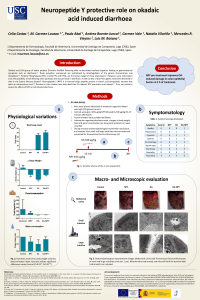
CostasC_Poster_IECT_2021-NEUROPEPTIDE Y PROTECTIVE ROLE ON OKADAIC ACID INDUCED DIARRHOEA.pdf
Oral chronic toxicity of the marine toxin tetrodotoxin
Synergistic attenuation of cancer-related pain and implications on adverse effects by the use of methadone and Phα1β in C57BL/6J mice