Event submissions
Published

This submission belongs to the session S7. Poster of the event 1st International Electronic Conference on Toxins
Published date
14 Jan, 2021
Citation
Mariya Kiseleva, Zakhar Chalyy, Irina Sedova, Herbal tea: transfer of mycotoxins from matrix into infusion, in Proceedings of 1st International Electronic Conference on Toxins, 16 January–31 January 2021, MDPI: Basel, Switzerland, doi: 10.3390/IECT2021-09159
Share
Email
Facebook
Twitter
LinkedIn
Herbal tea: transfer of mycotoxins from matrix into infusion
'%3e%3cpath%20d='M12.6647%2010.9104C12.4176%2010.325%2012.0589%209.7933%2011.6088%209.34485C11.16%208.89511%2010.6283%208.53653%2010.0432%208.28891C10.038%208.28629%2010.0327%208.28498%2010.0275%208.28236C10.8437%207.69282%2011.3743%206.73252%2011.3743%205.64907C11.3743%203.85423%209.92005%202.40002%208.12522%202.40002C6.33038%202.40002%204.87618%203.85423%204.87618%205.64907C4.87618%206.73252%205.40677%207.69282%206.22296%208.28367C6.21772%208.28629%206.21248%208.2876%206.20724%208.29022C5.62031%208.53783%205.09365%208.89287%204.64167%209.34616C4.19192%209.79496%203.83334%2010.3266%203.58573%2010.9117C3.34247%2011.4846%203.21128%2012.0987%203.19925%2012.721C3.1989%2012.735%203.20135%2012.7489%203.20646%2012.7619C3.21157%2012.7749%203.21924%2012.7868%203.22901%2012.7968C3.23877%2012.8068%203.25045%2012.8148%203.26334%2012.8202C3.27623%2012.8256%203.29007%2012.8284%203.30406%2012.8284H4.09012C4.14776%2012.8284%204.19362%2012.7825%204.19493%2012.7262C4.22113%2011.7148%204.62726%2010.7676%205.34519%2010.0497C6.08802%209.30686%207.07452%208.89811%208.12522%208.89811C9.17592%208.89811%2010.1624%209.30686%2010.9052%2010.0497C11.6232%2010.7676%2012.0293%2011.7148%2012.0555%2012.7262C12.0568%2012.7839%2012.1027%2012.8284%2012.1603%2012.8284H12.9464C12.9604%2012.8284%2012.9742%2012.8256%2012.9871%2012.8202C13%2012.8148%2013.0117%2012.8068%2013.0214%2012.7968C13.0312%2012.7868%2013.0389%2012.7749%2013.044%2012.7619C13.0491%2012.7489%2013.0515%2012.735%2013.0512%2012.721C13.0381%2012.0947%2012.9084%2011.4856%2012.6647%2010.9104ZM8.12522%207.90243C7.52388%207.90243%206.95792%207.66793%206.53214%207.24215C6.10636%206.81636%205.87185%206.2504%205.87185%205.64907C5.87185%205.04773%206.10636%204.48177%206.53214%204.05599C6.95792%203.63021%207.52388%203.3957%208.12522%203.3957C8.72655%203.3957%209.29252%203.63021%209.7183%204.05599C10.1441%204.48177%2010.3786%205.04773%2010.3786%205.64907C10.3786%206.2504%2010.1441%206.81636%209.7183%207.24215C9.29252%207.66793%208.72655%207.90243%208.12522%207.90243Z'%20fill='%235D1EE1'/%3e%3c/g%3e%3c/svg%3e)
Mariya Kiseleva 1
Zakhar Chalyy 2
Irina Sedova 1
1. Federal Research Centre of Nutrition and Biotechnology, Moscow, Russian Federation;
2. Federal Research Centre of Nutrition and Biotechnology, Moscow, Russian Federation;
Abstract
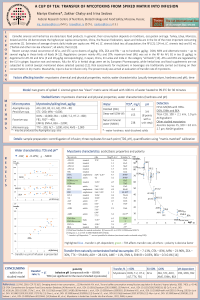
Herbal supplements are natural products, which are traditionally considered "helpful or at least harmless" for health promotion. Consumption of herbal products increases, but their safety, especially mycotoxin contamination, is still poorly controlled. Recent surveys report the occurrence of Aspergillus and Penicillium metabolites (aflatoxins (AFLs), ochratoxin A (OTA), cyclopiazonic and mycophenolic acids (MPA), sterigmatocystin (STE), citrinin), Fusarium (trichothecenes, zearalenone (ZEA), fumonisins (FBs), enniatins (ENNs)) and Alternaria (alternariol (AOH), its methyl ether (AME), tentoxin (TTX) and tenuazonic acid) toxins. A significant part of herbal supplements is consumed in the form of infusion. Thus correct risk assessment needs evaluation of mycotoxins transfer rates from the herbal matrix into the solution. We have studied the transfer of AFLs, OTA, STE, deoxynivalenol (DON), ZEA, FBs, T-2 and HT-2 toxins, AOH, AME, TE, ENNs, beauvericin and MPA from the spiked herbal matrix into infusion at different pH and total dissolved solids (TDS) characteristics of the water used for its preparation. Analytes were detected by HPLC-MS/MS. Transfer rate proved to be dependent on mycotoxins polarity and pH of the resulting infusion. TDS did not affect transfer significantly. ENNs, BEA, STC, ZEA and AOH transfer into infusion was below 25%; AFLs – 25-45%; DON, TTX and T-2 toxins – 60-90%, FB1 – 80-100%. The concentration of OTA, MPA and FB2 in the infusion depended on its pH. At pH about 4, it proved to be about 20%, 40% and 60% correspondingly. The increase of infusion pH led to almost complete transfer of these mycotoxins into the solution. The study of naturally contaminated samples supported the results of the model experiments.
Keywords
herbal supplements
infusion
mycotoxins
transfer rate
HPLC-MS/MS
Manuscript
MT_transfer_infusion_Toxins_2021.pdf
Poster
MT_transfer_infusion_Toxins_2021.pdf
Synergistic attenuation of cancer-related pain and implications on adverse effects by the use of methadone and Phα1β in C57BL/6J mice
Scorpionic serotherapy in pregnancy and its effects on the offspring