Event submissions
Published

This submission belongs to the session S7. Poster of the event 1st International Electronic Conference on Toxins
Published date
14 Jan, 2021
Citation
Olga Koksharova, Ivan O Butenko, Olga V Pobeguts, Nina A Safronova, Vadim M Govorun, The Regulatory Mechanisms of Cyanotoxin β-N-Methylamino-L-Alanine (BMAA) Action on the Key Cellular Processes in Diazotrophic Cyanobacteria, in Proceedings of 1st International Electronic Conference on Toxins, 16 January–31 January 2021, MDPI: Basel, Switzerland, doi: 10.3390/IECT2021-09161
Share
Email
Facebook
Twitter
LinkedIn
The Regulatory Mechanisms of Cyanotoxin β-N-Methylamino-L-Alanine (BMAA) Action on the Key Cellular Processes in Diazotrophic Cyanobacteria

Olga Koksharova 1
'%3e%3cpath%20d='M12.6647%2010.9104C12.4176%2010.325%2012.0589%209.7933%2011.6088%209.34485C11.16%208.89511%2010.6283%208.53653%2010.0432%208.28891C10.038%208.28629%2010.0327%208.28498%2010.0275%208.28236C10.8437%207.69282%2011.3743%206.73252%2011.3743%205.64907C11.3743%203.85423%209.92005%202.40002%208.12522%202.40002C6.33038%202.40002%204.87618%203.85423%204.87618%205.64907C4.87618%206.73252%205.40677%207.69282%206.22296%208.28367C6.21772%208.28629%206.21248%208.2876%206.20724%208.29022C5.62031%208.53783%205.09365%208.89287%204.64167%209.34616C4.19192%209.79496%203.83334%2010.3266%203.58573%2010.9117C3.34247%2011.4846%203.21128%2012.0987%203.19925%2012.721C3.1989%2012.735%203.20135%2012.7489%203.20646%2012.7619C3.21157%2012.7749%203.21924%2012.7868%203.22901%2012.7968C3.23877%2012.8068%203.25045%2012.8148%203.26334%2012.8202C3.27623%2012.8256%203.29007%2012.8284%203.30406%2012.8284H4.09012C4.14776%2012.8284%204.19362%2012.7825%204.19493%2012.7262C4.22113%2011.7148%204.62726%2010.7676%205.34519%2010.0497C6.08802%209.30686%207.07452%208.89811%208.12522%208.89811C9.17592%208.89811%2010.1624%209.30686%2010.9052%2010.0497C11.6232%2010.7676%2012.0293%2011.7148%2012.0555%2012.7262C12.0568%2012.7839%2012.1027%2012.8284%2012.1603%2012.8284H12.9464C12.9604%2012.8284%2012.9742%2012.8256%2012.9871%2012.8202C13%2012.8148%2013.0117%2012.8068%2013.0214%2012.7968C13.0312%2012.7868%2013.0389%2012.7749%2013.044%2012.7619C13.0491%2012.7489%2013.0515%2012.735%2013.0512%2012.721C13.0381%2012.0947%2012.9084%2011.4856%2012.6647%2010.9104ZM8.12522%207.90243C7.52388%207.90243%206.95792%207.66793%206.53214%207.24215C6.10636%206.81636%205.87185%206.2504%205.87185%205.64907C5.87185%205.04773%206.10636%204.48177%206.53214%204.05599C6.95792%203.63021%207.52388%203.3957%208.12522%203.3957C8.72655%203.3957%209.29252%203.63021%209.7183%204.05599C10.1441%204.48177%2010.3786%205.04773%2010.3786%205.64907C10.3786%206.2504%2010.1441%206.81636%209.7183%207.24215C9.29252%207.66793%208.72655%207.90243%208.12522%207.90243Z'%20fill='%235D1EE1'/%3e%3c/g%3e%3c/svg%3e)
Ivan O Butenko 2
Olga V Pobeguts 2
Nina A Safronova 1
Vadim M Govorun 2
1. Lomonosov Moscow State University, Belozersky Institute of Physico-Chemical Biology, Leninskie Gory, 1-40, Moscow, 119991, Russia
2. Scientific-Research Institute of Physical-Chemical Medicine, Moscow 119435, Russia
Abstract
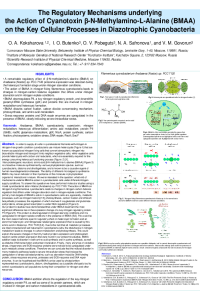
Non-proteinogenic neurotoxic amino acid β-N-methylamino-L-alanine (BMAA) is a bioactive molecule synthesized by various phytoplankton species, such as cyanobacteria, diatoms and dinoflagellates, and is known to be a causative agent of human neurodegeneration diseases. The ability of different microalgae to synthesize BMAA may be an indicator of the importance of this molecule in the interaction of phytoplankton organisms in nature. We were interested in the question: what kinds of mechanisms underline BMAA’s action on cyanobacterial cells under different nitrogen supply conditions. To answer this question we have performed molecular studies using a model cyanobacterial strain Nostoc (Anabaena) sp. PCC 7120. We have experimentally shown that the action of BMAA on nitrogen-fixing filamentous cyanobacteria changes nitrogen-carbon balance regulation, and differs under nitrogen starvation and in nitrogen-replete conditions. The primary main targets of BMAA’s action in cyanobacteria cells are, apparently, metabolic processes, such as nitrogen fixation, photosynthesis, carbon fixation and different biosynthetic processes, the regulation of which involves 2-oxyglutarate and glutamate. Our proteomic study has demonstrated that under BMAA-treatment the most significant difference lies in the expression change of a key nitrogen regulatory protein PII. This protein is downregulated in nitrogen-starving conditions and it is upregulated in nitrogen-replete conditions in the presence of BMAA. This could be the main reason behind a specific regulatory effect on heterocyst formation and heterocyst- and nitrogenase-related gene expression that this amino acid causes in Nostoc sp. PCC 7120. Due to the fact that all metabolic processes are interconnected and well balanced in cyanobacteria cells, the disturbance in nitrogen metabolism leads to changes in carbon metabolism and photosynthesis. This explains the severe changes of CO2 fixation proteins and photosystem reaction centre proteins that were found in our proteomics studies. BMAA addition leads to disorder in both amino acid synthesis and in purine synthesis, as well as disturbs DNA transcription and protein translation. Finally, many enzymes of oxidative stress, chaperones and SOS-response proteins are upregulated under such metabolic stress conditions. Therefore we can conclude that the disbalance in energy and metabolite amounts leads to severe intracellular stress that induces the upregulation of stress-activated proteins, such as: starvation-inducible DNA-binding protein, stress-response enzymes, proteases and SOS-response and DNA repair enzymes. It can be hypothesized that BMAA could be used by phytoplankton representatives (cyanobacteria, diatom, dinoflagelates) as a possible allelopatic tool to control cyanobacteria cell populations during their competition for nitrogen and other resources.
Keywords
BMAA
nitrogen fixation
nitrogenase
heterocyst differentiation
NtcA
PII protein
DNA repair
oxidative stress response
photosynthesis starvation
toxic molecule
Manuscript
Koksharova-et-al-2021__-_5-corrected_.pdf
Poster
Koksharova et al 2021__ (Poster).pdf
Scorpionic serotherapy in pregnancy and its effects on the offspring
Size matters: an evaluation on the molecular basis of ontogenetic modifications in the composition of Bothrops jararacussu snake venom