Event submissions
Published

This submission belongs to the session S7. Poster of the event 1st International Electronic Conference on Toxins
Published date
14 Jan, 2021
Citation
Sarah Natalie Cirilo Gimenes, Jacqueline Sachett, Mônica Colombini, Luciana Freitas-de-Sousa, Hiochelson Najibe dos Santos Ibiapina, Allyson Guimarães Costa, Monique Santana, Jeong-Jin Park, Nicholas Sherman, Luiz Carlos de Lima Ferreira, Fan Hui Wen, Wuelton Marcelo Monteiro, Ana Maria Moura da Silva, Jay William Fox, Blistering in Bothrops atrox envenomings: Evidence of antivenom and inflammatory factors in the bite site, in Proceedings of 1st International Electronic Conference on Toxins, 16 January–31 January 2021, MDPI: Basel, Switzerland, doi: 10.3390/IECT2021-09163
Share
Email
Facebook
Twitter
LinkedIn
Blistering in Bothrops atrox envenomings: Evidence of antivenom and inflammatory factors in the bite site
'%3e%3cpath%20d='M12.6647%2010.9104C12.4176%2010.325%2012.0589%209.7933%2011.6088%209.34485C11.16%208.89511%2010.6283%208.53653%2010.0432%208.28891C10.038%208.28629%2010.0327%208.28498%2010.0275%208.28236C10.8437%207.69282%2011.3743%206.73252%2011.3743%205.64907C11.3743%203.85423%209.92005%202.40002%208.12522%202.40002C6.33038%202.40002%204.87618%203.85423%204.87618%205.64907C4.87618%206.73252%205.40677%207.69282%206.22296%208.28367C6.21772%208.28629%206.21248%208.2876%206.20724%208.29022C5.62031%208.53783%205.09365%208.89287%204.64167%209.34616C4.19192%209.79496%203.83334%2010.3266%203.58573%2010.9117C3.34247%2011.4846%203.21128%2012.0987%203.19925%2012.721C3.1989%2012.735%203.20135%2012.7489%203.20646%2012.7619C3.21157%2012.7749%203.21924%2012.7868%203.22901%2012.7968C3.23877%2012.8068%203.25045%2012.8148%203.26334%2012.8202C3.27623%2012.8256%203.29007%2012.8284%203.30406%2012.8284H4.09012C4.14776%2012.8284%204.19362%2012.7825%204.19493%2012.7262C4.22113%2011.7148%204.62726%2010.7676%205.34519%2010.0497C6.08802%209.30686%207.07452%208.89811%208.12522%208.89811C9.17592%208.89811%2010.1624%209.30686%2010.9052%2010.0497C11.6232%2010.7676%2012.0293%2011.7148%2012.0555%2012.7262C12.0568%2012.7839%2012.1027%2012.8284%2012.1603%2012.8284H12.9464C12.9604%2012.8284%2012.9742%2012.8256%2012.9871%2012.8202C13%2012.8148%2013.0117%2012.8068%2013.0214%2012.7968C13.0312%2012.7868%2013.0389%2012.7749%2013.044%2012.7619C13.0491%2012.7489%2013.0515%2012.735%2013.0512%2012.721C13.0381%2012.0947%2012.9084%2011.4856%2012.6647%2010.9104ZM8.12522%207.90243C7.52388%207.90243%206.95792%207.66793%206.53214%207.24215C6.10636%206.81636%205.87185%206.2504%205.87185%205.64907C5.87185%205.04773%206.10636%204.48177%206.53214%204.05599C6.95792%203.63021%207.52388%203.3957%208.12522%203.3957C8.72655%203.3957%209.29252%203.63021%209.7183%204.05599C10.1441%204.48177%2010.3786%205.04773%2010.3786%205.64907C10.3786%206.2504%2010.1441%206.81636%209.7183%207.24215C9.29252%207.66793%208.72655%207.90243%208.12522%207.90243Z'%20fill='%235D1EE1'/%3e%3c/g%3e%3c/svg%3e)
Sarah Natalie Cirilo Gimenes 1
Jacqueline Sachett 2
Mônica Colombini 1
Luciana Freitas-de-Sousa 1
Hiochelson Najibe dos Santos Ibiapina 2
Allyson Guimarães Costa 2
Monique Santana 2
Jeong-Jin Park 3
Nicholas Sherman 3
Luiz Carlos de Lima Ferreira 2

Fan Hui Wen 1

Wuelton Marcelo Monteiro 2

Ana Maria Moura da Silva 1

Jay William Fox 3
1. Butantan Institute
2. Tropical Medicine Hospital, Manaus
3. University of Virginia
Abstract
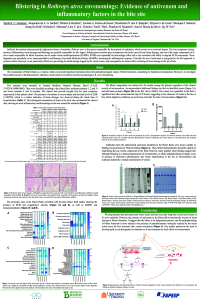
In the Brazilian Amazon, there is a significant occurrence of snake bites, predominated by Bothrops atrox. Tissue damage is one of the hallmarks in B. atrox envenoming. Interestingly, many snakebites patients have a delayed onset of blistering with a concomitant increase of the risk of infections. We hypothesize that blister fluid may represent a window into the pathophysiology at the injured tissues. In this study, we examined blister fluid by proteomics from 5 patients hospitalized with B. atrox envenomation, who were successfully treated with antivenom with no long-lasting effects nor morbidities. The proteomic data of the blister fluids correlated with previous blister fluid studies showing the presence of DAMPs and immunomodulators. The blister composition was observed to be similar among the patients regardless of the clinical severity of envenomation. An unprecedented additional finding was that we identified venom and antivenom proteins in the bite site by ELISA. Venom was quantified in the fluid a significant time after envenommation (up to135 hours), suggesting a slow clearance of venom at the site of bite, which might have influence on local tissue well after the time of envenomation. Antibodies from the administered antivenom identified in the blister fluids were shown capable of binding venom proteins by Western blotting. Thus, blister fluid antibodies should be capable of neutralizing the any venom components in the fluid. Taken together, these findings suggest that although blistering is a delayed phenomenon of envenomation, its likely pathophysiological origins occur in advance of antivenom administration and venom neutralization at the site of envenomation and continues despite the eventual neutralization of venom. This evidence confirms previous reports that the early events in envenomation pathophysiology give rise to endogenous factors that over time, contribute to the development of blisters which are not attenuated even by prompt antivenom administration.
Keywords
Bothrops atrox
blister
local damage
snake venom
antivenom
DAMPs
snakebite
Manuscript
Painel blister 2021 (1).pdf
Poster
Painel blister 2021 (1).pdf
Size matters: an evaluation on the molecular basis of ontogenetic modifications in the composition of Bothrops jararacussu snake venom
Functional role of individual parts of B. cereus hemolysin II