Event submissions
Published

This submission belongs to the session S7. Poster of the event 1st International Electronic Conference on Toxins
Published date
14 Jan, 2021
Citation
Alexander V Siunov, Alexey S Nagel, Zhanna I Andreeva-Kovalevskaya, Anna V Zamjatina, Natalia V Rudenko, Anna P Karatovskaya, Marina P Borisova, Vadim I Salyamov, Alexander S Kolesnikov, Bogdan S Melnik, Fedor A Brovko, Alexander S Solonin, Functional role of individual parts of B. cereus hemolysin II, in Proceedings of 1st International Electronic Conference on Toxins, 16 January–31 January 2021, MDPI: Basel, Switzerland, doi: 10.3390/IECT2021-09164
Share
Email
Facebook
Twitter
LinkedIn
Functional role of individual parts of B. cereus hemolysin II
'%3e%3cpath%20d='M12.6647%2010.9104C12.4176%2010.325%2012.0589%209.7933%2011.6088%209.34485C11.16%208.89511%2010.6283%208.53653%2010.0432%208.28891C10.038%208.28629%2010.0327%208.28498%2010.0275%208.28236C10.8437%207.69282%2011.3743%206.73252%2011.3743%205.64907C11.3743%203.85423%209.92005%202.40002%208.12522%202.40002C6.33038%202.40002%204.87618%203.85423%204.87618%205.64907C4.87618%206.73252%205.40677%207.69282%206.22296%208.28367C6.21772%208.28629%206.21248%208.2876%206.20724%208.29022C5.62031%208.53783%205.09365%208.89287%204.64167%209.34616C4.19192%209.79496%203.83334%2010.3266%203.58573%2010.9117C3.34247%2011.4846%203.21128%2012.0987%203.19925%2012.721C3.1989%2012.735%203.20135%2012.7489%203.20646%2012.7619C3.21157%2012.7749%203.21924%2012.7868%203.22901%2012.7968C3.23877%2012.8068%203.25045%2012.8148%203.26334%2012.8202C3.27623%2012.8256%203.29007%2012.8284%203.30406%2012.8284H4.09012C4.14776%2012.8284%204.19362%2012.7825%204.19493%2012.7262C4.22113%2011.7148%204.62726%2010.7676%205.34519%2010.0497C6.08802%209.30686%207.07452%208.89811%208.12522%208.89811C9.17592%208.89811%2010.1624%209.30686%2010.9052%2010.0497C11.6232%2010.7676%2012.0293%2011.7148%2012.0555%2012.7262C12.0568%2012.7839%2012.1027%2012.8284%2012.1603%2012.8284H12.9464C12.9604%2012.8284%2012.9742%2012.8256%2012.9871%2012.8202C13%2012.8148%2013.0117%2012.8068%2013.0214%2012.7968C13.0312%2012.7868%2013.0389%2012.7749%2013.044%2012.7619C13.0491%2012.7489%2013.0515%2012.735%2013.0512%2012.721C13.0381%2012.0947%2012.9084%2011.4856%2012.6647%2010.9104ZM8.12522%207.90243C7.52388%207.90243%206.95792%207.66793%206.53214%207.24215C6.10636%206.81636%205.87185%206.2504%205.87185%205.64907C5.87185%205.04773%206.10636%204.48177%206.53214%204.05599C6.95792%203.63021%207.52388%203.3957%208.12522%203.3957C8.72655%203.3957%209.29252%203.63021%209.7183%204.05599C10.1441%204.48177%2010.3786%205.04773%2010.3786%205.64907C10.3786%206.2504%2010.1441%206.81636%209.7183%207.24215C9.29252%207.66793%208.72655%207.90243%208.12522%207.90243Z'%20fill='%235D1EE1'/%3e%3c/g%3e%3c/svg%3e)
Alexander V Siunov 1
Alexey S Nagel 2
Zhanna I Andreeva-Kovalevskaya 1
Anna V Zamjatina 3
Natalia V Rudenko 3
Anna P Karatovskaya 3
Marina P Borisova 4
Vadim I Salyamov 1
Alexander S Kolesnikov 1
Bogdan S Melnik 5
Fedor A Brovko 3
Alexander S Solonin 1
1. G. K. Skryabin Institute of Biochemistry and physiology of microorganisms RAS, Pushchino, Russia
2. G.K. Skryabin Institute of Biochemistry and physiology of microorganisms RAS, Pushchino, Russia
3. Pushchino Branch, Shemyakin– Ovchinnikov Institute of Bioorganic Chemistry, Pushchino, Moscow, Russia
4. Institute of Theoretical and Experimental Biophysics, RAS, Pushchino, Russia
5. Institute of Protein Research RAS, Pushchino, Russia
Abstract
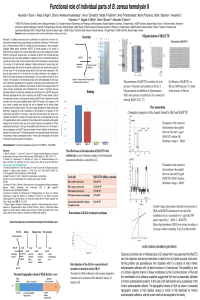
Hemolysin II of Bacillus cereus sensu lato is synthesized in a bacterial cell in the form of a water-soluble secreted monomer and penetrates into eukaryotic membranes. The HlyII protein has a C-terminal extension (HlyIICTD), includes 94 amino acid residues [1]. Removal of HlyIICTD from HlyII significantly complicates transfer of the deletion variant HlyIIDCTD to E. coli cells, possibly due to the attack of the bacterial membrane. Additional deletion of the signal peptide, which excludes the penetration of the protein into the periplasm, provides E. coli cells survival carrying this gene with two deletions. Using monoclonal antibodies against recombinant HlyIICTD [2], showed a similar the binding effectively to red blood cells of various origins and noticeably differ for cells of the J774 and Jurkat lines. HlyIICTD in water solution is able to form oligomeric structures. In the presence of membrane HlyIICTD exits in oligomeric form while monomeric forms are almost completely absent. HlyIICTD trimerized in the presence of 4M urea, forming a possibly some structure that can be integrated into the artificial bilayer membrane with the formation of pores. The current-voltage characteristic of these channels was determined. Such protein structures are characteristic of trimeric autotransporter proteins [3]. In this case, the secreted full-sized monomeric form of hemolysin II acts as a passenger, and HlyIICTD acts as an element involved in adhesion to membrane and secretion from bacterial cells. The materials presented in this paper demonstrate suggests that hemolysin II may belong to trimeric autotransporter proteins – the first case of the description of this family of molecules among Gram positive microorganisms.
Acknowledgments. The study was supported by a grant from the Russian foundation for basic research (no. 14-04-00592) and by the Ministry of Science and Higher Education of the Russian Federation (unique project number RFMEFI60419X0218).
- Baida G., Budarina Z. I., Kuzmin N.P., Solonin A.S. Complete nucleotide sequence and molecular characterization of hemolysin II gene from Bacillus cereus, FEMS Microbiol. 1999, V.180. pp. 7–14.
- Rudenko, N.V., Karatovskaya, A.P., Zamyatina, A.V., Siunov, A.V., Andreeva-Kovalevskaya, Zh.I., Nagel, A.S., Brovko, F.A., and Solonin, A.S., Russ. J. Bioorg. Chem., 2020, V. 46, pp. 321–326. doi.org/ https://doi.org/10.1134/S1068162020030188
- Kiessling A.R., Malik A., Goldman A. Recent advances in the understanding of trimeric autotransporter adhesins. Medical Microbiology and Immunology 2020, V. 209, pp 233–242 https://doi.org/10.1007/s00430-019-00652-3
Keywords
hemolysin
autotransporter proteins
secretion
artificial bilayer membrane
pore forming
Manuscript
Presentation Toxins.pdf
Poster
Functional Role - Presentation.pdf
Blistering in Bothrops atrox envenomings: Evidence of antivenom and inflammatory factors in the bite site
Detection of ciguatoxins in fish and algal samples with an electrochemical biosensor