Event submissions
Published

This submission belongs to the session S7. Poster of the event 1st International Electronic Conference on Toxins
Published date
14 Jan, 2021
Citation
Greta Gaiani, Sandra Leonardo, Takeshi Tsumuraya, Maria Rambla, Jorge Diogène, Ciara Kathleen O'Sullivan, Carles Alcaraz, Mònica Campàs, Detection of ciguatoxins in fish and algal samples with an electrochemical biosensor, in Proceedings of 1st International Electronic Conference on Toxins, 16 January–31 January 2021, MDPI: Basel, Switzerland, doi: 10.3390/IECT2021-09165
Share
Email
Facebook
Twitter
LinkedIn
Detection of ciguatoxins in fish and algal samples with an electrochemical biosensor
'%3e%3cpath%20d='M12.6647%2010.9104C12.4176%2010.325%2012.0589%209.7933%2011.6088%209.34485C11.16%208.89511%2010.6283%208.53653%2010.0432%208.28891C10.038%208.28629%2010.0327%208.28498%2010.0275%208.28236C10.8437%207.69282%2011.3743%206.73252%2011.3743%205.64907C11.3743%203.85423%209.92005%202.40002%208.12522%202.40002C6.33038%202.40002%204.87618%203.85423%204.87618%205.64907C4.87618%206.73252%205.40677%207.69282%206.22296%208.28367C6.21772%208.28629%206.21248%208.2876%206.20724%208.29022C5.62031%208.53783%205.09365%208.89287%204.64167%209.34616C4.19192%209.79496%203.83334%2010.3266%203.58573%2010.9117C3.34247%2011.4846%203.21128%2012.0987%203.19925%2012.721C3.1989%2012.735%203.20135%2012.7489%203.20646%2012.7619C3.21157%2012.7749%203.21924%2012.7868%203.22901%2012.7968C3.23877%2012.8068%203.25045%2012.8148%203.26334%2012.8202C3.27623%2012.8256%203.29007%2012.8284%203.30406%2012.8284H4.09012C4.14776%2012.8284%204.19362%2012.7825%204.19493%2012.7262C4.22113%2011.7148%204.62726%2010.7676%205.34519%2010.0497C6.08802%209.30686%207.07452%208.89811%208.12522%208.89811C9.17592%208.89811%2010.1624%209.30686%2010.9052%2010.0497C11.6232%2010.7676%2012.0293%2011.7148%2012.0555%2012.7262C12.0568%2012.7839%2012.1027%2012.8284%2012.1603%2012.8284H12.9464C12.9604%2012.8284%2012.9742%2012.8256%2012.9871%2012.8202C13%2012.8148%2013.0117%2012.8068%2013.0214%2012.7968C13.0312%2012.7868%2013.0389%2012.7749%2013.044%2012.7619C13.0491%2012.7489%2013.0515%2012.735%2013.0512%2012.721C13.0381%2012.0947%2012.9084%2011.4856%2012.6647%2010.9104ZM8.12522%207.90243C7.52388%207.90243%206.95792%207.66793%206.53214%207.24215C6.10636%206.81636%205.87185%206.2504%205.87185%205.64907C5.87185%205.04773%206.10636%204.48177%206.53214%204.05599C6.95792%203.63021%207.52388%203.3957%208.12522%203.3957C8.72655%203.3957%209.29252%203.63021%209.7183%204.05599C10.1441%204.48177%2010.3786%205.04773%2010.3786%205.64907C10.3786%206.2504%2010.1441%206.81636%209.7183%207.24215C9.29252%207.66793%208.72655%207.90243%208.12522%207.90243Z'%20fill='%235D1EE1'/%3e%3c/g%3e%3c/svg%3e)
Greta Gaiani 1
Sandra Leonardo 1

Takeshi Tsumuraya 2
Maria Rambla 1
Jorge Diogène 1
Ciara Kathleen O'Sullivan 3,4
Carles Alcaraz 1

Mònica Campàs 1
1. IRTA
2. Department of Biological Science, Graduate School of Science, Osaka Prefecture University
3. Departament d’Enginyeria Química, Universitat Rovira i Virgili
4. ICREA
Abstract
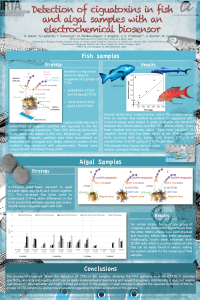
Ciguatera fish poisoning (CFP) is one of the most relevant seafood-borne diseases worldwide. It is caused by the ingestion of fish containing ciguatoxins (CTXs), lipophilic marine toxins produced by microalgae of the genera Gambierdiscus and Fukuyoa that accumulate into fish flesh and through the food webs. CFP is characterized by severe neurological, gastrointestinal, and cardiovascular disorders and affects approximately between 50,000 and 500,000 consumers annually worldwide. Real incidence of CFP is difficult to ascertain, due to under-reporting and misdiagnosis.
Here, the first electrochemical immunosensor for the detection of CTXs is presented. Three different monoclonal antibodies (mAbs), two capture (3G8, 10C9) and a detector (8H4), were merged in a sandwich configuration for the combined detection of two main groups of CTX congeners (CTX1B and CTX3C ). Initially, the applicability of the immunosensor has been demonstrated with the analysis of fish samples coming from La Réunion island, providing results that correlate with mouse bioassay and cell-based assay. Then, fish coming from Mediterranean waters were analysed, giving promising results. Finally, extracts from Gambierdiscus and Fukuyoa were screened, allowing the separate detection of the two groups of CTX congeners, and giving new information regarding the toxin production of the genera.
The developed bioanalytical tool is user-friendly, and can help to mitigate ciguatera risk, contributing to the protection of consumers health.
Keywords
ciguatera
ciguatoxin
electrochemical immunosensor
Gambierdiscus
Manuscript
Gaiani_immunosensor_Toxins2021 .pdf
Poster
Gaiani_immunosensor_Toxins2021 .pdf
Functional role of individual parts of B. cereus hemolysin II
Hemolytic activity of venoms of the water shrew Neomys fodiens and the common shrew Sorex araneus