Event submissions
Published

This submission belongs to the session S7. Poster of the event 1st International Electronic Conference on Toxins
Published date
14 Jan, 2021
Citation
Krzysztof Kowalski, Paweł Marciniak, Leszek Rychlik, Hemolytic activity of venoms of the water shrew Neomys fodiens and the common shrew Sorex araneus, in Proceedings of 1st International Electronic Conference on Toxins, 16 January–31 January 2021, MDPI: Basel, Switzerland, doi: 10.3390/IECT2021-09166
Share
Email
Facebook
Twitter
LinkedIn
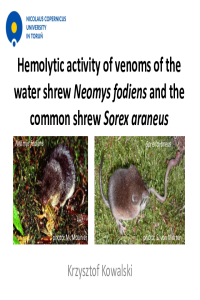
Hemolytic activity of venoms of the water shrew Neomys fodiens and the common shrew Sorex araneus
'%3e%3cpath%20d='M12.6647%2010.9104C12.4176%2010.325%2012.0589%209.7933%2011.6088%209.34485C11.16%208.89511%2010.6283%208.53653%2010.0432%208.28891C10.038%208.28629%2010.0327%208.28498%2010.0275%208.28236C10.8437%207.69282%2011.3743%206.73252%2011.3743%205.64907C11.3743%203.85423%209.92005%202.40002%208.12522%202.40002C6.33038%202.40002%204.87618%203.85423%204.87618%205.64907C4.87618%206.73252%205.40677%207.69282%206.22296%208.28367C6.21772%208.28629%206.21248%208.2876%206.20724%208.29022C5.62031%208.53783%205.09365%208.89287%204.64167%209.34616C4.19192%209.79496%203.83334%2010.3266%203.58573%2010.9117C3.34247%2011.4846%203.21128%2012.0987%203.19925%2012.721C3.1989%2012.735%203.20135%2012.7489%203.20646%2012.7619C3.21157%2012.7749%203.21924%2012.7868%203.22901%2012.7968C3.23877%2012.8068%203.25045%2012.8148%203.26334%2012.8202C3.27623%2012.8256%203.29007%2012.8284%203.30406%2012.8284H4.09012C4.14776%2012.8284%204.19362%2012.7825%204.19493%2012.7262C4.22113%2011.7148%204.62726%2010.7676%205.34519%2010.0497C6.08802%209.30686%207.07452%208.89811%208.12522%208.89811C9.17592%208.89811%2010.1624%209.30686%2010.9052%2010.0497C11.6232%2010.7676%2012.0293%2011.7148%2012.0555%2012.7262C12.0568%2012.7839%2012.1027%2012.8284%2012.1603%2012.8284H12.9464C12.9604%2012.8284%2012.9742%2012.8256%2012.9871%2012.8202C13%2012.8148%2013.0117%2012.8068%2013.0214%2012.7968C13.0312%2012.7868%2013.0389%2012.7749%2013.044%2012.7619C13.0491%2012.7489%2013.0515%2012.735%2013.0512%2012.721C13.0381%2012.0947%2012.9084%2011.4856%2012.6647%2010.9104ZM8.12522%207.90243C7.52388%207.90243%206.95792%207.66793%206.53214%207.24215C6.10636%206.81636%205.87185%206.2504%205.87185%205.64907C5.87185%205.04773%206.10636%204.48177%206.53214%204.05599C6.95792%203.63021%207.52388%203.3957%208.12522%203.3957C8.72655%203.3957%209.29252%203.63021%209.7183%204.05599C10.1441%204.48177%2010.3786%205.04773%2010.3786%205.64907C10.3786%206.2504%2010.1441%206.81636%209.7183%207.24215C9.29252%207.66793%208.72655%207.90243%208.12522%207.90243Z'%20fill='%235D1EE1'/%3e%3c/g%3e%3c/svg%3e)
Krzysztof Kowalski 1
Paweł Marciniak 2
Leszek Rychlik 3
1. Department of Vertebrate Zoology and Ecology, Institute of Biology, Faculty of Biological and Veterinary Sciences, Nicolaus Copernicus University in Toruń
2. Department of Animal Physiology and Development, Institute of Experimental Biology, Faculty of Biology, Adam Mickiewicz University, Uniwersytetu Poznańskiego 6, Poznań, 61-614, Poland
3. Department of Systematic Zoology, Institute of Environmental Biology, Faculty of Biology, Adam Mickiewicz University, Uniwersytetu Poznańskiego 6, Poznań, 61-614, Poland
Abstract
Venomous mammals are rare and their venoms have not been comprehensively investigated. Among shrews, only venoms of the short-tailed shrew Blarina brevicauda and the Eurasian water shrew Neomys fodiens have been characterized thus far. Neomys fodiens employs its venom to hunt on larger prey and store it in a comatose state. Recently, the potent paralytic activity of its venom has been confirmed. Here we assayed the hemolytic effects of crude extracts of salivary glands of N. fodiens and the common shrew Sorex araneus in the red blood cells of frog. Toxins present in saliva were identified by high-performance liquid chromatography coupled to tandem mass spectrometry. For both shrew species we found significant concentration-dependent effects of venom on hemolysis in erythrocytes evaluated as hemoglobin release. Hemolytic effects of N. fodiens saliva were stronger than those produced by S. araneus. We identified four toxins in N. fodiens venom and five in the saliva of S. araneus. Some of them are likely to produce hemolysis in frog’s erythrocytes. Our results show that shrew venoms, in addition to potent paralytic properties, possess also hemolytic activity that may allow them to hunt larger prey as frogs. Additionally, because S. araneus saliva exhibits toxic activity we propose to add the common shrew to the list of venomous mammals.
Keywords
eulipotyphlans
hemolysis
mammalian venom
natural toxins
shrews
toxic saliva
Manuscript
Kowalski-iect2021-poster.pdf
Poster
Kowalski-iect2021-presentation.pdf
Detection of ciguatoxins in fish and algal samples with an electrochemical biosensor
Paretic syndrome in gulls from southern Portugal: searching for the causative agent