Event submissions
Published

This submission belongs to the session S7. Poster of the event 1st International Electronic Conference on Toxins
Published date
14 Jan, 2021
Citation
M. Carmen Osorio-Ramírez, Lorena M. Durán-Riveroll, Allan D. Cembella, José Correa-Basurto, Free-binding energies and molecular interactions of yessotoxin in the voltage-gated sodium channel NaV1.5: an in silico approach, in Proceedings of 1st International Electronic Conference on Toxins, 16 January–31 January 2021, MDPI: Basel, Switzerland, doi: 10.3390/IECT2021-09172
Share
Email
Facebook
Twitter
LinkedIn
Free-binding energies and molecular interactions of yessotoxin in the voltage-gated sodium channel NaV1.5: an in silico approach

M. Carmen Osorio-Ramírez 1
'%3e%3cpath%20d='M12.6647%2010.9104C12.4176%2010.325%2012.0589%209.7933%2011.6088%209.34485C11.16%208.89511%2010.6283%208.53653%2010.0432%208.28891C10.038%208.28629%2010.0327%208.28498%2010.0275%208.28236C10.8437%207.69282%2011.3743%206.73252%2011.3743%205.64907C11.3743%203.85423%209.92005%202.40002%208.12522%202.40002C6.33038%202.40002%204.87618%203.85423%204.87618%205.64907C4.87618%206.73252%205.40677%207.69282%206.22296%208.28367C6.21772%208.28629%206.21248%208.2876%206.20724%208.29022C5.62031%208.53783%205.09365%208.89287%204.64167%209.34616C4.19192%209.79496%203.83334%2010.3266%203.58573%2010.9117C3.34247%2011.4846%203.21128%2012.0987%203.19925%2012.721C3.1989%2012.735%203.20135%2012.7489%203.20646%2012.7619C3.21157%2012.7749%203.21924%2012.7868%203.22901%2012.7968C3.23877%2012.8068%203.25045%2012.8148%203.26334%2012.8202C3.27623%2012.8256%203.29007%2012.8284%203.30406%2012.8284H4.09012C4.14776%2012.8284%204.19362%2012.7825%204.19493%2012.7262C4.22113%2011.7148%204.62726%2010.7676%205.34519%2010.0497C6.08802%209.30686%207.07452%208.89811%208.12522%208.89811C9.17592%208.89811%2010.1624%209.30686%2010.9052%2010.0497C11.6232%2010.7676%2012.0293%2011.7148%2012.0555%2012.7262C12.0568%2012.7839%2012.1027%2012.8284%2012.1603%2012.8284H12.9464C12.9604%2012.8284%2012.9742%2012.8256%2012.9871%2012.8202C13%2012.8148%2013.0117%2012.8068%2013.0214%2012.7968C13.0312%2012.7868%2013.0389%2012.7749%2013.044%2012.7619C13.0491%2012.7489%2013.0515%2012.735%2013.0512%2012.721C13.0381%2012.0947%2012.9084%2011.4856%2012.6647%2010.9104ZM8.12522%207.90243C7.52388%207.90243%206.95792%207.66793%206.53214%207.24215C6.10636%206.81636%205.87185%206.2504%205.87185%205.64907C5.87185%205.04773%206.10636%204.48177%206.53214%204.05599C6.95792%203.63021%207.52388%203.3957%208.12522%203.3957C8.72655%203.3957%209.29252%203.63021%209.7183%204.05599C10.1441%204.48177%2010.3786%205.04773%2010.3786%205.64907C10.3786%206.2504%2010.1441%206.81636%209.7183%207.24215C9.29252%207.66793%208.72655%207.90243%208.12522%207.90243Z'%20fill='%235D1EE1'/%3e%3c/g%3e%3c/svg%3e)
Lorena M. Durán-Riveroll 2,3

Allan D. Cembella 3
José Correa-Basurto 1
1. Laboratorio de Diseño y Desarrollo de Nuevos Fármacos e Innovación Biotecnológica, Sección de Estudios de Posgrado e Investigación, Escuela Superior de Medicina, Instituto Politécnico Nacional, Ciudad de México, Mexico
2. CONACyT-Departamento de Biotecnología Marina, Centro de Investigación Científica y de Educación Superior de Ensenada, B.C. Ensenada, Baja California, México
3. Alfred-Wegener-Institut, Helmholtz-Zentrum für Polar-und Meeresforschung, Bremerhaven, Germany
Abstract
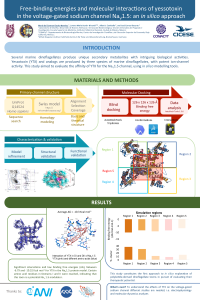
Several marine dinoflagellates produce unique secondary metabolites with intriguing biological activities, eliciting anticancer, antiepileptic, anti-inflammatory, or anti-microbial responses in various cell types. Among these known compounds are phycotoxins, such as the linear and cyclic polyethers considered as potential therapeutants due to their complex alternative mode of action as ion-channel effectors or enzyme inhibitors capable of modifying diverse intracellular signaling pathways. Yessotoxin (YTX) and analogs are polyketide-derived polycyclic toxins produced by certain species of marine dinoflagellates, Protoceratium reticulatum, Lingulodinium polyedra, and Gonyaulax spinifera, and are structurally related to ciguatoxins and brevetoxins with potent ion-channel activity. The over-expression or aberrant function of ion channels is considered a channelopathy, and critical pathologies in different intracellular signaling pathways that involve receptors such as voltage-gated ion-channels, particularly voltage-gated sodium channels (NaV), are exhibited in response to exposure to such toxins. In the search for innovative therapeutants, this study aimed to evaluate the affinity of YTX for the NaV1.5 channel, using in silico modelling tools. This approach allowed for identification of these interactions and determination of the respective free-binding energies. Our results showed significant interactions and low binding free energies (ΔG), between -6.79 and -10.32 Kcal mol-1 for YTX in the NaV1.5 protein model. Certain amino acid residues in Domains I and II were reached, indicating that this toxin is a potential NaV 1.5 modulator. This study constitutes the first approach to in silico exploration of polyketide-derived dinoflagellate toxins in pursuit of evaluating their therapeutic potential.
Keywords
biological activity
free-binding energy
ion channel modulator
molecular docking
Manuscript
Poster YTX Ramírez-Osorio2_FS.pdf
Poster
Poster YTX Ramírez-Osorio2_FS.pdf
Engineering the NADPH specificity of DepB, a novel aldo-keto reductase involved in the detoxification of the agroeconomic mycotoxin deoxynivalenol (DON)
Production of Monoclonal Antibodies (mAcs) Purified Anti-metalloprotease from the Venom of the Serpent Bitis arietans