Event submissions
EventsMOL2NET'18, Conference on Molecular, Biomed., Comput. & Network Science and Engineering, 4th ed.
Published
 10.3390/mol2net-04-09179 (registering DOI)
 This submission belongs to the session 09. NICEXSM-04: North-Ibero-American Congress on Exp. and Simul. Methods., Valencia, Spain-Talca, Chile-Miami, USA, 2018-2019 of the event MOL2NET'18, Conference on Molecular, Biomed., Comput. & Network Science and Engineering, 4th ed.
Published date
23 Jan, 2021
Citation
Jhon Jairo López, Angélica Fierro, Edwin Pérez, Jesús García-Colunga, New piperidine derivatives. Studies in silico on α7 nicotinic acetylcholine receptors, in Proceedings of MOL2NET'18, Conference on Molecular, Biomed., Comput. & Network Science and Engineering, 4th ed., 15 January 2018–20 January 2019, MDPI: Basel, Switzerland, doi: 10.3390/mol2net-04-09179
Share
Email
Facebook
Twitter
LinkedIn
New piperidine derivatives. Studies in silico on α7 nicotinic acetylcholine receptors
'%3e%3cpath%20d='M12.6647%2010.9104C12.4176%2010.325%2012.0589%209.7933%2011.6088%209.34485C11.16%208.89511%2010.6283%208.53653%2010.0432%208.28891C10.038%208.28629%2010.0327%208.28498%2010.0275%208.28236C10.8437%207.69282%2011.3743%206.73252%2011.3743%205.64907C11.3743%203.85423%209.92005%202.40002%208.12522%202.40002C6.33038%202.40002%204.87618%203.85423%204.87618%205.64907C4.87618%206.73252%205.40677%207.69282%206.22296%208.28367C6.21772%208.28629%206.21248%208.2876%206.20724%208.29022C5.62031%208.53783%205.09365%208.89287%204.64167%209.34616C4.19192%209.79496%203.83334%2010.3266%203.58573%2010.9117C3.34247%2011.4846%203.21128%2012.0987%203.19925%2012.721C3.1989%2012.735%203.20135%2012.7489%203.20646%2012.7619C3.21157%2012.7749%203.21924%2012.7868%203.22901%2012.7968C3.23877%2012.8068%203.25045%2012.8148%203.26334%2012.8202C3.27623%2012.8256%203.29007%2012.8284%203.30406%2012.8284H4.09012C4.14776%2012.8284%204.19362%2012.7825%204.19493%2012.7262C4.22113%2011.7148%204.62726%2010.7676%205.34519%2010.0497C6.08802%209.30686%207.07452%208.89811%208.12522%208.89811C9.17592%208.89811%2010.1624%209.30686%2010.9052%2010.0497C11.6232%2010.7676%2012.0293%2011.7148%2012.0555%2012.7262C12.0568%2012.7839%2012.1027%2012.8284%2012.1603%2012.8284H12.9464C12.9604%2012.8284%2012.9742%2012.8256%2012.9871%2012.8202C13%2012.8148%2013.0117%2012.8068%2013.0214%2012.7968C13.0312%2012.7868%2013.0389%2012.7749%2013.044%2012.7619C13.0491%2012.7489%2013.0515%2012.735%2013.0512%2012.721C13.0381%2012.0947%2012.9084%2011.4856%2012.6647%2010.9104ZM8.12522%207.90243C7.52388%207.90243%206.95792%207.66793%206.53214%207.24215C6.10636%206.81636%205.87185%206.2504%205.87185%205.64907C5.87185%205.04773%206.10636%204.48177%206.53214%204.05599C6.95792%203.63021%207.52388%203.3957%208.12522%203.3957C8.72655%203.3957%209.29252%203.63021%209.7183%204.05599C10.1441%204.48177%2010.3786%205.04773%2010.3786%205.64907C10.3786%206.2504%2010.1441%206.81636%209.7183%207.24215C9.29252%207.66793%208.72655%207.90243%208.12522%207.90243Z'%20fill='%235D1EE1'/%3e%3c/g%3e%3c/svg%3e)
Jhon Jairo López 1
Angélica Fierro 2
Edwin Pérez 3

Jesús García-Colunga 4
1. Department of Chemistry, Faculty of Sciences, University of Chile, Ñuñoa, 7800003 Santiago
2. Department of Organic Chemistry, Faculty of Chemistry, and Pharmacy, Pontificia Universidad Católica de Chile, Av. Vicuña Mackenna 4860, Casilla 306, Correo 22, Santiago, Chile
3. Department of Organic Chemistry, Faculty of Chemistry and Pharmacy, Pontificia Universidad Católica de Chile, Av. Vicuña Mackenna 4860, Casilla 306, Correo 22, Santiago, Chile
4. Departamento de Neurobiología Celular y Molecular, Instituto de Neurobiología, Universidad Nacional Autónoma de México, Campus Juriquilla, Boulevard Juriquilla 3001, Querétaro 76230, México.
Abstract
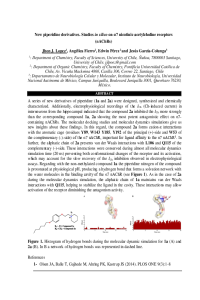
A series of new derivatives of piperidine (1a and 2a) were designed, synthesized and chemically characterized. Additionally, electrophysiological recordings of the ICh (Ch-induced current) in interneurons from the hippocampal indicated that the compound 2a inhibited the ICh more strongly than the corresponding compound 1a, 2a showing the most potent antagonistic effect on α7-containing nAChRs. The molecular docking studies and molecular dynamics simulations give us new insights about these findings. In this regard, the compound 2a forms cation-π interactions with the aromatic cage (residues Y89, W143 Y185, Y192 of the principal (+)-side and W53 of the complementary (-)-side) of the α7 nAChR, important for ligand affinity to the α7 nAChR1. In further, the aliphatic chain of 2a presents van der Waals interactions with L106 and Q115 of the complementary (-)-side. These interactions were conserved during almost all molecular dynamics simulation time (20 ns) preventing both conformational changes of the receptor and its activation, which may account for the slow recovery of the ICh inhibition observed in electrophysiological assays. Regarding with the non-methylated compound 1a the piperidine nitrogen of the compound is protonated at physiological pH, producing a hydrogen bond that forms a solvation network with the water molecules in the binding cavity of the α7 nAChR (see Figure 1). As in the case of 2a during the molecular dynamics simulation, the aliphatic chain of 1a maintains van der Waals interactions with Q115, helping to stabilize the ligand in the cavity. These interactions may allow activation of the receptor diminishing the antagonism activity.
Keywords
nicotinic acetylcholine receptors
Poster
Congresotalca2017.060.pdf
The impact of using single atomistic long range cutoff schemes with the GROMOS 54A7 force field