Event submissions
EventsThe 1st International Electronic Conference on Cancers: Exploiting Cancer Vulnerability by Targeting the DNA Damage Response
Published

This submission belongs to the session 8. Poster of the event The 1st International Electronic Conference on Cancers: Exploiting Cancer Vulnerability by Targeting the DNA Damage Response
Published date
29 Jan, 2021
Citation
Paola Peinado, Alvaro Andrades, Juan Sanjuan-Hidalgo, Jeffrey R. Haswell, Juan Carlos Alvarez-Perez, Frank J Slack, Pedro Medina Vico, ARID1A: The Good, the Bad and the Ugly., in Proceedings of The 1st International Electronic Conference on Cancers: Exploiting Cancer Vulnerability by Targeting the DNA Damage Response, 1 February–14 February 2021, MDPI: Basel, Switzerland, doi: 10.3390/IECC2021-09189
Share
Email
Facebook
Twitter
LinkedIn
ARID1A: The Good, the Bad and the Ugly.
'%3e%3cpath%20d='M12.6647%2010.9104C12.4176%2010.325%2012.0589%209.7933%2011.6088%209.34485C11.16%208.89511%2010.6283%208.53653%2010.0432%208.28891C10.038%208.28629%2010.0327%208.28498%2010.0275%208.28236C10.8437%207.69282%2011.3743%206.73252%2011.3743%205.64907C11.3743%203.85423%209.92005%202.40002%208.12522%202.40002C6.33038%202.40002%204.87618%203.85423%204.87618%205.64907C4.87618%206.73252%205.40677%207.69282%206.22296%208.28367C6.21772%208.28629%206.21248%208.2876%206.20724%208.29022C5.62031%208.53783%205.09365%208.89287%204.64167%209.34616C4.19192%209.79496%203.83334%2010.3266%203.58573%2010.9117C3.34247%2011.4846%203.21128%2012.0987%203.19925%2012.721C3.1989%2012.735%203.20135%2012.7489%203.20646%2012.7619C3.21157%2012.7749%203.21924%2012.7868%203.22901%2012.7968C3.23877%2012.8068%203.25045%2012.8148%203.26334%2012.8202C3.27623%2012.8256%203.29007%2012.8284%203.30406%2012.8284H4.09012C4.14776%2012.8284%204.19362%2012.7825%204.19493%2012.7262C4.22113%2011.7148%204.62726%2010.7676%205.34519%2010.0497C6.08802%209.30686%207.07452%208.89811%208.12522%208.89811C9.17592%208.89811%2010.1624%209.30686%2010.9052%2010.0497C11.6232%2010.7676%2012.0293%2011.7148%2012.0555%2012.7262C12.0568%2012.7839%2012.1027%2012.8284%2012.1603%2012.8284H12.9464C12.9604%2012.8284%2012.9742%2012.8256%2012.9871%2012.8202C13%2012.8148%2013.0117%2012.8068%2013.0214%2012.7968C13.0312%2012.7868%2013.0389%2012.7749%2013.044%2012.7619C13.0491%2012.7489%2013.0515%2012.735%2013.0512%2012.721C13.0381%2012.0947%2012.9084%2011.4856%2012.6647%2010.9104ZM8.12522%207.90243C7.52388%207.90243%206.95792%207.66793%206.53214%207.24215C6.10636%206.81636%205.87185%206.2504%205.87185%205.64907C5.87185%205.04773%206.10636%204.48177%206.53214%204.05599C6.95792%203.63021%207.52388%203.3957%208.12522%203.3957C8.72655%203.3957%209.29252%203.63021%209.7183%204.05599C10.1441%204.48177%2010.3786%205.04773%2010.3786%205.64907C10.3786%206.2504%2010.1441%206.81636%209.7183%207.24215C9.29252%207.66793%208.72655%207.90243%208.12522%207.90243Z'%20fill='%235D1EE1'/%3e%3c/g%3e%3c/svg%3e)
Paola Peinado 1,2
Alvaro Andrades 1,2
Juan Sanjuan-Hidalgo 2
Jeffrey R. Haswell 3
Juan Carlos Alvarez-Perez 1,2
Frank J Slack 3,4
Pedro Medina Vico 2,5
1. Department of Biochemistry and Molecular Biology I, University of Granada, Granada, Spain
2. GENYO, Centre for Genomics and Oncological Research: Pfizer/University of Granada/Andalusian Regional Government, Granada, Spain
3. Department of Pathology, Cancer Center, Beth Israel Deaconess Medical Center, Boston, MA, USA
4. Harvard Initiative for RNA Medicine, Boston, MA, USA.
5. Department of Biochemistry and Molecular Biology I, University of Granada
Abstract
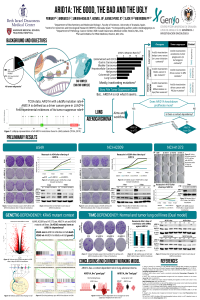
The chromatin-remodeling complex SWI/SNF is the most mutated remodeler that is currently described in many tumor types. Traditionally, it has been associated with a tumor suppressive role, leading the cellular machinery towards differentiation pathways and DNA repair processes. ARID1A is the most mutated SWI/SNF subunit across all human malignancies. It is also considered as one of the top mutated genes in lung adenocarcinoma (LUAD) and an important driver gene. However, there is a lack of phenotypical studies that confirm the tumor suppressive role of ARID1A in LUAD.
We have observed that ARID1A depletion in LUAD cell lines significantly impaired cell viability and promoted apoptosis. At first glance, these results contradicted its initially defined tumor suppressor status and could not be explained by synthetic lethal events involving other SWI/SNF subunits or driver genes. In addition, when we down-regulated ARID1A in a normal lung cell line, we did not see a significant reduction of cell viability, suggesting a tumor context dependency of ARID1A. Moreover, after performing RNA-seq in A549 after ARID1A-knockdown, we observed some up-regulated pathways related with apoptosis and genotoxic stress responses. We found that the depletion of ARID1A enhanced DNA damage in cells and triggered a severe ER stress response that promoted apoptosis. In addition, the protein levels of other subunits of the SWI/SNF complex decreased upon ARID1A, which could explain a decrease of the DNA repair processes.
Overall, we conclude that some LUAD cell lines are dependent on ARID1A expression in a tumor-dependent manner. In those contexts, ARID1A loss triggers a DNA damage-induced apoptosis, which could open new therapeutic opportunities.
Keywords
Vulnerability
DNA damage
apoptosis
SWI/SNF complex
ARID1A
lung adenocarcinoma
Manuscript
Poster_Cancervulnerabilities-2021.pdf
Poster
sciforum-041279.pdf
5-aminosalicylate–4-thiazolinone hybrid derivatives: A potent modulator of DNA damage response and G2/M cell cycle arrest via ATM/ATR pathway and Cyclin-CDK complex
BRAT1 impairs DNA damage repair in glioblastoma cell lines