Event submissions
EventsThe 1st International Electronic Conference on Cancers: Exploiting Cancer Vulnerability by Targeting the DNA Damage Response
Published

This submission belongs to the session 8. Poster of the event The 1st International Electronic Conference on Cancers: Exploiting Cancer Vulnerability by Targeting the DNA Damage Response
Published date
29 Jan, 2021
Citation
Alexandra M Blee, Bian Li, John Anthony Capra, Walter J Chazin, Developing a multidisciplinary strategy to interpret the impact of missense mutations in XPA on NER activity and cisplatin sensitivity, in Proceedings of The 1st International Electronic Conference on Cancers: Exploiting Cancer Vulnerability by Targeting the DNA Damage Response, 1 February–14 February 2021, MDPI: Basel, Switzerland, doi: 10.3390/IECC2021-09192
Share
Email
Facebook
Twitter
LinkedIn
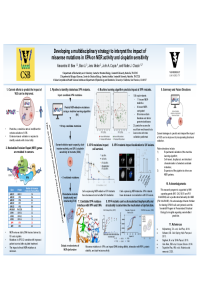
Developing a multidisciplinary strategy to interpret the impact of missense mutations in XPA on NER activity and cisplatin sensitivity
'%3e%3cpath%20d='M12.6647%2010.9104C12.4176%2010.325%2012.0589%209.7933%2011.6088%209.34485C11.16%208.89511%2010.6283%208.53653%2010.0432%208.28891C10.038%208.28629%2010.0327%208.28498%2010.0275%208.28236C10.8437%207.69282%2011.3743%206.73252%2011.3743%205.64907C11.3743%203.85423%209.92005%202.40002%208.12522%202.40002C6.33038%202.40002%204.87618%203.85423%204.87618%205.64907C4.87618%206.73252%205.40677%207.69282%206.22296%208.28367C6.21772%208.28629%206.21248%208.2876%206.20724%208.29022C5.62031%208.53783%205.09365%208.89287%204.64167%209.34616C4.19192%209.79496%203.83334%2010.3266%203.58573%2010.9117C3.34247%2011.4846%203.21128%2012.0987%203.19925%2012.721C3.1989%2012.735%203.20135%2012.7489%203.20646%2012.7619C3.21157%2012.7749%203.21924%2012.7868%203.22901%2012.7968C3.23877%2012.8068%203.25045%2012.8148%203.26334%2012.8202C3.27623%2012.8256%203.29007%2012.8284%203.30406%2012.8284H4.09012C4.14776%2012.8284%204.19362%2012.7825%204.19493%2012.7262C4.22113%2011.7148%204.62726%2010.7676%205.34519%2010.0497C6.08802%209.30686%207.07452%208.89811%208.12522%208.89811C9.17592%208.89811%2010.1624%209.30686%2010.9052%2010.0497C11.6232%2010.7676%2012.0293%2011.7148%2012.0555%2012.7262C12.0568%2012.7839%2012.1027%2012.8284%2012.1603%2012.8284H12.9464C12.9604%2012.8284%2012.9742%2012.8256%2012.9871%2012.8202C13%2012.8148%2013.0117%2012.8068%2013.0214%2012.7968C13.0312%2012.7868%2013.0389%2012.7749%2013.044%2012.7619C13.0491%2012.7489%2013.0515%2012.735%2013.0512%2012.721C13.0381%2012.0947%2012.9084%2011.4856%2012.6647%2010.9104ZM8.12522%207.90243C7.52388%207.90243%206.95792%207.66793%206.53214%207.24215C6.10636%206.81636%205.87185%206.2504%205.87185%205.64907C5.87185%205.04773%206.10636%204.48177%206.53214%204.05599C6.95792%203.63021%207.52388%203.3957%208.12522%203.3957C8.72655%203.3957%209.29252%203.63021%209.7183%204.05599C10.1441%204.48177%2010.3786%205.04773%2010.3786%205.64907C10.3786%206.2504%2010.1441%206.81636%209.7183%207.24215C9.29252%207.66793%208.72655%207.90243%208.12522%207.90243Z'%20fill='%235D1EE1'/%3e%3c/g%3e%3c/svg%3e)
Alexandra M Blee 1
Bian Li 2
John Anthony Capra 3
Walter J Chazin 1
1. Departments of Biochemistry and Chemistry, Center for Structural Biology, Vanderbilt University, Nashville, TN, 37235, USA
2. Department of Biological Sciences, Center for Structural Biology, Genetics Institute, Vanderbilt University, Nashville, TN, 37235, USA
3. Bakar Computational Health Sciences Institute and Department of Epidemiology and Biostatistics, University of California, San Francisco, CA, 94107, USA
Abstract
Nucleotide excision repair (NER) is an essential DNA damage repair pathway that removes bulky DNA lesions formed by exposure to ultraviolet light, environmental toxins, and platinum (Pt)-based chemotherapeutic drugs that are a standard of care for many cancer types. Mutation or decreased NER gene expression in cancer correlates with improved patient survival after Pt-based chemotherapy. However, the impact of most missense mutations in NER genes is unknown, and few approaches exist to reliably identify nonrecurrent passenger mutations with functional consequences. In this study, a multidisciplinary strategy will be developed to predict, validate, and characterize NER-defective mutations in the essential NER scaffold protein Xeroderma Pigmentosum Complementation Group A (XPA). Computational analyses were used to score NER-deficient versus NER-proficient mutations for further study. Predicted NER-deficient XPA mutants are being expressed in human XPA-deficient cells and screened for both NER activity and cisplatin sensitivity. In-depth biophysical and structural studies are being implemented to elucidate mechanisms of dysfunction. Identifying NER-deficient mutations that may sensitize tumors to Pt-based chemotherapies represents a promising strategy to stratify patients for optimal treatment strategies.
Keywords
nucleotide excision repair
cisplatin
XPA
VUS
Manuscript
20210118_BleePoster.pdf
Poster
20210118_BleePoster.pdf
Synergistic activity of DNA damage response kinase inhibitors in combination with the targeted alpha therapy radium-223 dichloride for metastatic castration-resistant prostate cancer
The roles of cell cycle and BRCA1 in the DNA damage response