Event submissions
EventsThe 1st International Electronic Conference on Cancers: Exploiting Cancer Vulnerability by Targeting the DNA Damage Response
Published

This submission belongs to the session 8. Poster of the event The 1st International Electronic Conference on Cancers: Exploiting Cancer Vulnerability by Targeting the DNA Damage Response
Published date
29 Jan, 2021
Citation
Charlotte Smith, Danilo Cucchi, Amy Gibson, Kirsten Brooksbank, Sarah Anne Martin, Identification of genetic determinants of DNA mismatch repair loss that predict response to immune checkpoint blockade, in Proceedings of The 1st International Electronic Conference on Cancers: Exploiting Cancer Vulnerability by Targeting the DNA Damage Response, 1 February–14 February 2021, MDPI: Basel, Switzerland, doi: 10.3390/IECC2021-09195
Share
Email
Facebook
Twitter
LinkedIn
Identification of genetic determinants of DNA mismatch repair loss that predict response to immune checkpoint blockade
'%3e%3cpath%20d='M12.6647%2010.9104C12.4176%2010.325%2012.0589%209.7933%2011.6088%209.34485C11.16%208.89511%2010.6283%208.53653%2010.0432%208.28891C10.038%208.28629%2010.0327%208.28498%2010.0275%208.28236C10.8437%207.69282%2011.3743%206.73252%2011.3743%205.64907C11.3743%203.85423%209.92005%202.40002%208.12522%202.40002C6.33038%202.40002%204.87618%203.85423%204.87618%205.64907C4.87618%206.73252%205.40677%207.69282%206.22296%208.28367C6.21772%208.28629%206.21248%208.2876%206.20724%208.29022C5.62031%208.53783%205.09365%208.89287%204.64167%209.34616C4.19192%209.79496%203.83334%2010.3266%203.58573%2010.9117C3.34247%2011.4846%203.21128%2012.0987%203.19925%2012.721C3.1989%2012.735%203.20135%2012.7489%203.20646%2012.7619C3.21157%2012.7749%203.21924%2012.7868%203.22901%2012.7968C3.23877%2012.8068%203.25045%2012.8148%203.26334%2012.8202C3.27623%2012.8256%203.29007%2012.8284%203.30406%2012.8284H4.09012C4.14776%2012.8284%204.19362%2012.7825%204.19493%2012.7262C4.22113%2011.7148%204.62726%2010.7676%205.34519%2010.0497C6.08802%209.30686%207.07452%208.89811%208.12522%208.89811C9.17592%208.89811%2010.1624%209.30686%2010.9052%2010.0497C11.6232%2010.7676%2012.0293%2011.7148%2012.0555%2012.7262C12.0568%2012.7839%2012.1027%2012.8284%2012.1603%2012.8284H12.9464C12.9604%2012.8284%2012.9742%2012.8256%2012.9871%2012.8202C13%2012.8148%2013.0117%2012.8068%2013.0214%2012.7968C13.0312%2012.7868%2013.0389%2012.7749%2013.044%2012.7619C13.0491%2012.7489%2013.0515%2012.735%2013.0512%2012.721C13.0381%2012.0947%2012.9084%2011.4856%2012.6647%2010.9104ZM8.12522%207.90243C7.52388%207.90243%206.95792%207.66793%206.53214%207.24215C6.10636%206.81636%205.87185%206.2504%205.87185%205.64907C5.87185%205.04773%206.10636%204.48177%206.53214%204.05599C6.95792%203.63021%207.52388%203.3957%208.12522%203.3957C8.72655%203.3957%209.29252%203.63021%209.7183%204.05599C10.1441%204.48177%2010.3786%205.04773%2010.3786%205.64907C10.3786%206.2504%2010.1441%206.81636%209.7183%207.24215C9.29252%207.66793%208.72655%207.90243%208.12522%207.90243Z'%20fill='%235D1EE1'/%3e%3c/g%3e%3c/svg%3e)
Charlotte Smith 1
Danilo Cucchi 1
Amy Gibson 1
Kirsten Brooksbank 1
Sarah Anne Martin 1
1. BCI
Abstract
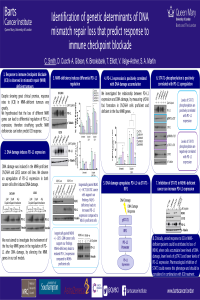
Despite showing great clinical promise, response rates to immune checkpoint blockade (ICB) vary greatly and biomarkers of response are lacking. A recent Phase II clinical trial in patients with deficiency in the DNA mismatch repair (MMR) pathway indicated that MMR status predicted clinical benefit with the PD-1 inhibitor, pembrolizumab. These findings have led to the first tissue-agnostic approval for anti PD-1 therapy for unresectable or metastatic solid tumours with MMR deficiency. However, it is becoming increasingly clear that many MMR-deficient tumours fail to respond to ICBs with ~50% refractory to treatment. Furthermore, there is a wide diversity of clinical benefit among responders. However why this is the case and how this can be clinically translated remains largely unknown.
Our exciting preliminary data suggest that loss of specific MMR genes results in a differential increased expression of the immune checkpoint molecule, PD-L1. Significantly, we observed an upregulation of PD-L1 expression in cells silenced for the MMR genes, MLH1, MSH2, PMS2 and MSH3, as expected. However, we did not observe an increased expression of PD-L1 upon MSH6 loss. This differential expression amongst MMR gene loss was further validated at both RNA and cell surface level.
Upon investigation of the molecular mechanism regulating PD-L1 expression after MMR loss, we observed that that phosphorylation of STAT1 positively correlates with PD-L1 expression whilst STAT3 phosphorylation was negatively correlated, such that increased STAT1 phosphorylation was observed upon MLH1 and PMS2 loss and not in MSH6-deficient cells whilst STAT3 phosphorylation was only observed upon MSH6 loss. Significantly, inhibition of STAT3, both pharmacologically and genetically, reinstated PD-L1 expression in MSH6-deficient cells.
Therefore, we have evidence that loss of specific MMR genes can trigger differential expression of PD-L1 through a STAT1/STAT3 mediated pathway and we hypothesize that it is this differential expression that may in part determine sensitivity to treatment with ICB.
Keywords
DNA mismatch repair (MMR)
immune checkpoint blockade (ICB)
PD-L1
STAT
Manuscript
IECC 2021 Poster Charlotte Smith Final Edit.pdf
Poster
sciforum-041403.pdf
Differences in durability of PARP inhibition by PARP inhibitors in ovarian cancer cells
Loss of MLH1 regulates a metabolic phenotype in endometrial cancer