Event submissions
EventsThe 1st International Electronic Conference on Cancers: Exploiting Cancer Vulnerability by Targeting the DNA Damage Response
Published

This submission belongs to the session 8. Poster of the event The 1st International Electronic Conference on Cancers: Exploiting Cancer Vulnerability by Targeting the DNA Damage Response
Published date
29 Jan, 2021
Citation
Amy Gibson, Valle Morales, Katiuscia Bianchi, Emma Crosbie, Gabriella Ficz, Sarah Martin, Loss of MLH1 regulates a metabolic phenotype in endometrial cancer, in Proceedings of The 1st International Electronic Conference on Cancers: Exploiting Cancer Vulnerability by Targeting the DNA Damage Response, 1 February–14 February 2021, MDPI: Basel, Switzerland, doi: 10.3390/IECC2021-09196
Share
Email
Facebook
Twitter
LinkedIn
Loss of MLH1 regulates a metabolic phenotype in endometrial cancer
'%3e%3cpath%20d='M12.6647%2010.9104C12.4176%2010.325%2012.0589%209.7933%2011.6088%209.34485C11.16%208.89511%2010.6283%208.53653%2010.0432%208.28891C10.038%208.28629%2010.0327%208.28498%2010.0275%208.28236C10.8437%207.69282%2011.3743%206.73252%2011.3743%205.64907C11.3743%203.85423%209.92005%202.40002%208.12522%202.40002C6.33038%202.40002%204.87618%203.85423%204.87618%205.64907C4.87618%206.73252%205.40677%207.69282%206.22296%208.28367C6.21772%208.28629%206.21248%208.2876%206.20724%208.29022C5.62031%208.53783%205.09365%208.89287%204.64167%209.34616C4.19192%209.79496%203.83334%2010.3266%203.58573%2010.9117C3.34247%2011.4846%203.21128%2012.0987%203.19925%2012.721C3.1989%2012.735%203.20135%2012.7489%203.20646%2012.7619C3.21157%2012.7749%203.21924%2012.7868%203.22901%2012.7968C3.23877%2012.8068%203.25045%2012.8148%203.26334%2012.8202C3.27623%2012.8256%203.29007%2012.8284%203.30406%2012.8284H4.09012C4.14776%2012.8284%204.19362%2012.7825%204.19493%2012.7262C4.22113%2011.7148%204.62726%2010.7676%205.34519%2010.0497C6.08802%209.30686%207.07452%208.89811%208.12522%208.89811C9.17592%208.89811%2010.1624%209.30686%2010.9052%2010.0497C11.6232%2010.7676%2012.0293%2011.7148%2012.0555%2012.7262C12.0568%2012.7839%2012.1027%2012.8284%2012.1603%2012.8284H12.9464C12.9604%2012.8284%2012.9742%2012.8256%2012.9871%2012.8202C13%2012.8148%2013.0117%2012.8068%2013.0214%2012.7968C13.0312%2012.7868%2013.0389%2012.7749%2013.044%2012.7619C13.0491%2012.7489%2013.0515%2012.735%2013.0512%2012.721C13.0381%2012.0947%2012.9084%2011.4856%2012.6647%2010.9104ZM8.12522%207.90243C7.52388%207.90243%206.95792%207.66793%206.53214%207.24215C6.10636%206.81636%205.87185%206.2504%205.87185%205.64907C5.87185%205.04773%206.10636%204.48177%206.53214%204.05599C6.95792%203.63021%207.52388%203.3957%208.12522%203.3957C8.72655%203.3957%209.29252%203.63021%209.7183%204.05599C10.1441%204.48177%2010.3786%205.04773%2010.3786%205.64907C10.3786%206.2504%2010.1441%206.81636%209.7183%207.24215C9.29252%207.66793%208.72655%207.90243%208.12522%207.90243Z'%20fill='%235D1EE1'/%3e%3c/g%3e%3c/svg%3e)
Amy Gibson 1
Valle Morales 1
Katiuscia Bianchi 1
Emma Crosbie 2
Gabriella Ficz 1
Sarah Martin 1
1. BCI
2. Division of Cancer Sciences, University of Manchester
Abstract
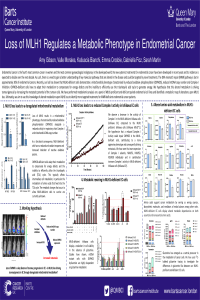
Endometrial cancer is the fourth most common cancer in women and the most common gynaecological malignancy in the developed world. No new systemic treatments for endometrial cancer have been developed in recent years and its incidence is expected to double over the next decade. As such, there is a need to gain a better understanding of key molecular pathways that are altered in the disease and could be targeted by novel treatments. The DNA mismatch repair (MMR) pathway is lost in approximately 30% of endometrial cancers. Recently, our lab has shown that MLH1-deficient cells demonstrate a mitochondrial phenotype characterised by reduced oxidative phosphorylation (OXPHOS), reduced mtDNA copy number and Complex I inhibition. OXPHOS-deficient cells have to adapt their metabolism to compensate for energy defects and the inability to efficiently use the tricarboxylic acid cycle to generate energy. We hypothesise that this altered metabolism is driving tumourigenesis by increasing the metastatic potential of the tumour cells and are investigating this using orthotopic models of MLH1-deficient endometrial cancer in vivo. We have performed metabolomic analysis on a panel of MLH1-proficient and deficient paired endometrial cell lines and identified a metabolic map of alterations upon MLH1 loss. Ultimately, we aim to use this knowledge of altered metabolism upon MLH1 loss to identify more targeted treatments for MMR-deficient endometrial cancer patients.
Keywords
MMR deficiency
cancer metabolism
endometrial cancer
Manuscript
AG IECC Abstract.pdf
Poster
AG IECC Poster.pdf
Identification of genetic determinants of DNA mismatch repair loss that predict response to immune checkpoint blockade
Development of small molecule NUDT22 inhibitors for uses in cancer.