Event submissions
EventsThe 1st International Electronic Conference on Cancers: Exploiting Cancer Vulnerability by Targeting the DNA Damage Response
Published

This submission belongs to the session 8. Poster of the event The 1st International Electronic Conference on Cancers: Exploiting Cancer Vulnerability by Targeting the DNA Damage Response
Published date
29 Jan, 2021
Citation
Victoria Sanchez-Martin, G-quadruplexes and DNA damage in colorectal cancer tumorigenesis, in Proceedings of The 1st International Electronic Conference on Cancers: Exploiting Cancer Vulnerability by Targeting the DNA Damage Response, 1 February–14 February 2021, MDPI: Basel, Switzerland, doi: 10.3390/IECC2021-09198
Share
Email
Facebook
Twitter
LinkedIn
G-quadruplexes and DNA damage in colorectal cancer tumorigenesis
'%3e%3cpath%20d='M12.6647%2010.9104C12.4176%2010.325%2012.0589%209.7933%2011.6088%209.34485C11.16%208.89511%2010.6283%208.53653%2010.0432%208.28891C10.038%208.28629%2010.0327%208.28498%2010.0275%208.28236C10.8437%207.69282%2011.3743%206.73252%2011.3743%205.64907C11.3743%203.85423%209.92005%202.40002%208.12522%202.40002C6.33038%202.40002%204.87618%203.85423%204.87618%205.64907C4.87618%206.73252%205.40677%207.69282%206.22296%208.28367C6.21772%208.28629%206.21248%208.2876%206.20724%208.29022C5.62031%208.53783%205.09365%208.89287%204.64167%209.34616C4.19192%209.79496%203.83334%2010.3266%203.58573%2010.9117C3.34247%2011.4846%203.21128%2012.0987%203.19925%2012.721C3.1989%2012.735%203.20135%2012.7489%203.20646%2012.7619C3.21157%2012.7749%203.21924%2012.7868%203.22901%2012.7968C3.23877%2012.8068%203.25045%2012.8148%203.26334%2012.8202C3.27623%2012.8256%203.29007%2012.8284%203.30406%2012.8284H4.09012C4.14776%2012.8284%204.19362%2012.7825%204.19493%2012.7262C4.22113%2011.7148%204.62726%2010.7676%205.34519%2010.0497C6.08802%209.30686%207.07452%208.89811%208.12522%208.89811C9.17592%208.89811%2010.1624%209.30686%2010.9052%2010.0497C11.6232%2010.7676%2012.0293%2011.7148%2012.0555%2012.7262C12.0568%2012.7839%2012.1027%2012.8284%2012.1603%2012.8284H12.9464C12.9604%2012.8284%2012.9742%2012.8256%2012.9871%2012.8202C13%2012.8148%2013.0117%2012.8068%2013.0214%2012.7968C13.0312%2012.7868%2013.0389%2012.7749%2013.044%2012.7619C13.0491%2012.7489%2013.0515%2012.735%2013.0512%2012.721C13.0381%2012.0947%2012.9084%2011.4856%2012.6647%2010.9104ZM8.12522%207.90243C7.52388%207.90243%206.95792%207.66793%206.53214%207.24215C6.10636%206.81636%205.87185%206.2504%205.87185%205.64907C5.87185%205.04773%206.10636%204.48177%206.53214%204.05599C6.95792%203.63021%207.52388%203.3957%208.12522%203.3957C8.72655%203.3957%209.29252%203.63021%209.7183%204.05599C10.1441%204.48177%2010.3786%205.04773%2010.3786%205.64907C10.3786%206.2504%2010.1441%206.81636%209.7183%207.24215C9.29252%207.66793%208.72655%207.90243%208.12522%207.90243Z'%20fill='%235D1EE1'/%3e%3c/g%3e%3c/svg%3e)
Victoria Sanchez-Martin 1
1. Centre for Genomics and Oncological Research (GENYO), Granada, Spain
Abstract
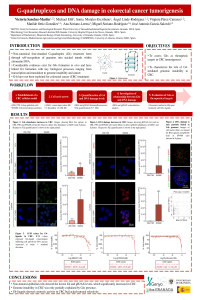
Non-canonical four-stranded G-quadruplex (G4) structures form through self-recognition of guanines into stacked tetrads within chromatin DNA. Considerable evidences exist for G4s formation in vitro and have linked G4 formation with key biological processes ranging from transcription and translation to genome instability and cancer. However, G4s have not been exploited for colorectal cancer (CRC) treatment before. Our aim was to assess G4s as therapeutic targets in CRC tumorigenesis and characterize the role of G4-mediated genomic instability in CRC. We measured the presence of G4s and DNA damage at G0/G1 and S phase of cell cycle by immunofluorescence and Fiji quantification (N > 200) using antibodies against G4s (termed BG4) and gH2AX respectively in a cellular progression model of CRC. In addition, antitumoral activity of well-known G4-ligands was assessed by Resazurin method. Genomic instability driven by these G4-ligands was also evaluated by gH2AX immunofluorescence. Non-tumoral epithelial cells showed the lowest G4 and gH2AX levels, which significantly increased along CRC progression, suggesting a role in CRC tumorigenesis. Both G4s and gH2AX levels were positively correlated and the typical genome instability in CRC was partially explained by G4s presence. G4-ligands showed cytotoxic activity and significantly induced DNA damage. Subsequent studies are required to further evaluate the therapeutic potential of G4s and associated genomic instability in CRC.
Keywords
G-quadruplexes
DNA damage
cancer
Manuscript
POSTER_V.pdf
Poster
POSTER_V.pdf
Development of small molecule NUDT22 inhibitors for uses in cancer.
Evidences of the nerve-cancer connection in female reproductive cancers