Event submissions
EventsThe 1st International Electronic Conference on Cancers: Exploiting Cancer Vulnerability by Targeting the DNA Damage Response
Published

This submission belongs to the session 8. Poster of the event The 1st International Electronic Conference on Cancers: Exploiting Cancer Vulnerability by Targeting the DNA Damage Response
Published date
29 Jan, 2021
Citation
Patricia Pellicena, Matthew Duncton, David Wilson, Millie Georgiadis, Ashley Deacon, Debanu Das, Targeting the DNA repair enzyme APE1 in cancer therapy, in Proceedings of The 1st International Electronic Conference on Cancers: Exploiting Cancer Vulnerability by Targeting the DNA Damage Response, 1 February–14 February 2021, MDPI: Basel, Switzerland, doi: 10.3390/IECC2021-09201
Share
Email
Facebook
Twitter
LinkedIn
Targeting the DNA repair enzyme APE1 in cancer therapy
'%3e%3cpath%20d='M12.6647%2010.9104C12.4176%2010.325%2012.0589%209.7933%2011.6088%209.34485C11.16%208.89511%2010.6283%208.53653%2010.0432%208.28891C10.038%208.28629%2010.0327%208.28498%2010.0275%208.28236C10.8437%207.69282%2011.3743%206.73252%2011.3743%205.64907C11.3743%203.85423%209.92005%202.40002%208.12522%202.40002C6.33038%202.40002%204.87618%203.85423%204.87618%205.64907C4.87618%206.73252%205.40677%207.69282%206.22296%208.28367C6.21772%208.28629%206.21248%208.2876%206.20724%208.29022C5.62031%208.53783%205.09365%208.89287%204.64167%209.34616C4.19192%209.79496%203.83334%2010.3266%203.58573%2010.9117C3.34247%2011.4846%203.21128%2012.0987%203.19925%2012.721C3.1989%2012.735%203.20135%2012.7489%203.20646%2012.7619C3.21157%2012.7749%203.21924%2012.7868%203.22901%2012.7968C3.23877%2012.8068%203.25045%2012.8148%203.26334%2012.8202C3.27623%2012.8256%203.29007%2012.8284%203.30406%2012.8284H4.09012C4.14776%2012.8284%204.19362%2012.7825%204.19493%2012.7262C4.22113%2011.7148%204.62726%2010.7676%205.34519%2010.0497C6.08802%209.30686%207.07452%208.89811%208.12522%208.89811C9.17592%208.89811%2010.1624%209.30686%2010.9052%2010.0497C11.6232%2010.7676%2012.0293%2011.7148%2012.0555%2012.7262C12.0568%2012.7839%2012.1027%2012.8284%2012.1603%2012.8284H12.9464C12.9604%2012.8284%2012.9742%2012.8256%2012.9871%2012.8202C13%2012.8148%2013.0117%2012.8068%2013.0214%2012.7968C13.0312%2012.7868%2013.0389%2012.7749%2013.044%2012.7619C13.0491%2012.7489%2013.0515%2012.735%2013.0512%2012.721C13.0381%2012.0947%2012.9084%2011.4856%2012.6647%2010.9104ZM8.12522%207.90243C7.52388%207.90243%206.95792%207.66793%206.53214%207.24215C6.10636%206.81636%205.87185%206.2504%205.87185%205.64907C5.87185%205.04773%206.10636%204.48177%206.53214%204.05599C6.95792%203.63021%207.52388%203.3957%208.12522%203.3957C8.72655%203.3957%209.29252%203.63021%209.7183%204.05599C10.1441%204.48177%2010.3786%205.04773%2010.3786%205.64907C10.3786%206.2504%2010.1441%206.81636%209.7183%207.24215C9.29252%207.66793%208.72655%207.90243%208.12522%207.90243Z'%20fill='%235D1EE1'/%3e%3c/g%3e%3c/svg%3e)
Patricia Pellicena 1
Matthew Duncton 1
David Wilson 1
Millie Georgiadis 1
Ashley Deacon 1
Debanu Das 1
1. XPose Therapeutics
Abstract
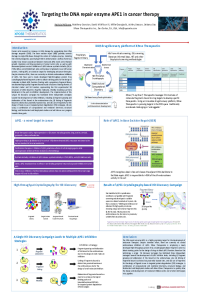
Cancer cells respond to increases in DNA damage by upregulating their DNA damage response (DDR). The base excision repair (BER) pathway corrects damage to single DNA bases through the action of multiple enzymes, including the central protagonist, apurinic/apyrimidinic endonuclease 1 (APE1). Numerous studies have shown association between increased APE1 levels and enhanced growth, migration, and drug resistance in human tumor cells, as well as with decreased patient survival. APE1 has been implicated in over 20 human cancers, making this an attractive target for developing anticancer therapies. Despite intensive effort, there are currently no clinical endonuclease inhibitors of APE1. We have used a newly developed high-throughput protein X-ray crystallography-based fragment screen to obtain starting points for the design of molecules to block APE1 function. Starting with a proprietary fragment library, we obtained high quality fragment-bound crystal structures showing diversity of chemical matter and hit location, representing the first experimental 3D structures of APE1 bound to drug-like molecules, thereby resolving a primary bottleneck in the path to inhibitor development. The implementation of this unique lead discovery campaign has facilitated three independent strategies toward the development of APE1 inhibitors, including (i) fragment growing and elaboration of hits bound at the endonuclease site; (ii) linking of fragments bound to distinct but proximally located sites, and (iii) use of fragments for the design of hooks to use in targeted protein degradation (TPD) strategies. We are using a combination of computational and medicinal chemistry, structural biology, and biochemical and biophysical studies and will discuss our progress towards these goals.
Keywords
APE1
Cancer therapeutics
DNA damage response
DNA repair
Fragment-based drug discovery
Structure-based drug discovery
X-ray crystallography
Manuscript
XPoseTx_Poster_IECC2021e_012021_PP.pdf
Poster
XPoseTx_Poster_IECC2021e_012021_PP.pdf
Identification of a novel regulator of FANCD2 mediated DNA Repair
The extent of consequential DNA damage in human tumors from TCGA PanCanAtlas