Event submissions
EventsThe 1st International Electronic Conference on Cancers: Exploiting Cancer Vulnerability by Targeting the DNA Damage Response
Published

This submission belongs to the session 8. Poster of the event The 1st International Electronic Conference on Cancers: Exploiting Cancer Vulnerability by Targeting the DNA Damage Response
Published date
29 Jan, 2021
Citation
Josephine Mun-Yee Ko, Shiu-Yeung Lam, Lvwen Ning, Annie Wai-Yeeng Chai, Lisa Chan Lei, Sheyne Sta Ana Choi, Maria Li Lung, RAD50 loss of function variants in the zinc hook domain associated with higher risk of familial esophageal squamous cell carcinoma, in Proceedings of The 1st International Electronic Conference on Cancers: Exploiting Cancer Vulnerability by Targeting the DNA Damage Response, 1 February–14 February 2021, MDPI: Basel, Switzerland, doi: 10.3390/IECC2021-09203
Share
Email
Facebook
Twitter
LinkedIn
RAD50 loss of function variants in the zinc hook domain associated with higher risk of familial esophageal squamous cell carcinoma
'%3e%3cpath%20d='M12.6647%2010.9104C12.4176%2010.325%2012.0589%209.7933%2011.6088%209.34485C11.16%208.89511%2010.6283%208.53653%2010.0432%208.28891C10.038%208.28629%2010.0327%208.28498%2010.0275%208.28236C10.8437%207.69282%2011.3743%206.73252%2011.3743%205.64907C11.3743%203.85423%209.92005%202.40002%208.12522%202.40002C6.33038%202.40002%204.87618%203.85423%204.87618%205.64907C4.87618%206.73252%205.40677%207.69282%206.22296%208.28367C6.21772%208.28629%206.21248%208.2876%206.20724%208.29022C5.62031%208.53783%205.09365%208.89287%204.64167%209.34616C4.19192%209.79496%203.83334%2010.3266%203.58573%2010.9117C3.34247%2011.4846%203.21128%2012.0987%203.19925%2012.721C3.1989%2012.735%203.20135%2012.7489%203.20646%2012.7619C3.21157%2012.7749%203.21924%2012.7868%203.22901%2012.7968C3.23877%2012.8068%203.25045%2012.8148%203.26334%2012.8202C3.27623%2012.8256%203.29007%2012.8284%203.30406%2012.8284H4.09012C4.14776%2012.8284%204.19362%2012.7825%204.19493%2012.7262C4.22113%2011.7148%204.62726%2010.7676%205.34519%2010.0497C6.08802%209.30686%207.07452%208.89811%208.12522%208.89811C9.17592%208.89811%2010.1624%209.30686%2010.9052%2010.0497C11.6232%2010.7676%2012.0293%2011.7148%2012.0555%2012.7262C12.0568%2012.7839%2012.1027%2012.8284%2012.1603%2012.8284H12.9464C12.9604%2012.8284%2012.9742%2012.8256%2012.9871%2012.8202C13%2012.8148%2013.0117%2012.8068%2013.0214%2012.7968C13.0312%2012.7868%2013.0389%2012.7749%2013.044%2012.7619C13.0491%2012.7489%2013.0515%2012.735%2013.0512%2012.721C13.0381%2012.0947%2012.9084%2011.4856%2012.6647%2010.9104ZM8.12522%207.90243C7.52388%207.90243%206.95792%207.66793%206.53214%207.24215C6.10636%206.81636%205.87185%206.2504%205.87185%205.64907C5.87185%205.04773%206.10636%204.48177%206.53214%204.05599C6.95792%203.63021%207.52388%203.3957%208.12522%203.3957C8.72655%203.3957%209.29252%203.63021%209.7183%204.05599C10.1441%204.48177%2010.3786%205.04773%2010.3786%205.64907C10.3786%206.2504%2010.1441%206.81636%209.7183%207.24215C9.29252%207.66793%208.72655%207.90243%208.12522%207.90243Z'%20fill='%235D1EE1'/%3e%3c/g%3e%3c/svg%3e)
Josephine Mun-Yee Ko 1
Shiu-Yeung Lam 1
Lvwen Ning 1

Annie Wai-Yeeng Chai 1

Lisa Chan Lei 1
Sheyne Sta Ana Choi 1
Maria Li Lung 1
1. The University of Hong Kong
Abstract
Abstract
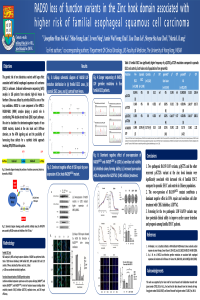
Esophageal cancer occurs with extraordinarily high incidence and dismal survival in high-risk regions of Northern China, highlighting the unmet need for early detection to improve patient survival. Combining the enrichment of genetic component strategy and unbiased whole-exome sequencing (WES) approaches, we performed next-generation sequencing (NGS) analysis for 186 familial esophageal squamous cell carcinoma (ESCC) cases involving two generations with ≥2 family members diagnosed with ESCC, including the proband. We identified multiple candidate cancer predisposition genes (CPGs) for familial ESCC, including BRCA2, POLQ, and MSH2 involved in DNA repair. Further data mining of the WES data in the discovery phase by applying loss-of-function (LOF) filtering strategy, RAD50 was prioritized as the top CPG for validation in a larger cohort of 3103 individuals. The combined study consisted of 3289 Henan individuals (2118 ESCC cases and 1171 controls). We did not observe a significant difference in the frequency of LOF variants considering the entire RAD50 gene in familial ESCC patients compared to sporadic ESCC patients and controls. However, two pathogenic RAD50 LOF variants, p.Q672X and the other recurrent p.K722fs variant (4/2088, 0.19%) at the zinc hook domain, were associated with increased risk of familial ESCC compared to sporadic ESCC and controls (0/4490, 0%) (p = 0.01). An increased risk of familial ESCC was also observed, when compared to East Asians from the gnomAD database (4/19954, 0.06%) (OR 9.57, p = 4.1x10⁻³) and all populations from gnomAD (5/251308, 0.028%) (OR 96, p = 5.6x10⁻⁷). Further functional characterization suggested that the Q672X variant contributed a dominant negative effect in the DNA repair. Our study suggested RAD50 LOF variants in the zinc hook domain associate with higher risk of familial ESCC in Chinese. Screening of the two pathogenic LOF RAD50 variants may be utilized to improve cancer detection and prognosis among familial ESCC patients.
Keywords
RAD50
pathogenic variants
Zinc Hook Domain
familial ESCC risk
Chinese
Manuscript
Rad50_Cancers_Submission_20-1-2021a.pdf
Poster
IECC2021poster_RAD50.ml_JK.pdf
The extent of consequential DNA damage in human tumors from TCGA PanCanAtlas
Anti-inflammatory combinatorial therapy to enhance killing efficacy with patient-derived preclinical models