Event submissions
EventsThe 1st International Electronic Conference on Cancers: Exploiting Cancer Vulnerability by Targeting the DNA Damage Response
Published

This submission belongs to the session 8. Poster of the event The 1st International Electronic Conference on Cancers: Exploiting Cancer Vulnerability by Targeting the DNA Damage Response
Published date
29 Jan, 2021
Citation
Maria Rita Fabbrizi, Catherine M Nickson, Rachel J Carter, Jonathan R Hughes, Andrzej Kacperek, Mark A Hill, Jason L Parsons, USP9X inhibition enhances radiosensitisation of head and neck cancer cells in response to high-LET radiation by destabilizing centrosome proteins, in Proceedings of The 1st International Electronic Conference on Cancers: Exploiting Cancer Vulnerability by Targeting the DNA Damage Response, 1 February–14 February 2021, MDPI: Basel, Switzerland, doi: 10.3390/IECC2021-09211
Share
Email
Facebook
Twitter
LinkedIn
USP9X inhibition enhances radiosensitisation of head and neck cancer cells in response to high-LET radiation by destabilizing centrosome proteins
'%3e%3cpath%20d='M12.6647%2010.9104C12.4176%2010.325%2012.0589%209.7933%2011.6088%209.34485C11.16%208.89511%2010.6283%208.53653%2010.0432%208.28891C10.038%208.28629%2010.0327%208.28498%2010.0275%208.28236C10.8437%207.69282%2011.3743%206.73252%2011.3743%205.64907C11.3743%203.85423%209.92005%202.40002%208.12522%202.40002C6.33038%202.40002%204.87618%203.85423%204.87618%205.64907C4.87618%206.73252%205.40677%207.69282%206.22296%208.28367C6.21772%208.28629%206.21248%208.2876%206.20724%208.29022C5.62031%208.53783%205.09365%208.89287%204.64167%209.34616C4.19192%209.79496%203.83334%2010.3266%203.58573%2010.9117C3.34247%2011.4846%203.21128%2012.0987%203.19925%2012.721C3.1989%2012.735%203.20135%2012.7489%203.20646%2012.7619C3.21157%2012.7749%203.21924%2012.7868%203.22901%2012.7968C3.23877%2012.8068%203.25045%2012.8148%203.26334%2012.8202C3.27623%2012.8256%203.29007%2012.8284%203.30406%2012.8284H4.09012C4.14776%2012.8284%204.19362%2012.7825%204.19493%2012.7262C4.22113%2011.7148%204.62726%2010.7676%205.34519%2010.0497C6.08802%209.30686%207.07452%208.89811%208.12522%208.89811C9.17592%208.89811%2010.1624%209.30686%2010.9052%2010.0497C11.6232%2010.7676%2012.0293%2011.7148%2012.0555%2012.7262C12.0568%2012.7839%2012.1027%2012.8284%2012.1603%2012.8284H12.9464C12.9604%2012.8284%2012.9742%2012.8256%2012.9871%2012.8202C13%2012.8148%2013.0117%2012.8068%2013.0214%2012.7968C13.0312%2012.7868%2013.0389%2012.7749%2013.044%2012.7619C13.0491%2012.7489%2013.0515%2012.735%2013.0512%2012.721C13.0381%2012.0947%2012.9084%2011.4856%2012.6647%2010.9104ZM8.12522%207.90243C7.52388%207.90243%206.95792%207.66793%206.53214%207.24215C6.10636%206.81636%205.87185%206.2504%205.87185%205.64907C5.87185%205.04773%206.10636%204.48177%206.53214%204.05599C6.95792%203.63021%207.52388%203.3957%208.12522%203.3957C8.72655%203.3957%209.29252%203.63021%209.7183%204.05599C10.1441%204.48177%2010.3786%205.04773%2010.3786%205.64907C10.3786%206.2504%2010.1441%206.81636%209.7183%207.24215C9.29252%207.66793%208.72655%207.90243%208.12522%207.90243Z'%20fill='%235D1EE1'/%3e%3c/g%3e%3c/svg%3e)
Maria Rita Fabbrizi 1
Catherine M Nickson 1
Rachel J Carter 1
Jonathan R Hughes 1
Andrzej Kacperek 2

Mark A Hill 3

Jason L Parsons 4
1. Cancer Research Centre, Department of Molecular and Clinical Cancer Medicine, University of Liverpool
2. Clatterbridge Cancer Centre NHS Foundation Trust
3. CRUK/MRC Oxford Institute for Radiation Oncology, University of Oxford
4. Cancer Research Centre, Department of Molecular and Clinical Cancer Medicine, University of Liverpool
Clatterbridge Cancer Centre NHS Foundation Trust
Abstract
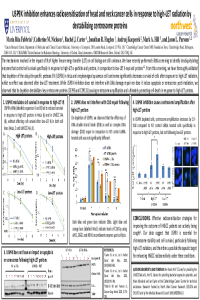
Ionizing radiation (IR) is widely used in cancer treatment as it induces vast DNA damage leading ultimately to tumour cell death. The mechanisms involved in x-ray-induced cell death have been deeply studied, while little is known about the impact of IR of higher linear energy transfer (LET) on cell biology and the critical enzymes and mechanisms that are responsive to this. We have recently performed a focused small interfering RNA (siRNA) screen to identify proteins involved in cell survival in response to high-LET α-particles and protons, versus low-LET x-rays and protons. From this screening, we have validated that depletion of the ubiquitin-specific protease 9X (USP9X) in HeLa and oropharyngeal squamous cell carcinoma (UMSCC74A) cells using siRNA leads to significantly decreased survival of cells after exposure to high-LET radiation, whilst no effect was observed after low-LET radiation (protons and x-rays) treatment. We consequently investigated the mechanism through which this occurs and found that USP9X inhibition does not interfere with DNA damage (double strand breaks and complex DNA damage) repair post-irradiation, nor does it induce apoptosis, autophagy or senescence. Instead, we observed that USP9X depletion destabilizes key centrosome proteins (CEP55 and CEP131) causing centrosome amplification and ultimately cell death in response to high-LET protons.
Keywords
Head and neck cancer
USP9X
DDR
centrosomes
radiosensitivity
Manuscript
Poster Fabbrizi.pdf
Poster
sciforum-041956.pdf
Elucidating the role of XRN2-mediated DNA repair programs
Exploiting DNA Repair Defect in Triple Negative Brest Cancer Using CDK Inhibition Strategy