Event submissions
EventsThe 1st International Electronic Conference on Cancers: Exploiting Cancer Vulnerability by Targeting the DNA Damage Response
Published

This submission belongs to the session 4. MMR defects, mutator phenotype of the event The 1st International Electronic Conference on Cancers: Exploiting Cancer Vulnerability by Targeting the DNA Damage Response
Published date
29 Jan, 2021
Citation
Carolina Velázquez, Esin Orhan, Imene Tabet, Lise Fenou, Laura Boudarel, Charles Theillet, Exploiting DNA Repair Defect in Triple Negative Brest Cancer Using CDK Inhibition Strategy, in Proceedings of The 1st International Electronic Conference on Cancers: Exploiting Cancer Vulnerability by Targeting the DNA Damage Response, 1 February–14 February 2021, MDPI: Basel, Switzerland, doi: 10.3390/IECC2021-09212
Share
Email
Facebook
Twitter
LinkedIn
Exploiting DNA Repair Defect in Triple Negative Brest Cancer Using CDK Inhibition Strategy
'%3e%3cpath%20d='M12.6647%2010.9104C12.4176%2010.325%2012.0589%209.7933%2011.6088%209.34485C11.16%208.89511%2010.6283%208.53653%2010.0432%208.28891C10.038%208.28629%2010.0327%208.28498%2010.0275%208.28236C10.8437%207.69282%2011.3743%206.73252%2011.3743%205.64907C11.3743%203.85423%209.92005%202.40002%208.12522%202.40002C6.33038%202.40002%204.87618%203.85423%204.87618%205.64907C4.87618%206.73252%205.40677%207.69282%206.22296%208.28367C6.21772%208.28629%206.21248%208.2876%206.20724%208.29022C5.62031%208.53783%205.09365%208.89287%204.64167%209.34616C4.19192%209.79496%203.83334%2010.3266%203.58573%2010.9117C3.34247%2011.4846%203.21128%2012.0987%203.19925%2012.721C3.1989%2012.735%203.20135%2012.7489%203.20646%2012.7619C3.21157%2012.7749%203.21924%2012.7868%203.22901%2012.7968C3.23877%2012.8068%203.25045%2012.8148%203.26334%2012.8202C3.27623%2012.8256%203.29007%2012.8284%203.30406%2012.8284H4.09012C4.14776%2012.8284%204.19362%2012.7825%204.19493%2012.7262C4.22113%2011.7148%204.62726%2010.7676%205.34519%2010.0497C6.08802%209.30686%207.07452%208.89811%208.12522%208.89811C9.17592%208.89811%2010.1624%209.30686%2010.9052%2010.0497C11.6232%2010.7676%2012.0293%2011.7148%2012.0555%2012.7262C12.0568%2012.7839%2012.1027%2012.8284%2012.1603%2012.8284H12.9464C12.9604%2012.8284%2012.9742%2012.8256%2012.9871%2012.8202C13%2012.8148%2013.0117%2012.8068%2013.0214%2012.7968C13.0312%2012.7868%2013.0389%2012.7749%2013.044%2012.7619C13.0491%2012.7489%2013.0515%2012.735%2013.0512%2012.721C13.0381%2012.0947%2012.9084%2011.4856%2012.6647%2010.9104ZM8.12522%207.90243C7.52388%207.90243%206.95792%207.66793%206.53214%207.24215C6.10636%206.81636%205.87185%206.2504%205.87185%205.64907C5.87185%205.04773%206.10636%204.48177%206.53214%204.05599C6.95792%203.63021%207.52388%203.3957%208.12522%203.3957C8.72655%203.3957%209.29252%203.63021%209.7183%204.05599C10.1441%204.48177%2010.3786%205.04773%2010.3786%205.64907C10.3786%206.2504%2010.1441%206.81636%209.7183%207.24215C9.29252%207.66793%208.72655%207.90243%208.12522%207.90243Z'%20fill='%235D1EE1'/%3e%3c/g%3e%3c/svg%3e)
Carolina Velázquez 1
Esin Orhan 1
Imene Tabet 1
Lise Fenou 1
Laura Boudarel 1

Charles Theillet 1
1. Genetic and phenotypic plasticity of cancer" team
Institut de Recherche en Cancérologie de Montpellier (IRCM)
Abstract
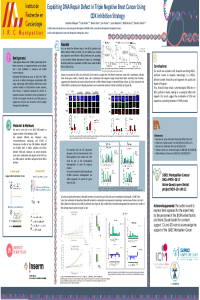
Triple-negative breast cancer (TNBC), representing 15% of breast carcinomas, is an aggressive breast cancer subtype with a high probability of metastasis and limited treatment options. Noticeably, BRCA-deficiency occurs in 25% of the TNBCs and results in deficient homologous recombination (HR) repair. Interestingly, PARP inhibitors (PARPi) have shown synthetic lethality in a BRCA-deficient context, however, their efficacy is frequently hampered by intrinsic or acquired resistance mechanisms involving restoration of the HR. In that regard, the role of some CDKs proven to regulate key HR actors was of interest to us.
We aim at understanding the rewiring pathways determining resistance to PARPi in BRCA-deficient cancers and assessing the role of transcriptional regulating CDKs such as CDK7, CDK9 or CDK12 in the transcriptional regulation of key HR genes. Our ultimate goal is to determine whether and which CDK inhibitors could be effective approaches to repress HR gene expression and induce pharmacological HR-deficiency. As such, these CDK-inhibitors could be molecules of choice allowing sensitization of tumors that would otherwise respond poorly to DNA damaging treatment. With this purpose, we use in vitro and in vivo (PDX) models of TNBC and study the attenuation of HR response in tumor cells and PDX models treated with CDK-inhibitors. Our final aim is to determine the most efficient combination CDK-I + PARP-I. Our HR read outs are RAD51 and BRCA1 foci formation upon PARP-I treatment. We also measure the modification of RNA and protein expression levels induced by CDK-I treatment on a series of diagnostic HR genes (BRCA2, PALB2, ATR, FAND2), as a measure of HR repression.
We will present data comparing the relative efficiency of 3 CDK-I, dinaciclib, NVP-2 and SR-4835, which have different specificities and inhibit different CDKs with variable efficacy.
Keywords
triple negativo breast cancer
targeted therapy
BRCAness
Manuscript
Velazquez et al Poster.pdf
Poster
sciforum-041976 .pdf
USP9X inhibition enhances radiosensitisation of head and neck cancer cells in response to high-LET radiation by destabilizing centrosome proteins
Targeting OGG1 as a Novel Anti-Cancer Strategy