Event submissions
EventsThe 1st International Electronic Conference on Cancers: Exploiting Cancer Vulnerability by Targeting the DNA Damage Response
Published

This submission belongs to the session 8. Poster of the event The 1st International Electronic Conference on Cancers: Exploiting Cancer Vulnerability by Targeting the DNA Damage Response
Published date
29 Jan, 2021
Citation
Bishoy M. F. Hanna, Torkild Visnes, Carlos Benitez-Buelga, Armando Cazares-Körner, Kumar Sanjiv, Oliver Mortusewicz, Geoffrey Masuyer, Olov Wallner, Maurice Michel, Olga Loseva, Ann-Sofie Jemth, Christina Kalderen, Pal Stenmark, Ulrika Warpman Berglund, Thomas Helleday, Targeting OGG1 as a Novel Anti-Cancer Strategy, in Proceedings of The 1st International Electronic Conference on Cancers: Exploiting Cancer Vulnerability by Targeting the DNA Damage Response, 1 February–14 February 2021, MDPI: Basel, Switzerland, doi: 10.3390/IECC2021-09213
Share
Email
Facebook
Twitter
LinkedIn
Targeting OGG1 as a Novel Anti-Cancer Strategy
'%3e%3cpath%20d='M12.6647%2010.9104C12.4176%2010.325%2012.0589%209.7933%2011.6088%209.34485C11.16%208.89511%2010.6283%208.53653%2010.0432%208.28891C10.038%208.28629%2010.0327%208.28498%2010.0275%208.28236C10.8437%207.69282%2011.3743%206.73252%2011.3743%205.64907C11.3743%203.85423%209.92005%202.40002%208.12522%202.40002C6.33038%202.40002%204.87618%203.85423%204.87618%205.64907C4.87618%206.73252%205.40677%207.69282%206.22296%208.28367C6.21772%208.28629%206.21248%208.2876%206.20724%208.29022C5.62031%208.53783%205.09365%208.89287%204.64167%209.34616C4.19192%209.79496%203.83334%2010.3266%203.58573%2010.9117C3.34247%2011.4846%203.21128%2012.0987%203.19925%2012.721C3.1989%2012.735%203.20135%2012.7489%203.20646%2012.7619C3.21157%2012.7749%203.21924%2012.7868%203.22901%2012.7968C3.23877%2012.8068%203.25045%2012.8148%203.26334%2012.8202C3.27623%2012.8256%203.29007%2012.8284%203.30406%2012.8284H4.09012C4.14776%2012.8284%204.19362%2012.7825%204.19493%2012.7262C4.22113%2011.7148%204.62726%2010.7676%205.34519%2010.0497C6.08802%209.30686%207.07452%208.89811%208.12522%208.89811C9.17592%208.89811%2010.1624%209.30686%2010.9052%2010.0497C11.6232%2010.7676%2012.0293%2011.7148%2012.0555%2012.7262C12.0568%2012.7839%2012.1027%2012.8284%2012.1603%2012.8284H12.9464C12.9604%2012.8284%2012.9742%2012.8256%2012.9871%2012.8202C13%2012.8148%2013.0117%2012.8068%2013.0214%2012.7968C13.0312%2012.7868%2013.0389%2012.7749%2013.044%2012.7619C13.0491%2012.7489%2013.0515%2012.735%2013.0512%2012.721C13.0381%2012.0947%2012.9084%2011.4856%2012.6647%2010.9104ZM8.12522%207.90243C7.52388%207.90243%206.95792%207.66793%206.53214%207.24215C6.10636%206.81636%205.87185%206.2504%205.87185%205.64907C5.87185%205.04773%206.10636%204.48177%206.53214%204.05599C6.95792%203.63021%207.52388%203.3957%208.12522%203.3957C8.72655%203.3957%209.29252%203.63021%209.7183%204.05599C10.1441%204.48177%2010.3786%205.04773%2010.3786%205.64907C10.3786%206.2504%2010.1441%206.81636%209.7183%207.24215C9.29252%207.66793%208.72655%207.90243%208.12522%207.90243Z'%20fill='%235D1EE1'/%3e%3c/g%3e%3c/svg%3e)
Bishoy M. F. Hanna 1
Torkild Visnes 1,2
Carlos Benitez-Buelga 1
Armando Cazares-Körner 1
Kumar Sanjiv 1
Oliver Mortusewicz 1
Geoffrey Masuyer 3,4
Olov Wallner 1
Maurice Michel 1
Olga Loseva 1
Ann-Sofie Jemth 1
Christina Kalderen 1
Pal Stenmark 3,5
Ulrika Warpman Berglund 1
Thomas Helleday 1,6
1. Science for Life Laboratory, Department of Oncology and Pathology, Karolinska Institutet, S-171 76 Stockholm, Sweden
2. Department of Biotechnology and Nanomedicine, SINTEF Industry, N-7465 Trondheim, Norway
3. Department of Biochemistry and Biophysics, Stockholm University, SE-106 91 Stockholm, Sweden
4. Department of Pharmacy and Pharmacology, Centre for Therapeutic Innovation. University of Bath, Bath BA2 7AY, UK
5. Department of Experimental Medical Science, Lund University, SE-221 00 Lund, Sweden
6. Weston Park Cancer Centre, Department of Oncology and Metabolism, University of Sheffield, Sheffield S10 2RX, UK
Abstract
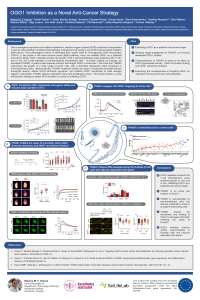
Due to oncogene expression and altered metabolism, reactive oxygen species (ROS) production is augmented in cancer cells resulting in oxidative DNA damage. 8‑oxoguanine (8-oxoG) is one of the most abundant oxidative DNA lesions. This premutagenic lesion is eliminated from duplex DNA by 8‑Oxoguanine DNA Glycosylase (OGG1), a key player in the base excision repair (BER) pathway. Here, we validate OGG1 as a potential anti-cancer target. OGG1 depletion impairs the growth of A3 T-cell lymphoblastic acute leukemia both in vitro and in vivo, but is well tolerated in non-transformed immortalized cells1. To further validate our findings, we developed TH5487, a potent small-molecule inhibitor that targets OGG1's active site [1,2]. We show that TH5487 suppresses the growth of a wide range of tumor cells, with a favorable therapeutic index compared to non‑transformed cells [1]. Mechanistically, TH5487 treatment inhibits the repair of potassium bromate-induced 8-oxo(d)G lesions, affects OGG1-chromatin dynamics, and hinders OGG1 recruitment to DNA damage regions [3]. Importantly, TH5487 induces replication stress and proliferation arrest1. This study presents a novel mechanistic strategy to exploit ROS elevation in cancer by inhibiting OGG1.
References:
- Visnes, T.; Benítez-Buelga, C.; Cázares-Körner, A.; Sanjiv, K.; Hanna, B.M.; Mortusewicz, O.; Rajagopal, V.; Albers, J.J.; Hagey, D.W.; Bekkhus, T. et al. Targeting OGG1 arrests cancer cell proliferation by inducing replication stress. Nucleic acids research 2020; 48, 12234–12251.
- Visnes, T.; Cázares-Körner, A.; Hao, W.; Wallner, O.; Masuyer, G.; Loseva, O.; Mortusewicz, O.; Wiita, E.; Sarno, A.; Manoilov, A. et al. Small-molecule inhibitor of OGG1 suppresses proinflammatory gene expression and inflammation. Science 2018, 362, 834–839.
- Hanna, B.M.F.; Helleday, T.; Mortusewicz, O. OGG1 inhibitor TH5487 alters OGG1 chromatin dynamics and prevents incisions. Biomolecules 2020, 10, 1–10.
Institutional Review Board Statement: The study was conducted according to the guidelines of the Declaration of Helsinki, and approved by approved by the regional experimental animal Ethical Committee in Stockholm 2010/63 (N8914)
Keywords
DNA damage response
oxidative DNA damage
base excision repair
OGG1 glycosylase
OGG1 inhibitor
TH5487
cancer
replication stress
Manuscript
msf-1292011-Abstract.pdf
Poster
Poster_proof.pdf
Exploiting DNA Repair Defect in Triple Negative Brest Cancer Using CDK Inhibition Strategy
Role of Mitotic slippage in cancer resistance and DNA damage response in the MDA-MB-231-DOX-Treated Cells