Event submissions
EventsThe 1st International Electronic Conference on Cancers: Exploiting Cancer Vulnerability by Targeting the DNA Damage Response
Published

This submission belongs to the session 8. Poster of the event The 1st International Electronic Conference on Cancers: Exploiting Cancer Vulnerability by Targeting the DNA Damage Response
Published date
31 Jan, 2021
Citation
Roberta Carriero, Lucia Maita, Silvia Bione, Giuseppe Biamonti, Alessandra Montecucco, LINP1 lncRNA expression profile is modulated in response to DNA damage, in Proceedings of The 1st International Electronic Conference on Cancers: Exploiting Cancer Vulnerability by Targeting the DNA Damage Response, 1 February–14 February 2021, MDPI: Basel, Switzerland, doi: 10.3390/IECC2021-09218
Share
Email
Facebook
Twitter
LinkedIn
LINP1 lncRNA expression profile is modulated in response to DNA damage
'%3e%3cpath%20d='M12.6647%2010.9104C12.4176%2010.325%2012.0589%209.7933%2011.6088%209.34485C11.16%208.89511%2010.6283%208.53653%2010.0432%208.28891C10.038%208.28629%2010.0327%208.28498%2010.0275%208.28236C10.8437%207.69282%2011.3743%206.73252%2011.3743%205.64907C11.3743%203.85423%209.92005%202.40002%208.12522%202.40002C6.33038%202.40002%204.87618%203.85423%204.87618%205.64907C4.87618%206.73252%205.40677%207.69282%206.22296%208.28367C6.21772%208.28629%206.21248%208.2876%206.20724%208.29022C5.62031%208.53783%205.09365%208.89287%204.64167%209.34616C4.19192%209.79496%203.83334%2010.3266%203.58573%2010.9117C3.34247%2011.4846%203.21128%2012.0987%203.19925%2012.721C3.1989%2012.735%203.20135%2012.7489%203.20646%2012.7619C3.21157%2012.7749%203.21924%2012.7868%203.22901%2012.7968C3.23877%2012.8068%203.25045%2012.8148%203.26334%2012.8202C3.27623%2012.8256%203.29007%2012.8284%203.30406%2012.8284H4.09012C4.14776%2012.8284%204.19362%2012.7825%204.19493%2012.7262C4.22113%2011.7148%204.62726%2010.7676%205.34519%2010.0497C6.08802%209.30686%207.07452%208.89811%208.12522%208.89811C9.17592%208.89811%2010.1624%209.30686%2010.9052%2010.0497C11.6232%2010.7676%2012.0293%2011.7148%2012.0555%2012.7262C12.0568%2012.7839%2012.1027%2012.8284%2012.1603%2012.8284H12.9464C12.9604%2012.8284%2012.9742%2012.8256%2012.9871%2012.8202C13%2012.8148%2013.0117%2012.8068%2013.0214%2012.7968C13.0312%2012.7868%2013.0389%2012.7749%2013.044%2012.7619C13.0491%2012.7489%2013.0515%2012.735%2013.0512%2012.721C13.0381%2012.0947%2012.9084%2011.4856%2012.6647%2010.9104ZM8.12522%207.90243C7.52388%207.90243%206.95792%207.66793%206.53214%207.24215C6.10636%206.81636%205.87185%206.2504%205.87185%205.64907C5.87185%205.04773%206.10636%204.48177%206.53214%204.05599C6.95792%203.63021%207.52388%203.3957%208.12522%203.3957C8.72655%203.3957%209.29252%203.63021%209.7183%204.05599C10.1441%204.48177%2010.3786%205.04773%2010.3786%205.64907C10.3786%206.2504%2010.1441%206.81636%209.7183%207.24215C9.29252%207.66793%208.72655%207.90243%208.12522%207.90243Z'%20fill='%235D1EE1'/%3e%3c/g%3e%3c/svg%3e)
Roberta Carriero 1
Lucia Maita 1
Silvia Bione 1

Giuseppe Biamonti 1
Alessandra Montecucco 1
1. Istituto di Genetica Molecolare CNR
Abstract
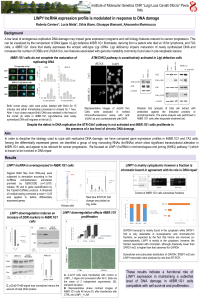
Rapidly dividing cancer cells show elevated levels of DNA double-strand breaks (DSBs) resulting from replication stress and linked to genome instability. To verify the hypothesis that a low level of endogenous replicative DNA damage may impact gene expression programs and cell biology features relevant to cancer progression, we used DNA ligase I (LigI) defective 46BR.1G1 fibroblasts, deriving from a patient who died at 19 for lymphoma, and the 7A3 cell clone, obtained from 46BR.1G1 by stably expressing ectopic wild-type LigI. LigI deficiency impairs maturation of newly synthesized DNA and increases the number of DSBs and γH2AX foci, features associated with genome instability commonly found also in pre-neoplastic lesions. In order to decipher the strategy used to cope with replicative DNA damage, we have compared gene expression profiles in 46BR.1G1 and 7A3 cells. Among the differentially expressed genes, we identified a group of long noncoding RNAs (lncRNAs) which show significant transcriptional alteration in 46BR.1G1 cells, and appear to be relevant for cancer progression. An interesting up-regulated lncRNA in 46BR.1G1 cells is LINP1 (lncRNA in nonhomologous end joining (NHEJ) pathway 1) which has been shown to be involved in DNA repair. We have observed that LINP1 up-regulation contributes to proliferation and survival of 46BR.1G1 that could account for genome instability. Moreover, we observed that LINP1 is upregulated at later times in control human fibroblasts exposed to exogenous sources of DNA damage. Our observations support the notion that LINP1 lncRNA targeting could reduce the DNA repair efficacy of tumour cells.
* These authors contributed equally to this work.
Keywords
DDR
lncRNA
DNA replication
DNA Ligase I
Manuscript
Carriero et al._Poster.pdf
Poster
sciforum-041679.pdf
Electrochemical behavior of Methotrexate upon binding to the DNA of different cell lines
Space and time in the universe of the cell nucleus after ionizing radiation attacks: a comparison of cancer and non-cancer cell response