Event submissions
EventsThe 1st International Electronic Conference on Cancers: Exploiting Cancer Vulnerability by Targeting the DNA Damage Response
Published

This submission belongs to the session 8. Poster of the event The 1st International Electronic Conference on Cancers: Exploiting Cancer Vulnerability by Targeting the DNA Damage Response
Published date
31 Jan, 2021
Citation
Meysam Khosravifarsani, Samia Ait-mohand, Benoit Paquette, Léon Sanche, Brigitte Guérin, The cytotoxic effect of ⁶⁴Cu/NOTA-terpyridine platinum conjugate, as a novel chemoradiotherapy agent, in Proceedings of The 1st International Electronic Conference on Cancers: Exploiting Cancer Vulnerability by Targeting the DNA Damage Response, 1 February–14 February 2021, MDPI: Basel, Switzerland, doi: 10.3390/IECC2021-09220
Share
Email
Facebook
Twitter
LinkedIn
The cytotoxic effect of 64Cu/NOTA-terpyridine platinum conjugate, as a novel chemoradiotherapy agent
'%3e%3cpath%20d='M12.6647%2010.9104C12.4176%2010.325%2012.0589%209.7933%2011.6088%209.34485C11.16%208.89511%2010.6283%208.53653%2010.0432%208.28891C10.038%208.28629%2010.0327%208.28498%2010.0275%208.28236C10.8437%207.69282%2011.3743%206.73252%2011.3743%205.64907C11.3743%203.85423%209.92005%202.40002%208.12522%202.40002C6.33038%202.40002%204.87618%203.85423%204.87618%205.64907C4.87618%206.73252%205.40677%207.69282%206.22296%208.28367C6.21772%208.28629%206.21248%208.2876%206.20724%208.29022C5.62031%208.53783%205.09365%208.89287%204.64167%209.34616C4.19192%209.79496%203.83334%2010.3266%203.58573%2010.9117C3.34247%2011.4846%203.21128%2012.0987%203.19925%2012.721C3.1989%2012.735%203.20135%2012.7489%203.20646%2012.7619C3.21157%2012.7749%203.21924%2012.7868%203.22901%2012.7968C3.23877%2012.8068%203.25045%2012.8148%203.26334%2012.8202C3.27623%2012.8256%203.29007%2012.8284%203.30406%2012.8284H4.09012C4.14776%2012.8284%204.19362%2012.7825%204.19493%2012.7262C4.22113%2011.7148%204.62726%2010.7676%205.34519%2010.0497C6.08802%209.30686%207.07452%208.89811%208.12522%208.89811C9.17592%208.89811%2010.1624%209.30686%2010.9052%2010.0497C11.6232%2010.7676%2012.0293%2011.7148%2012.0555%2012.7262C12.0568%2012.7839%2012.1027%2012.8284%2012.1603%2012.8284H12.9464C12.9604%2012.8284%2012.9742%2012.8256%2012.9871%2012.8202C13%2012.8148%2013.0117%2012.8068%2013.0214%2012.7968C13.0312%2012.7868%2013.0389%2012.7749%2013.044%2012.7619C13.0491%2012.7489%2013.0515%2012.735%2013.0512%2012.721C13.0381%2012.0947%2012.9084%2011.4856%2012.6647%2010.9104ZM8.12522%207.90243C7.52388%207.90243%206.95792%207.66793%206.53214%207.24215C6.10636%206.81636%205.87185%206.2504%205.87185%205.64907C5.87185%205.04773%206.10636%204.48177%206.53214%204.05599C6.95792%203.63021%207.52388%203.3957%208.12522%203.3957C8.72655%203.3957%209.29252%203.63021%209.7183%204.05599C10.1441%204.48177%2010.3786%205.04773%2010.3786%205.64907C10.3786%206.2504%2010.1441%206.81636%209.7183%207.24215C9.29252%207.66793%208.72655%207.90243%208.12522%207.90243Z'%20fill='%235D1EE1'/%3e%3c/g%3e%3c/svg%3e)
Meysam Khosravifarsani 1
Samia Ait-mohand 1
Benoit Paquette 1
Léon Sanche 1
Brigitte Guérin 1,2
1. Department of Nuclear Medicine and Radiobiology, Faculty of Medicine and Health Sciences, Université de Sherbrooke, Sherbrooke, QC, Canada
2. Sherbrooke Molecular Imaging Center (CIMS) of the CRCHUS, 3001, 12e Avenue Nord, Sherbrooke, QC, Canada
Abstract
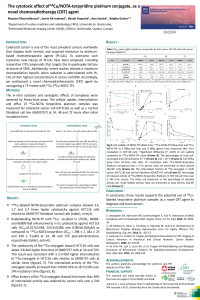
Colorectal cancer is one of the most prevalent cancers worldwide that displays both intrinsic and acquired resistance to platinum-based chemotherapeutic agents (Pt-CAs). To overcome such resistance, new classes of Pt-CAs have been proposed, including terpyridine (TP) compounds that targets the G-quadruplex tertiary structure of DNA. Additionally, recent studies indicate a maximum chemoradiation benefit, when radiation is administered with Pt-CAs at their highest concentrations in cancer cell DNA. Accordingly, we synthesized a novel chemoradiotheranostic agent by conjugating a TP moiety with 64Cu (64Cu-NOTA-TP). The in-vitro cytotoxic effects, cellular uptake, internalization and efflux of 64Cu-NOTA-TP was measured for a colorectal cancer (HCT116) and normal fibroblast (GM05757) cells. Radiolabelling NOTA-TP with 64Cu resulted in 17530-, 40083- and 66000-fold enhancements in its cytotoxicity against HCT116 cells (EC50=0.017±0.004, 0.012±0.006 and 0.005±0.0002µM) as compared to coldCu-NOTA-terpyridine (EC50 = 298 ± 2, 481 ± 25 and 330 ± 51µM) at 24, 48 and 72h post-administration, respectively. More importantly, the cytotoxicity of the 64Cu-conjugate toward the HCT116 cells was about 3.8-fold higher than that of GM05757 cells at 24 and 72h. This result was consistent with a 2-3-fold higher internalization of 64Cu-conjugate in HCT116 cells relative to GM05757 cells at similar times. The internalized activity of the 64Cu-conjugate steadily increased from 0.04 ± 0.02% to 18.7±2.8% over 24h incubation time. Moreover, efflux kinetics of the 64Cu-conjugate showed that more than 40% of internalized activity was retained by cancer cells over a 24h. In conclusion, this work presents a novel chemoradiotherapeutic agent with considerable potential for targeted cancer treatment combined with radioisotope imaging.
Keywords
Colorectal cancer
Terpyridine (TP) compounds
Platinum-based chemotherapeutic agents
Chemoradiotherapeutic agent
Cytotoxicity
Manuscript
sciforum-041834-Poster for IECC2021.pdf
Poster
sciforum-041834-Poster for IECC2021.pdf
Space and time in the universe of the cell nucleus after ionizing radiation attacks: a comparison of cancer and non-cancer cell response
Heterogeneity of biomarker expression in clinical urine biopsies