Event submissions
EventsThe 1st International Electronic Conference on Cancers: Exploiting Cancer Vulnerability by Targeting the DNA Damage Response
Published

This submission belongs to the session 8. Poster of the event The 1st International Electronic Conference on Cancers: Exploiting Cancer Vulnerability by Targeting the DNA Damage Response
Published date
31 Jan, 2021
Citation
Jacqueline Nathansen, Vasyl Lukiyanchuk, Linda Hein, Maya-Isabell Stolte, Kerstin Borgmann, Steffen Löck, Ina Kurth, Mechthild Krause, Annett Linge, Anna Dubrovska, The pluripotency transcription factor Oct4 contributes to head and neck squamous cell carcinoma radioresistance via regulation of DNA repair and the stem cell phenotype, in Proceedings of The 1st International Electronic Conference on Cancers: Exploiting Cancer Vulnerability by Targeting the DNA Damage Response, 1 February–14 February 2021, MDPI: Basel, Switzerland, doi: 10.3390/IECC2021-09224
Share
Email
Facebook
Twitter
LinkedIn
The pluripotency transcription factor Oct4 contributes to head and neck squamous cell carcinoma radioresistance via regulation of DNA repair and the stem cell phenotype
'%3e%3cpath%20d='M12.6647%2010.9104C12.4176%2010.325%2012.0589%209.7933%2011.6088%209.34485C11.16%208.89511%2010.6283%208.53653%2010.0432%208.28891C10.038%208.28629%2010.0327%208.28498%2010.0275%208.28236C10.8437%207.69282%2011.3743%206.73252%2011.3743%205.64907C11.3743%203.85423%209.92005%202.40002%208.12522%202.40002C6.33038%202.40002%204.87618%203.85423%204.87618%205.64907C4.87618%206.73252%205.40677%207.69282%206.22296%208.28367C6.21772%208.28629%206.21248%208.2876%206.20724%208.29022C5.62031%208.53783%205.09365%208.89287%204.64167%209.34616C4.19192%209.79496%203.83334%2010.3266%203.58573%2010.9117C3.34247%2011.4846%203.21128%2012.0987%203.19925%2012.721C3.1989%2012.735%203.20135%2012.7489%203.20646%2012.7619C3.21157%2012.7749%203.21924%2012.7868%203.22901%2012.7968C3.23877%2012.8068%203.25045%2012.8148%203.26334%2012.8202C3.27623%2012.8256%203.29007%2012.8284%203.30406%2012.8284H4.09012C4.14776%2012.8284%204.19362%2012.7825%204.19493%2012.7262C4.22113%2011.7148%204.62726%2010.7676%205.34519%2010.0497C6.08802%209.30686%207.07452%208.89811%208.12522%208.89811C9.17592%208.89811%2010.1624%209.30686%2010.9052%2010.0497C11.6232%2010.7676%2012.0293%2011.7148%2012.0555%2012.7262C12.0568%2012.7839%2012.1027%2012.8284%2012.1603%2012.8284H12.9464C12.9604%2012.8284%2012.9742%2012.8256%2012.9871%2012.8202C13%2012.8148%2013.0117%2012.8068%2013.0214%2012.7968C13.0312%2012.7868%2013.0389%2012.7749%2013.044%2012.7619C13.0491%2012.7489%2013.0515%2012.735%2013.0512%2012.721C13.0381%2012.0947%2012.9084%2011.4856%2012.6647%2010.9104ZM8.12522%207.90243C7.52388%207.90243%206.95792%207.66793%206.53214%207.24215C6.10636%206.81636%205.87185%206.2504%205.87185%205.64907C5.87185%205.04773%206.10636%204.48177%206.53214%204.05599C6.95792%203.63021%207.52388%203.3957%208.12522%203.3957C8.72655%203.3957%209.29252%203.63021%209.7183%204.05599C10.1441%204.48177%2010.3786%205.04773%2010.3786%205.64907C10.3786%206.2504%2010.1441%206.81636%209.7183%207.24215C9.29252%207.66793%208.72655%207.90243%208.12522%207.90243Z'%20fill='%235D1EE1'/%3e%3c/g%3e%3c/svg%3e)
Jacqueline Nathansen 1,2
Vasyl Lukiyanchuk 1,2
Linda Hein 1
Maya-Isabell Stolte 3

Kerstin Borgmann 3
Steffen Löck 1,4,5
Ina Kurth 1,6
Mechthild Krause 1,2,4,5,7
Annett Linge 1,4,5,7

Anna Dubrovska 1,2,4,7
1. 1 OncoRay–National Center for Radiation Research in Oncology, Faculty of Medicine and University Hospital Carl Gustav Carus, Technische Universität Dresden, Helmholtz-Zentrum Dresden-Rossendorf, Dresden, Germany.
2. 2 Helmholtz-Zentrum Dresden-Rossendorf, Institute of Radiooncology-OncoRay, Dresden, Germany.
3. 3 Laboratory of Radiobiology and Experimental Radiooncology, Center of Oncology, University Medical Center Hamburg-Eppendorf, Hamburg, Germany.
4. 4 German Cancer Consortium (DKTK), partner site Dresden and German Cancer Research Center (DKFZ), Heidelberg, Germany.
5. 5 Department of Radiotherapy and Radiation Oncology, Faculty of Medicine and University Hospital Carl Gustav Carus, Technische Universität Dresden, Dresden, Germany.
6. 6 German Cancer Research Center (DKFZ), Heidelberg, Germany.
7. 7 National Center for Tumor Diseases (NCT), partner site Dresden: German Cancer Research Center (DKFZ), Heidelberg; Faculty of Medicine and University Hospital Carl Gustav Carus, Technische Universität Dresden, and Helmholtz-Zentrum Dresden-Rossendorf (HZ
Abstract
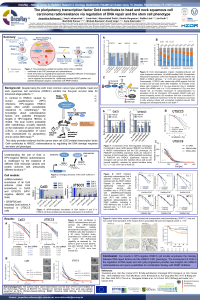
Despite being the sixth most common cancer type worldwide, head and neck squamous cell carcinoma (HNSCC) exhibits low five-year survival rates for advanced-stage patients. The local control probability after radiotherapy crucially depends on the eradication of cancer stem cells (CSCs). This pluripotent sub-population of tumor cells is characterized by an active DNA repair and, consequently, an enhanced radio(chemo)therapy resistance. This study provides evidence that the CSC-related transcription factor Oct4 contributes to HNSCC radioresistance by regulating the DNA damage response and stem cell phenotype.
In a siRNA-mediated Oct4 knockdown model, we observed reduced self-renewal capacity and partial radiosensitization of HNSCC cell lines accompanied by decreased expression of the cell cycle checkpoint kinases Chk-1 and WEE1. Consequently, Oct4 knockdown impaired the G2 checkpoint induction after irradiation, linking Oct4 to the HNSCC DNA damage response. Upon CRISPR/Cas9-mediated knockout of the pluripotency-related isoform Oct4 A, radiosensitization of HNSCC cells could only be achieved in combination treatment with the PARP inhibitor Olaparib. In addition, irradiation-induced up-regulation of DNA repair genes, like the homologous recombination repair (HRR) gene BRCA1, was abolished in Oct4 A knockout cells, indicating that Oct4 A depletion leads to HRR deficiency in HNSCC cells.
Further analysis of the Oct4-correlating gene signature in the HNSCC TCGA patient dataset identified the HRR genes PSMC3IP and RAD54L showing a significant correlation with the overall survival of radiotherapy-treated HNSCC patients. siRNA-mediated knockdown of PSMC3IP and RAD54L reduced the HNSCC self-renewal capacity and clonogenic cell survival after irradiation, emphasizing the interplay between DNA repair and the CSC phenotype in HNSCC radioresistance mechanisms.
All in all, the involvement of Oct4 in the regulation of DNA repair and cell cycle progression provides new insights into HNSCC radioresistance and opens possibilities for combination therapy with PARP inhibitors.
Keywords
HNSCC
radiotherapy
Oct4
CSC
HRR
Manuscript
sciforum-041950.pdf
Poster
sciforum-041950.pdf
Interplay between cellular metabolism and the DNA damage response
Determination of the effect of selected low fluoride concentrations on migratory abilities of human glioma U-87MG cell line.