Event submissions
EventsThe 1st International Electronic Conference on Cancers: Exploiting Cancer Vulnerability by Targeting the DNA Damage Response
Published

This submission belongs to the session 8. Poster of the event The 1st International Electronic Conference on Cancers: Exploiting Cancer Vulnerability by Targeting the DNA Damage Response
Published date
31 Jan, 2021
Citation
Wojciech Żwierełło, Marta Skórka-Majewicz, Justyna Antoniewicz, Konrad Grzeszczak, Karolina Rogulska, Agnieszka Maruszewska, Determination of the effect of selected low fluoride concentrations on migratory abilities of human glioma U-87MG cell line., in Proceedings of The 1st International Electronic Conference on Cancers: Exploiting Cancer Vulnerability by Targeting the DNA Damage Response, 1 February–14 February 2021, MDPI: Basel, Switzerland, doi: 10.3390/IECC2021-09225
Share
Email
Facebook
Twitter
LinkedIn
Determination of the effect of selected low fluoride concentrations on migratory abilities of human glioma U-87MG cell line.

Wojciech Żwierełło 1
'%3e%3cpath%20d='M12.6647%2010.9104C12.4176%2010.325%2012.0589%209.7933%2011.6088%209.34485C11.16%208.89511%2010.6283%208.53653%2010.0432%208.28891C10.038%208.28629%2010.0327%208.28498%2010.0275%208.28236C10.8437%207.69282%2011.3743%206.73252%2011.3743%205.64907C11.3743%203.85423%209.92005%202.40002%208.12522%202.40002C6.33038%202.40002%204.87618%203.85423%204.87618%205.64907C4.87618%206.73252%205.40677%207.69282%206.22296%208.28367C6.21772%208.28629%206.21248%208.2876%206.20724%208.29022C5.62031%208.53783%205.09365%208.89287%204.64167%209.34616C4.19192%209.79496%203.83334%2010.3266%203.58573%2010.9117C3.34247%2011.4846%203.21128%2012.0987%203.19925%2012.721C3.1989%2012.735%203.20135%2012.7489%203.20646%2012.7619C3.21157%2012.7749%203.21924%2012.7868%203.22901%2012.7968C3.23877%2012.8068%203.25045%2012.8148%203.26334%2012.8202C3.27623%2012.8256%203.29007%2012.8284%203.30406%2012.8284H4.09012C4.14776%2012.8284%204.19362%2012.7825%204.19493%2012.7262C4.22113%2011.7148%204.62726%2010.7676%205.34519%2010.0497C6.08802%209.30686%207.07452%208.89811%208.12522%208.89811C9.17592%208.89811%2010.1624%209.30686%2010.9052%2010.0497C11.6232%2010.7676%2012.0293%2011.7148%2012.0555%2012.7262C12.0568%2012.7839%2012.1027%2012.8284%2012.1603%2012.8284H12.9464C12.9604%2012.8284%2012.9742%2012.8256%2012.9871%2012.8202C13%2012.8148%2013.0117%2012.8068%2013.0214%2012.7968C13.0312%2012.7868%2013.0389%2012.7749%2013.044%2012.7619C13.0491%2012.7489%2013.0515%2012.735%2013.0512%2012.721C13.0381%2012.0947%2012.9084%2011.4856%2012.6647%2010.9104ZM8.12522%207.90243C7.52388%207.90243%206.95792%207.66793%206.53214%207.24215C6.10636%206.81636%205.87185%206.2504%205.87185%205.64907C5.87185%205.04773%206.10636%204.48177%206.53214%204.05599C6.95792%203.63021%207.52388%203.3957%208.12522%203.3957C8.72655%203.3957%209.29252%203.63021%209.7183%204.05599C10.1441%204.48177%2010.3786%205.04773%2010.3786%205.64907C10.3786%206.2504%2010.1441%206.81636%209.7183%207.24215C9.29252%207.66793%208.72655%207.90243%208.12522%207.90243Z'%20fill='%235D1EE1'/%3e%3c/g%3e%3c/svg%3e)
Marta Skórka-Majewicz 1
Justyna Antoniewicz 2
Konrad Grzeszczak 3
Karolina Rogulska 4
Agnieszka Maruszewska 5,6
1. Department of Medical Chemistry, Pomeranian Medical University in Szczecin, Powst. Wlkp. 72, Szczecin 70-111, Poland
2. Department of Human Nutrition and Metabolomics, Pomeranian Medical University in Szczecin, Broniewskiego 24, Szczecin 71-460, Poland
3. Department of Biology and Medical Parasitology, Pomeranian Medical University in Szczecin, Powstańców Wielkopolskich 72, 70-111 Szczecin, Poland
4. Department of Microbiology, Immunology and Laboratory Medicine, Pomeranian Medical University, Powstańców Wlkp. 72, 70-111 Szczecin, Poland.
5. Institute of Biology, University of Szczecin, 3c Felczaka St., Szczecin 71-412, Poland
6. Molecular Biology and Biotechnology Center, Institute of Biology, University of Szczecin, 13 Wąska St, Szczecin 71-415, Poland
Abstract
Introduction
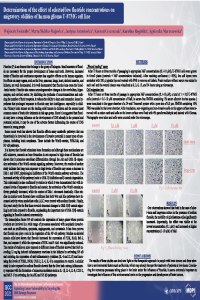
Fluorine (F) is an element that belongs to the group of halogens. Small amounts of fluoride are necessary for the proper development of bones and teeth. However, increased intake of fluorine and continuous exposure has negative effects on the human organism. Some recent works have shown that fluoride affects many metabolic pathways that can theoretically be involved in the development of invasive potential in many types of cancers, including brain neoplasms. In light of recent studies, the influence of fluoride on the invasiveness of cancer cells seems highly probable but is practically unexplored.
Methods
„Wound healing” assay
After 72 hours or three months of passaging in appropriate NaF concentrations (0.1-10 µM), U-87MG cells were grown in 6-well plates (controls + NaF concentrations indicated). After reaching confluence (~ 80%), the cell layers were scratched with 200 µl pipette tips and washed with PBS to remove cell debris. Fresh medium without serum was added to each well and the wound closure was visualized at 0, 3, 6, 12, and 24 hours using a microscope.
Cell migration test
After 72 hours or three months of passage in appropriate NaF concentrations (0.1-10 µM), a total of 1 × 10⁵ U-87MG cells (controls + 0.1-10 µM concentration of NaF, in serum-free EMEM containing 1% serum albumin bovine species ) were inoculated in the upper chamber of a 24-well Transwell system with a pore size of 8.0 µm. EMEM containing 10% FBS was added to the lower chamber. After incubation, non-migrating and non-invasive cells on the upper surface were removed with a cotton swab and cells on the lower surface were fixed with 4% paraformaldehyde and stained with Giemsa. Photographs were taken and cells were counted under the microscope.
Results
Our observations showed that both in the case of short-term and long-term culture in the presence of sodium fluoride, the mobility of glioblastoma cells significantly increased. Importantly, the effect was visible at the lowest concentration (0.1 µM ) and increased at higher concentrations (1-10 µM) of NaF.
Conclusions
The results of these studies can shed new light on the therapeutic approach in people with brain tumors and draw attention to environmental factors such as fluoride, which may already hamper the treatment of patients at low doses. Considering the numerous processes taking place in the brain under the influence of fluoride, it seems extremely important to investigate the influence of this environmental toxin on the progression and development of brain tumors.
Keywords
glioblastoma
fluoride
migration
U-87MG
Manuscript
zwierello.poster.iecc2021.pdf
Poster
sciforum-042701.pdf
The pluripotency transcription factor Oct4 contributes to head and neck squamous cell carcinoma radioresistance via regulation of DNA repair and the stem cell phenotype
Exploring sensitivity to replicative stress in BRCA deficient Triple Negative Breast Cancer