Event submissions
EventsThe 1st International Electronic Conference on Cancers: Exploiting Cancer Vulnerability by Targeting the DNA Damage Response
Published

This submission belongs to the session 8. Poster of the event The 1st International Electronic Conference on Cancers: Exploiting Cancer Vulnerability by Targeting the DNA Damage Response
Published date
31 Jan, 2021
Citation
Helge Gad, Zhao Zhenjun, Carlos Benitez-Buelga, Kumar Sanjiv, Hua Xiangwei, He Kang, Feng Mingxuan, Zhao Zhicong, Ulrika Warpman Berglund, Xia Qiang, Thomas Helleday, NEIL3-mediated mitotic base excision repair of oxidative lesions at telomeres prevents senescence in hepatocellular carcinoma, in Proceedings of The 1st International Electronic Conference on Cancers: Exploiting Cancer Vulnerability by Targeting the DNA Damage Response, 1 February–14 February 2021, MDPI: Basel, Switzerland, doi: 10.3390/IECC2021-09227
Share
Email
Facebook
Twitter
LinkedIn
NEIL3-mediated mitotic base excision repair of oxidative lesions at telomeres prevents senescence in hepatocellular carcinoma
'%3e%3cpath%20d='M12.6647%2010.9104C12.4176%2010.325%2012.0589%209.7933%2011.6088%209.34485C11.16%208.89511%2010.6283%208.53653%2010.0432%208.28891C10.038%208.28629%2010.0327%208.28498%2010.0275%208.28236C10.8437%207.69282%2011.3743%206.73252%2011.3743%205.64907C11.3743%203.85423%209.92005%202.40002%208.12522%202.40002C6.33038%202.40002%204.87618%203.85423%204.87618%205.64907C4.87618%206.73252%205.40677%207.69282%206.22296%208.28367C6.21772%208.28629%206.21248%208.2876%206.20724%208.29022C5.62031%208.53783%205.09365%208.89287%204.64167%209.34616C4.19192%209.79496%203.83334%2010.3266%203.58573%2010.9117C3.34247%2011.4846%203.21128%2012.0987%203.19925%2012.721C3.1989%2012.735%203.20135%2012.7489%203.20646%2012.7619C3.21157%2012.7749%203.21924%2012.7868%203.22901%2012.7968C3.23877%2012.8068%203.25045%2012.8148%203.26334%2012.8202C3.27623%2012.8256%203.29007%2012.8284%203.30406%2012.8284H4.09012C4.14776%2012.8284%204.19362%2012.7825%204.19493%2012.7262C4.22113%2011.7148%204.62726%2010.7676%205.34519%2010.0497C6.08802%209.30686%207.07452%208.89811%208.12522%208.89811C9.17592%208.89811%2010.1624%209.30686%2010.9052%2010.0497C11.6232%2010.7676%2012.0293%2011.7148%2012.0555%2012.7262C12.0568%2012.7839%2012.1027%2012.8284%2012.1603%2012.8284H12.9464C12.9604%2012.8284%2012.9742%2012.8256%2012.9871%2012.8202C13%2012.8148%2013.0117%2012.8068%2013.0214%2012.7968C13.0312%2012.7868%2013.0389%2012.7749%2013.044%2012.7619C13.0491%2012.7489%2013.0515%2012.735%2013.0512%2012.721C13.0381%2012.0947%2012.9084%2011.4856%2012.6647%2010.9104ZM8.12522%207.90243C7.52388%207.90243%206.95792%207.66793%206.53214%207.24215C6.10636%206.81636%205.87185%206.2504%205.87185%205.64907C5.87185%205.04773%206.10636%204.48177%206.53214%204.05599C6.95792%203.63021%207.52388%203.3957%208.12522%203.3957C8.72655%203.3957%209.29252%203.63021%209.7183%204.05599C10.1441%204.48177%2010.3786%205.04773%2010.3786%205.64907C10.3786%206.2504%2010.1441%206.81636%209.7183%207.24215C9.29252%207.66793%208.72655%207.90243%208.12522%207.90243Z'%20fill='%235D1EE1'/%3e%3c/g%3e%3c/svg%3e)
Helge Gad 1,2
Zhao Zhenjun 3
Carlos Benitez-Buelga 2
Kumar Sanjiv 2
Hua Xiangwei 4
He Kang 3
Feng Mingxuan 3
Zhao Zhicong 3
Ulrika Warpman Berglund 2
Xia Qiang 3
Thomas Helleday 1,2
1. Weston Park Cancer Centre, Department of Oncology and Metabolism, University of Sheffield, Sheffield S10 2RX, UK.
2. Science for Life Laboratory, Department of Oncology-Pathology, Karolinska Institutet, S-171 76 Stockholm, Sweden.
3. Department of Liver Surgery, Renji Hospital, School of Medicine, Shanghai Jiao Tong University, Shanghai, China.
4. Organ Transplantation Center, the Affiliated Hospital of Qingdao University, Qingdao, China
Abstract
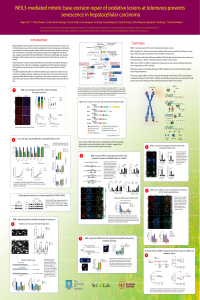
While the repair of DNA double-strand breaks is known to be confined to different phases of the cell cycle and differentially activated at telomeres, less is known of compartmentalisation of base excision repair (BER). Here, we report that Endonuclease VIII like protein 3 (NEIL3) relocates to telomeres following oxidative DNA damage specifically during mitosis and recruits the APE1 to damaged telomeres. Using META-FISH, we demonstrate that NEIL3, but not NEIL1 or NEIL2, is required to initiate base excision repair at oxidised telomeres in mitotic cells, a process dependent on APE1 and Polβ. Repetitive exposure of oxidizing damage in NEIL3 depleted cells induced chromatin bridges and damaged telomeres. Interestingly, we identify that NEIL3 is elevated in Hepatocellular carcinoma (HCC), the most common type of a liver cancer, which correlates with poor survival. We demonstrate that HCC cell lines (6/6) depend on NEIL3 catalytic activity for survival and prevention of senescence, which is not the case for non-transformed cells where NEIL3 is dispensable. In conclusion, we demonstrate a novel function for NEIL3 in repair of oxidative DNA damage at telomeres in mitosis which is important to prevent senescence of HCC. Furthermore, these data suggest NEIL3 could be a target for therapeutic intervention of HCC.
Keywords
DNA repair
mitotic base excision repair
NEIL3
hepatocellular carcinoma
oxidative stress
mitosis
Manuscript
Poster Gad et al 200121.pdf
Poster
sciforum-042613.pdf
Exploring sensitivity to replicative stress in BRCA deficient Triple Negative Breast Cancer
Does the modification of serine 477 of DNA mismatch repair protein MLH1 play a role in cell proliferation?