Event submissions
EventsThe 1st International Electronic Conference on Cancers: Exploiting Cancer Vulnerability by Targeting the DNA Damage Response
Published

This submission belongs to the session 8. Poster of the event The 1st International Electronic Conference on Cancers: Exploiting Cancer Vulnerability by Targeting the DNA Damage Response
Published date
31 Jan, 2021
Citation
PD Dr. Angela Brieger, May-Britt Firnau, Does the modification of serine 477 of DNA mismatch repair protein MLH1 play a role in cell proliferation?, in Proceedings of The 1st International Electronic Conference on Cancers: Exploiting Cancer Vulnerability by Targeting the DNA Damage Response, 1 February–14 February 2021, MDPI: Basel, Switzerland, doi: 10.3390/IECC2021-09228
Share
Email
Facebook
Twitter
LinkedIn
Does the modification of serine 477 of DNA mismatch repair protein MLH1 play a role in cell proliferation?
'%3e%3cpath%20d='M12.6647%2010.9104C12.4176%2010.325%2012.0589%209.7933%2011.6088%209.34485C11.16%208.89511%2010.6283%208.53653%2010.0432%208.28891C10.038%208.28629%2010.0327%208.28498%2010.0275%208.28236C10.8437%207.69282%2011.3743%206.73252%2011.3743%205.64907C11.3743%203.85423%209.92005%202.40002%208.12522%202.40002C6.33038%202.40002%204.87618%203.85423%204.87618%205.64907C4.87618%206.73252%205.40677%207.69282%206.22296%208.28367C6.21772%208.28629%206.21248%208.2876%206.20724%208.29022C5.62031%208.53783%205.09365%208.89287%204.64167%209.34616C4.19192%209.79496%203.83334%2010.3266%203.58573%2010.9117C3.34247%2011.4846%203.21128%2012.0987%203.19925%2012.721C3.1989%2012.735%203.20135%2012.7489%203.20646%2012.7619C3.21157%2012.7749%203.21924%2012.7868%203.22901%2012.7968C3.23877%2012.8068%203.25045%2012.8148%203.26334%2012.8202C3.27623%2012.8256%203.29007%2012.8284%203.30406%2012.8284H4.09012C4.14776%2012.8284%204.19362%2012.7825%204.19493%2012.7262C4.22113%2011.7148%204.62726%2010.7676%205.34519%2010.0497C6.08802%209.30686%207.07452%208.89811%208.12522%208.89811C9.17592%208.89811%2010.1624%209.30686%2010.9052%2010.0497C11.6232%2010.7676%2012.0293%2011.7148%2012.0555%2012.7262C12.0568%2012.7839%2012.1027%2012.8284%2012.1603%2012.8284H12.9464C12.9604%2012.8284%2012.9742%2012.8256%2012.9871%2012.8202C13%2012.8148%2013.0117%2012.8068%2013.0214%2012.7968C13.0312%2012.7868%2013.0389%2012.7749%2013.044%2012.7619C13.0491%2012.7489%2013.0515%2012.735%2013.0512%2012.721C13.0381%2012.0947%2012.9084%2011.4856%2012.6647%2010.9104ZM8.12522%207.90243C7.52388%207.90243%206.95792%207.66793%206.53214%207.24215C6.10636%206.81636%205.87185%206.2504%205.87185%205.64907C5.87185%205.04773%206.10636%204.48177%206.53214%204.05599C6.95792%203.63021%207.52388%203.3957%208.12522%203.3957C8.72655%203.3957%209.29252%203.63021%209.7183%204.05599C10.1441%204.48177%2010.3786%205.04773%2010.3786%205.64907C10.3786%206.2504%2010.1441%206.81636%209.7183%207.24215C9.29252%207.66793%208.72655%207.90243%208.12522%207.90243Z'%20fill='%235D1EE1'/%3e%3c/g%3e%3c/svg%3e)
PD Dr. Angela Brieger 1
May-Britt Firnau 1
1. Medical Clinic I, Biomedical Research Laboratory, JWG University Hospital Frankfurt, Frankfurt (Main), Germany
Abstract
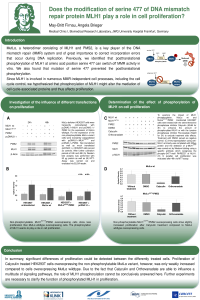
MutLα, a heterodimer consisting of MLH1 and PMS2, is a key player of the DNA mismatch repair (MMR) system and of great importance to correct incorporation errors that occur during DNA replication.
Previously, we identified that posttranslational phosphorylation of MLH1 at amino acid position serine 477 can switch off MMR activity in vitro. We also found that mutation of serine 477 prevented the posttranslational phosphorylation. Since MLH1 is involved in numerous MMR-independent cell processes, including the cell cycle control, we hypothesized that phosphorylation of MLH1 might alter the mediation of cell cycle-associated proteins and thus affects proliferation.
To investigate the impact of phosphorylation of MLH1 on proliferation an MTT-assay was used. MutLα deficient HEK293T cells were transiently cotransfected with pcDNA3.1+/MLH1 and pcDNA3.1+/PMS2 for the expression of MutLα wildtype. For the expression of the non-phosphorylatable MutLα variant cells were transiently cotransfected with pcDNA3.1+/MLH1S477A and pcDNA3.1+/PMS2. 48h after transfection cells were treated with Calyculin (50 nM), a serine-threonine-phosphatase inhibitor, to enhance the amount of phosphorylated MLH1. In parallel, cells were treated with Orthovanadate (50 µM), a competitive inhibitor of protein-phosphotyrosine phosphatases, to exclude inhibitor side effects. DMSO was used as a negative control. After a cultivation period of 15min to 3h, cells were incubated with MTT-reagent and proliferation was evaluated via ELISA reader.
In summary, significant differences of proliferation could be detected between the differently treated cells. Proliferation of Calyculin treated HEK293T cells overexpressing the non-phosphorylatable MutLα variant, however, was only weakly increased compared to cells overexpressing MutLα wildtype. Due to the fact that Calyculin and Orthovanadate are able to influence a multitude of signaling pathways, the role of MLH1 phosphorylation cannot be conclusively answered here. Further experiments are necessary to clarify the function of phosphorylated MLH1 in proliferation.
Keywords
MMR
MLH1
phosphorylation
proliferation
Manuscript
Does the modification of serine 477 of DNA mismatch repair protein MLH1 play a role in cell proliferation.ppt.pdf
Poster
sciforum-042275.pdf
NEIL3-mediated mitotic base excision repair of oxidative lesions at telomeres prevents senescence in hepatocellular carcinoma
Changes in gene expression of metalloproteinases-2 and -9 and their inhibitors TIMP2 and TIMP3 in human glioma cells exposed to low levels of fluoride.