Event submissions
EventsThe 1st International Electronic Conference on Cancers: Exploiting Cancer Vulnerability by Targeting the DNA Damage Response
Published

This submission belongs to the session 8. Poster of the event The 1st International Electronic Conference on Cancers: Exploiting Cancer Vulnerability by Targeting the DNA Damage Response
Published date
01 Feb, 2021
Citation
Yu-An Chen, Yi-Ru Lai, Ho Lin, Jer-Tsong Hsieh, Yu-Hsin Lin, Chih-Ho Lai, Novel bacterial genotoxin-loaded nanoparticles for targeting therapy of radioresistant prostate cancer, in Proceedings of The 1st International Electronic Conference on Cancers: Exploiting Cancer Vulnerability by Targeting the DNA Damage Response, 1 February–14 February 2021, MDPI: Basel, Switzerland, doi: 10.3390/IECC2021-09230
Share
Email
Facebook
Twitter
LinkedIn
Novel bacterial genotoxin-loaded nanoparticles for targeting therapy of radioresistant prostate cancer
'%3e%3cpath%20d='M12.6647%2010.9104C12.4176%2010.325%2012.0589%209.7933%2011.6088%209.34485C11.16%208.89511%2010.6283%208.53653%2010.0432%208.28891C10.038%208.28629%2010.0327%208.28498%2010.0275%208.28236C10.8437%207.69282%2011.3743%206.73252%2011.3743%205.64907C11.3743%203.85423%209.92005%202.40002%208.12522%202.40002C6.33038%202.40002%204.87618%203.85423%204.87618%205.64907C4.87618%206.73252%205.40677%207.69282%206.22296%208.28367C6.21772%208.28629%206.21248%208.2876%206.20724%208.29022C5.62031%208.53783%205.09365%208.89287%204.64167%209.34616C4.19192%209.79496%203.83334%2010.3266%203.58573%2010.9117C3.34247%2011.4846%203.21128%2012.0987%203.19925%2012.721C3.1989%2012.735%203.20135%2012.7489%203.20646%2012.7619C3.21157%2012.7749%203.21924%2012.7868%203.22901%2012.7968C3.23877%2012.8068%203.25045%2012.8148%203.26334%2012.8202C3.27623%2012.8256%203.29007%2012.8284%203.30406%2012.8284H4.09012C4.14776%2012.8284%204.19362%2012.7825%204.19493%2012.7262C4.22113%2011.7148%204.62726%2010.7676%205.34519%2010.0497C6.08802%209.30686%207.07452%208.89811%208.12522%208.89811C9.17592%208.89811%2010.1624%209.30686%2010.9052%2010.0497C11.6232%2010.7676%2012.0293%2011.7148%2012.0555%2012.7262C12.0568%2012.7839%2012.1027%2012.8284%2012.1603%2012.8284H12.9464C12.9604%2012.8284%2012.9742%2012.8256%2012.9871%2012.8202C13%2012.8148%2013.0117%2012.8068%2013.0214%2012.7968C13.0312%2012.7868%2013.0389%2012.7749%2013.044%2012.7619C13.0491%2012.7489%2013.0515%2012.735%2013.0512%2012.721C13.0381%2012.0947%2012.9084%2011.4856%2012.6647%2010.9104ZM8.12522%207.90243C7.52388%207.90243%206.95792%207.66793%206.53214%207.24215C6.10636%206.81636%205.87185%206.2504%205.87185%205.64907C5.87185%205.04773%206.10636%204.48177%206.53214%204.05599C6.95792%203.63021%207.52388%203.3957%208.12522%203.3957C8.72655%203.3957%209.29252%203.63021%209.7183%204.05599C10.1441%204.48177%2010.3786%205.04773%2010.3786%205.64907C10.3786%206.2504%2010.1441%206.81636%209.7183%207.24215C9.29252%207.66793%208.72655%207.90243%208.12522%207.90243Z'%20fill='%235D1EE1'/%3e%3c/g%3e%3c/svg%3e)
Yu-An Chen 1
Yi-Ru Lai 2

Ho Lin 3
Jer-Tsong Hsieh 1
Yu-Hsin Lin 4
Chih-Ho Lai 5
1. University of Texas Southwestern Medical Center
2. Chang Gung University
3. National Chung Hsing University
4. National Yang-Ming University
5. Graduate Institute of Biomedical Sciences, Chang Gung University, Taoyuan, Taiwan
Abstract
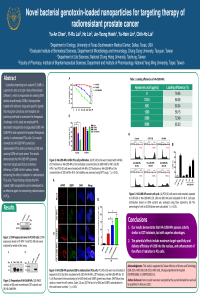
Background: Prostate cancer (PCa) is one of the most commonly diagnosed cancers in men and usually becomes refractory because of recurrence and metastasis. CD44, a transmembrane glycoprotein, serves as a receptor for hyaluronic acid (HA) and has been found to be abundantly expressed in cancer stem cells (CSCs) that often exhibit a radioresistant phenotype. Cytolethal distending toxin subunit B (CdtB), produced by Campylobacter jejuni, is a genotoxin acts as a type I deoxyribonuclease (DNase I), which is responsible for creating DNA double-strand breaks (DSBs). Nanoparticles loaded with antitumor drugs and specific ligands that recognize cancerous cell receptors are promising methods to overcome the therapeutic challenges.
Results: Our results showed that administration of bacterial genotoxin significantly improved the efficacy of radiotherapy in a xenograft mouse model. We further prepared HA-decorated nanoparticles-encapsulated CdtB (HA-CdtB-NPs) and investigated the targeted therapeutic activity in radioresistant PCa cells. The results showed that HA-CdtB-NPs sensitized radioresistant PCa cells by enhancing DSB and causing G2/M cell-cycle arrest, without affecting the normal prostate epithelial cells. Our results demonstrate that HA-CdtB-NPs possess maximum target-specificity and delivery efficiency of CdtB into the nucleus, thereby enhancing the effect of radiation in radioresistant PCa cells.
Conclusions: These findings indicate that HA-loaded CdtB nanoparticles exert target-specificity accompanied with radiomimetic activity, which can be developed as an effective agent for overcoming radioresistance in PCa.
Keywords
DNA damage response
genotoxin
hyaluronic acid
nanoparticle
radiosensitizer
Manuscript
Poster.pdf
Poster
Poster.pdf
Changes in gene expression of metalloproteinases-2 and -9 and their inhibitors TIMP2 and TIMP3 in human glioma cells exposed to low levels of fluoride.