Event submissions
Published

This submission belongs to the session S7. Deep-Space Probes of the event 1st Electronic Conference on Universe
Published date
22 Feb, 2021
Citation
Cinzia Cernetti, Francesco Nozzoli, Beryllium radioactive isotopes as a probe to measure residence time of Cosmic Rays in the Galaxy and halo thickness., in Proceedings of 1st Electronic Conference on Universe, 22 February–28 February 2021, MDPI: Basel, Switzerland, doi: 10.3390/ECU2021-09273
Share
Email
Facebook
Twitter
LinkedIn
Beryllium radioactive isotopes as a probe to measure residence time of Cosmic Rays in the Galaxy and halo thickness.
'%3e%3cpath%20d='M12.6647%2010.9104C12.4176%2010.325%2012.0589%209.7933%2011.6088%209.34485C11.16%208.89511%2010.6283%208.53653%2010.0432%208.28891C10.038%208.28629%2010.0327%208.28498%2010.0275%208.28236C10.8437%207.69282%2011.3743%206.73252%2011.3743%205.64907C11.3743%203.85423%209.92005%202.40002%208.12522%202.40002C6.33038%202.40002%204.87618%203.85423%204.87618%205.64907C4.87618%206.73252%205.40677%207.69282%206.22296%208.28367C6.21772%208.28629%206.21248%208.2876%206.20724%208.29022C5.62031%208.53783%205.09365%208.89287%204.64167%209.34616C4.19192%209.79496%203.83334%2010.3266%203.58573%2010.9117C3.34247%2011.4846%203.21128%2012.0987%203.19925%2012.721C3.1989%2012.735%203.20135%2012.7489%203.20646%2012.7619C3.21157%2012.7749%203.21924%2012.7868%203.22901%2012.7968C3.23877%2012.8068%203.25045%2012.8148%203.26334%2012.8202C3.27623%2012.8256%203.29007%2012.8284%203.30406%2012.8284H4.09012C4.14776%2012.8284%204.19362%2012.7825%204.19493%2012.7262C4.22113%2011.7148%204.62726%2010.7676%205.34519%2010.0497C6.08802%209.30686%207.07452%208.89811%208.12522%208.89811C9.17592%208.89811%2010.1624%209.30686%2010.9052%2010.0497C11.6232%2010.7676%2012.0293%2011.7148%2012.0555%2012.7262C12.0568%2012.7839%2012.1027%2012.8284%2012.1603%2012.8284H12.9464C12.9604%2012.8284%2012.9742%2012.8256%2012.9871%2012.8202C13%2012.8148%2013.0117%2012.8068%2013.0214%2012.7968C13.0312%2012.7868%2013.0389%2012.7749%2013.044%2012.7619C13.0491%2012.7489%2013.0515%2012.735%2013.0512%2012.721C13.0381%2012.0947%2012.9084%2011.4856%2012.6647%2010.9104ZM8.12522%207.90243C7.52388%207.90243%206.95792%207.66793%206.53214%207.24215C6.10636%206.81636%205.87185%206.2504%205.87185%205.64907C5.87185%205.04773%206.10636%204.48177%206.53214%204.05599C6.95792%203.63021%207.52388%203.3957%208.12522%203.3957C8.72655%203.3957%209.29252%203.63021%209.7183%204.05599C10.1441%204.48177%2010.3786%205.04773%2010.3786%205.64907C10.3786%206.2504%2010.1441%206.81636%209.7183%207.24215C9.29252%207.66793%208.72655%207.90243%208.12522%207.90243Z'%20fill='%235D1EE1'/%3e%3c/g%3e%3c/svg%3e)
Cinzia Cernetti 1

Francesco Nozzoli 2
1. Trento University, via Sommarive 14 I-38123, Trento, IT
2. INFN-TIFPA, via Sommarive 14 I-38123, Trento, IT
Abstract
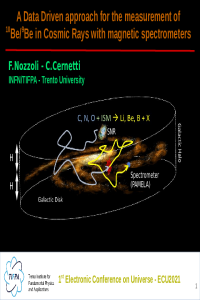
Cosmic Rays (CR) are a powerful tool for the investigation of the structure of the magnetic fields in the galactic halo and the property of the Inter-Stellar Medium. In particular the ratio of secondary CR (as Li,Be,B) over the primary CR (as He,C,O) is able to provide the grammage, that is the amount of material crossed by CR in their journey through the Galaxy. Two parameters of the CR propagation models: the galactic halo thickness, H, and the diffusion coefficient, D, are loosely constrained by such a grammage measurement, in particular a large degeneracy exist being only H/D well measured. The uncertainties on D and H parameters (this last one know to be in the range 3-8 kpc) also reflects on the accuracy of the determination of secondary anti-proton and positrons fluxes that are the background for the Dark Matter or exotic (astro-)physics searches. The 10Be/9Be isotopic flux ratio (thanks to the 2 My lifetime of 10Be) can be used as a radioactive clock providing the measurement of CR residence time in the galaxy. This is an important tool to solve the H/D degeneracy. Past measurements of 10Be/9Be isotopic flux ratio in CR are scarce, limited to low energy and affected by large uncertainties. Here a new technique to measure 10Be/9Be isotopic flux ratio with a Data-Driven approach in magnetic spectrometers is presented. As an example by applying the method to Beryllium data collected and published by PAMELA collaboration it is now possible to determine this important measurement avoiding the prohibitive uncertainties coming from the Monte Carlo simulation. It is shown that the accuracy of PAMELA data permits to infer a value of the halo thickness H within 20% precision.
Keywords
Cosmic Rays
halo thickness
Beryllium isotopes
Manuscript
Nozzoli_Cernetti_DataDrivenBe.pdf
Poster
ECU2021_NOZZOLI_CERNETTI.pdf
New perspectives for multifrequency GW astronomy: strong gravitational lensing of GW
Testing General Relativity vs. Alternative Theories of Gravitation with the SaToR-G Experiment