Event submissions
Published

This submission belongs to the session S9. Teaching Relativity and Modern Physics in General of the event 1st Electronic Conference on Universe
Published date
22 Feb, 2021
Citation
Marco Di Mauro, Salvatore Esposito, Adele Naddeo, A proposal for teaching introductory quantum physics in the footsteps of Einstein, in Proceedings of 1st Electronic Conference on Universe, 22 February–28 February 2021, MDPI: Basel, Switzerland, doi: 10.3390/ECU2021-09320
Share
Email
Facebook
Twitter
LinkedIn
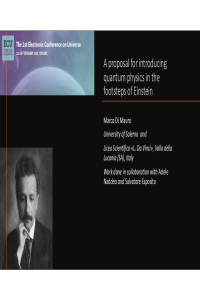
A proposal for teaching introductory quantum physics in the footsteps of Einstein

Marco Di Mauro 1

Salvatore Esposito 2
'%3e%3cpath%20d='M12.6647%2010.9104C12.4176%2010.325%2012.0589%209.7933%2011.6088%209.34485C11.16%208.89511%2010.6283%208.53653%2010.0432%208.28891C10.038%208.28629%2010.0327%208.28498%2010.0275%208.28236C10.8437%207.69282%2011.3743%206.73252%2011.3743%205.64907C11.3743%203.85423%209.92005%202.40002%208.12522%202.40002C6.33038%202.40002%204.87618%203.85423%204.87618%205.64907C4.87618%206.73252%205.40677%207.69282%206.22296%208.28367C6.21772%208.28629%206.21248%208.2876%206.20724%208.29022C5.62031%208.53783%205.09365%208.89287%204.64167%209.34616C4.19192%209.79496%203.83334%2010.3266%203.58573%2010.9117C3.34247%2011.4846%203.21128%2012.0987%203.19925%2012.721C3.1989%2012.735%203.20135%2012.7489%203.20646%2012.7619C3.21157%2012.7749%203.21924%2012.7868%203.22901%2012.7968C3.23877%2012.8068%203.25045%2012.8148%203.26334%2012.8202C3.27623%2012.8256%203.29007%2012.8284%203.30406%2012.8284H4.09012C4.14776%2012.8284%204.19362%2012.7825%204.19493%2012.7262C4.22113%2011.7148%204.62726%2010.7676%205.34519%2010.0497C6.08802%209.30686%207.07452%208.89811%208.12522%208.89811C9.17592%208.89811%2010.1624%209.30686%2010.9052%2010.0497C11.6232%2010.7676%2012.0293%2011.7148%2012.0555%2012.7262C12.0568%2012.7839%2012.1027%2012.8284%2012.1603%2012.8284H12.9464C12.9604%2012.8284%2012.9742%2012.8256%2012.9871%2012.8202C13%2012.8148%2013.0117%2012.8068%2013.0214%2012.7968C13.0312%2012.7868%2013.0389%2012.7749%2013.044%2012.7619C13.0491%2012.7489%2013.0515%2012.735%2013.0512%2012.721C13.0381%2012.0947%2012.9084%2011.4856%2012.6647%2010.9104ZM8.12522%207.90243C7.52388%207.90243%206.95792%207.66793%206.53214%207.24215C6.10636%206.81636%205.87185%206.2504%205.87185%205.64907C5.87185%205.04773%206.10636%204.48177%206.53214%204.05599C6.95792%203.63021%207.52388%203.3957%208.12522%203.3957C8.72655%203.3957%209.29252%203.63021%209.7183%204.05599C10.1441%204.48177%2010.3786%205.04773%2010.3786%205.64907C10.3786%206.2504%2010.1441%206.81636%209.7183%207.24215C9.29252%207.66793%208.72655%207.90243%208.12522%207.90243Z'%20fill='%235D1EE1'/%3e%3c/g%3e%3c/svg%3e)
Adele Naddeo 2
1. University of Salerno
2. INFN Sezione di Napoli
Abstract
A timely challenge in current physics education is to develop educational tracks aimed at introducing advanced high school students to the main concepts of quantum theory. While standard tracks are historical in nature, going from Planck’s hypothesis to the Schrödinger equation, several points of this history tend to be left out. However, the richness of the history of quantum physics makes much more material available, part of which could potentially be adopted to enhance students’ understanding of basic quantum physics. In this respect, the pivotal work by Einstein stands out, because of its clarity and readability, also for modern readers, and especially because many of the characteristic features of quantum physics can in fact be traced to some paper by him on the quantum theory of radiation. This is the case of light quanta (introduced in 1905, and then applied to the photoelectric effect), wave-particle duality for light (1909) and probability (1916). These concepts were all introduced using clear and compelling statistical arguments, which however are not part of usual high school curricula. We were led to think that high school students can be fruitfully be exposed to the above material, and therefore we developed a didactic track, which introduces some characteristic concepts of quantum physics in a way that follows Einsteins’ original arguments. This can be done in a way that requires nothing more than elementary integral calculus and statistics, plus elements of classical physics which are part of the standard curriculum of advanced high school students. Such a track can then usefully complement the usual historically oriented curricula, while giving the students a grasp of subtle quantum concepts, which can also help them when they come to more advanced topics such as matter waves, the Schrödinger equation and Born’s rule.
Keywords
Quantum physics
physics teaching
history of physics.
Manuscript
DiMauro_paper.pdf
Poster
DiMauro_Einstein.pdf
Teaching Einsteinian gravity in Italian primary school
Particle physics for primary schools—enthusing children to modern science