Event submissions
Published

This submission belongs to the session I. Poster Session of the event The 1st International Electronic Conference on Metallurgy and Metals
Published date
23 Feb, 2021
Citation
Ikram Abarkan, Abdellatif Khamlichi, Rabee Shamass, Numerical and Analytical Analysis of the Low Cycle Fatigue Behavior of Notched and Un-notched 316 L (N) Austenitic Stainless Steel Samples at Ambient and Elevated Temperatures, in Proceedings of The 1st International Electronic Conference on Metallurgy and Metals, 22 February–7 March 2021, MDPI: Basel, Switzerland, doi: 10.3390/IEC2M-09329
Share
Email
Facebook
Twitter
LinkedIn
Numerical and Analytical Analysis of the Low Cycle Fatigue Behavior of Notched and Un-notched 316 L (N) Austenitic Stainless Steel Samples at Ambient and Elevated Temperatures

Ikram Abarkan 1
'%3e%3cpath%20d='M12.6647%2010.9104C12.4176%2010.325%2012.0589%209.7933%2011.6088%209.34485C11.16%208.89511%2010.6283%208.53653%2010.0432%208.28891C10.038%208.28629%2010.0327%208.28498%2010.0275%208.28236C10.8437%207.69282%2011.3743%206.73252%2011.3743%205.64907C11.3743%203.85423%209.92005%202.40002%208.12522%202.40002C6.33038%202.40002%204.87618%203.85423%204.87618%205.64907C4.87618%206.73252%205.40677%207.69282%206.22296%208.28367C6.21772%208.28629%206.21248%208.2876%206.20724%208.29022C5.62031%208.53783%205.09365%208.89287%204.64167%209.34616C4.19192%209.79496%203.83334%2010.3266%203.58573%2010.9117C3.34247%2011.4846%203.21128%2012.0987%203.19925%2012.721C3.1989%2012.735%203.20135%2012.7489%203.20646%2012.7619C3.21157%2012.7749%203.21924%2012.7868%203.22901%2012.7968C3.23877%2012.8068%203.25045%2012.8148%203.26334%2012.8202C3.27623%2012.8256%203.29007%2012.8284%203.30406%2012.8284H4.09012C4.14776%2012.8284%204.19362%2012.7825%204.19493%2012.7262C4.22113%2011.7148%204.62726%2010.7676%205.34519%2010.0497C6.08802%209.30686%207.07452%208.89811%208.12522%208.89811C9.17592%208.89811%2010.1624%209.30686%2010.9052%2010.0497C11.6232%2010.7676%2012.0293%2011.7148%2012.0555%2012.7262C12.0568%2012.7839%2012.1027%2012.8284%2012.1603%2012.8284H12.9464C12.9604%2012.8284%2012.9742%2012.8256%2012.9871%2012.8202C13%2012.8148%2013.0117%2012.8068%2013.0214%2012.7968C13.0312%2012.7868%2013.0389%2012.7749%2013.044%2012.7619C13.0491%2012.7489%2013.0515%2012.735%2013.0512%2012.721C13.0381%2012.0947%2012.9084%2011.4856%2012.6647%2010.9104ZM8.12522%207.90243C7.52388%207.90243%206.95792%207.66793%206.53214%207.24215C6.10636%206.81636%205.87185%206.2504%205.87185%205.64907C5.87185%205.04773%206.10636%204.48177%206.53214%204.05599C6.95792%203.63021%207.52388%203.3957%208.12522%203.3957C8.72655%203.3957%209.29252%203.63021%209.7183%204.05599C10.1441%204.48177%2010.3786%205.04773%2010.3786%205.64907C10.3786%206.2504%2010.1441%206.81636%209.7183%207.24215C9.29252%207.66793%208.72655%207.90243%208.12522%207.90243Z'%20fill='%235D1EE1'/%3e%3c/g%3e%3c/svg%3e)
Abdellatif Khamlichi 2
Rabee Shamass 3
1. Department of Physics, Faculty of Sciences, Abdelmalek Essaadi University, Tetouan, Morocco
2. Department of Industrial and Civil Sciences and Technologies, National School of Applied Sciences, Abdelmalek Essaadi University, 93000 Tetouan, Morocco
3. Division of Civil and Building Services Engineering, School of Build Environment and Architecture, London South Bank University, London 103, UK
Abstract
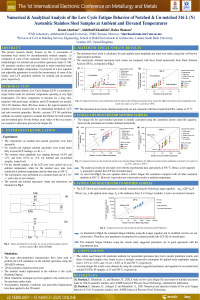
Smooth and notched mechanical components made of metals frequently experience repeated cyclic loads at different temperatures. Thus, low cycle fatigue (LCF) is considered the dominant failure mode for these components. The stainless steel (SS) is the most widely selected materials by engineers, owing to its outstanding mechanical and LCF properties and anti-corrosion properties. Moreover, a reliable estimation of the fatigue life is essential in order to preserve people’s safety in industries. In the present study, an evaluation of some of the commonly known low cycle fatigue life methodologies is performed for notched and un-notched samples made of 316L (N) SS, at ambient and higher temperatures. For the notched ones, the elastic-plastic strains were firstly determined and then the fatigue lives were estimated for constant nominal strain amplitudes, varying from ± 0.4 to ± 0.8%. A comparison between the calculated fatigue lives and those obtained experimentally from the literature was made. Overall, some of the widely used fatigue life prediction methods for smooth specimens have resulted in unsafe estimations for applied strain amplitudes ranging from ± 0.3% to ±1.0%. And those of notched specimens were generally found to give strongly conservative predictions. To overcome this problem, attempts have been made to suggest new parameters that can precisely assess the lifetimes of smooth samples, and a new equation was suggested for notched ones, under both room and high temperatures.
Keywords
Notched samples
smooth samples
low cycle fatigue
316 L (N) austenitic stainless steel.
Manuscript
IEC2M21_Abarkan_et_al.pdf
Poster
IEC2M21_Abarkan_et_al.pdf
The Effects of Cyclic Close Die Forging on Microstructure and Mechanical Properties of Ti – 5Al – 3Mo – 1.5V Alloy
DETERMINATION OF THE REACTION RATE CONTROLLING RESISTANCE OF GOETHITE IRON ORE REDUCTION USING CO/CO2 GASES FROM WOOD CHARCOAL