Event submissions
Published

This submission belongs to the session S4. Dark Matter and Dark Energy of the event 1st Electronic Conference on Universe
Published date
24 Feb, 2021
Citation
Susana Cebrián Guajardo, Julio Amaré, David Cintas, Iván Coarasa, Eduardo García, María Martínez, Miguel Angel Oliván, Ysrael Ortigoza, Alfonso Ortiz de Solórzano, Jorge Puimedón, Ana Salinas, María Luisa Sarsa, Patricia Villar, Dark matter annual modulation results from the ANAIS-112 experiment, in Proceedings of 1st Electronic Conference on Universe, 22 February–28 February 2021, MDPI: Basel, Switzerland, doi: 10.3390/ECU2021-09331
Share
Email
Facebook
Twitter
LinkedIn
Dark matter annual modulation results from the ANAIS-112 experiment

Susana Cebrián Guajardo 1
'%3e%3cpath%20d='M12.6647%2010.9104C12.4176%2010.325%2012.0589%209.7933%2011.6088%209.34485C11.16%208.89511%2010.6283%208.53653%2010.0432%208.28891C10.038%208.28629%2010.0327%208.28498%2010.0275%208.28236C10.8437%207.69282%2011.3743%206.73252%2011.3743%205.64907C11.3743%203.85423%209.92005%202.40002%208.12522%202.40002C6.33038%202.40002%204.87618%203.85423%204.87618%205.64907C4.87618%206.73252%205.40677%207.69282%206.22296%208.28367C6.21772%208.28629%206.21248%208.2876%206.20724%208.29022C5.62031%208.53783%205.09365%208.89287%204.64167%209.34616C4.19192%209.79496%203.83334%2010.3266%203.58573%2010.9117C3.34247%2011.4846%203.21128%2012.0987%203.19925%2012.721C3.1989%2012.735%203.20135%2012.7489%203.20646%2012.7619C3.21157%2012.7749%203.21924%2012.7868%203.22901%2012.7968C3.23877%2012.8068%203.25045%2012.8148%203.26334%2012.8202C3.27623%2012.8256%203.29007%2012.8284%203.30406%2012.8284H4.09012C4.14776%2012.8284%204.19362%2012.7825%204.19493%2012.7262C4.22113%2011.7148%204.62726%2010.7676%205.34519%2010.0497C6.08802%209.30686%207.07452%208.89811%208.12522%208.89811C9.17592%208.89811%2010.1624%209.30686%2010.9052%2010.0497C11.6232%2010.7676%2012.0293%2011.7148%2012.0555%2012.7262C12.0568%2012.7839%2012.1027%2012.8284%2012.1603%2012.8284H12.9464C12.9604%2012.8284%2012.9742%2012.8256%2012.9871%2012.8202C13%2012.8148%2013.0117%2012.8068%2013.0214%2012.7968C13.0312%2012.7868%2013.0389%2012.7749%2013.044%2012.7619C13.0491%2012.7489%2013.0515%2012.735%2013.0512%2012.721C13.0381%2012.0947%2012.9084%2011.4856%2012.6647%2010.9104ZM8.12522%207.90243C7.52388%207.90243%206.95792%207.66793%206.53214%207.24215C6.10636%206.81636%205.87185%206.2504%205.87185%205.64907C5.87185%205.04773%206.10636%204.48177%206.53214%204.05599C6.95792%203.63021%207.52388%203.3957%208.12522%203.3957C8.72655%203.3957%209.29252%203.63021%209.7183%204.05599C10.1441%204.48177%2010.3786%205.04773%2010.3786%205.64907C10.3786%206.2504%2010.1441%206.81636%209.7183%207.24215C9.29252%207.66793%208.72655%207.90243%208.12522%207.90243Z'%20fill='%235D1EE1'/%3e%3c/g%3e%3c/svg%3e)
Julio Amaré 1
David Cintas 1
Iván Coarasa 1
Eduardo García 1
María Martínez 2
Miguel Angel Oliván 3
Ysrael Ortigoza 1
Alfonso Ortiz de Solórzano 1
Jorge Puimedón 1
Ana Salinas 1
María Luisa Sarsa 1
Patricia Villar 1
1. University of Zaragoza
2. University of Zaragoza / Fundación ARAID
3. University of Zaragoza / Fundación CIRCE
Abstract
For dark matter particles in the Milky Way’s halo, an annual modulation in the interaction rate is expected by the revolution of the Earth around the Sun; the DAMA/LIBRA observation of an annual modulation signal compatible with expectations for about two decades is one of the most puzzling experimental results in the field. It has neither been confirmed nor ruled out in a model independent way, despite the impressive improvement in sensitivity in dark matter direct detection experiments based on new detector technologies combined with strong background suppression. ANAIS experiment, using 112.5 kg of sodium iodide as target, is taking data smoothly at the Canfranc Underground Laboratory in Spain since August 2017 aiming at testing the observation by the DAMA/LIBRA experiment using the same target and technique.
The first results on the search for modulation in the ANAIS-112 experiment were derived from 157.5 kg·y of data; results from two years (220.7 kg·y) have been presented too and the preliminary analysis of three years (313.6 kg·y) are now available. The best fits for the modulation hypothesis give in all cases amplitudes compatible with zero for the [2-6] and [1-6] keV energy regions; the results, compatible with the absence of modulation, are in agreement with the expected sensitivity of 2.6σ for the accumulated exposure of three years; this supports the projected goal of reaching a 3σ sensitivity to the DAMA/LIBRA result for a five-year operation. Before unblinding the data, the whole analysis procedure was fixed, the background of the experiment thoroughly studied and the expected sensitivity evaluated.
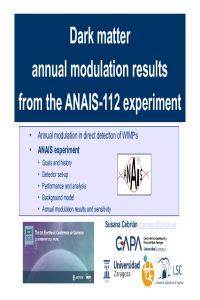
Here, the ANAIS-112 experiment will be firstly described presenting the set-up, performance, and analysis methods. Then, the obtained results from the annual modulation analysis will be shown and their implications and the future prospects will be discussed.
Keywords
Dark matter
WIMPs
direct detection
annual modulation
NaI scintillators
Manuscript
Universe2021-ANAIS - revised.pdf
Poster
Universe2021_ANAIS_Cebrian.pdf
"Null String" Gas Cosmology: 1st steps
Existence and Stability of Static Spherical Fluid Shells in a Schwarzschild-Rindler-anti-de Sitter Metric