Event submissions
Published

This submission belongs to the session A. Mineral Processing and Metallurgy of the event The 2nd International Electronic Conference on Mineral Science
Published date
25 Feb, 2021
Citation
Jennire Vanessa Nava Rosario, Juan María Menéndez Aguado, Teresa Llorens González, Characterization, Classification, Dry High Intensity Magnetic Separation (DHIMS) and Re-rinding Techniques to Improve the Mineral Performance of Sn-Ta-Nb Mineral Concentrate, in Proceedings of The 2nd International Electronic Conference on Mineral Science, 1 March–15 March 2021, MDPI: Basel, Switzerland, doi: 10.3390/iecms2021-09344
Share
Email
Facebook
Twitter
LinkedIn
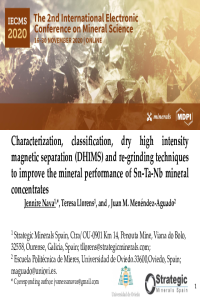
Characterization, Classification, Dry High Intensity Magnetic Separation (DHIMS) and Re-rinding Techniques to Improve the Mineral Performance of Sn-Ta-Nb Mineral Concentrate
'%3e%3cpath%20d='M12.6647%2010.9104C12.4176%2010.325%2012.0589%209.7933%2011.6088%209.34485C11.16%208.89511%2010.6283%208.53653%2010.0432%208.28891C10.038%208.28629%2010.0327%208.28498%2010.0275%208.28236C10.8437%207.69282%2011.3743%206.73252%2011.3743%205.64907C11.3743%203.85423%209.92005%202.40002%208.12522%202.40002C6.33038%202.40002%204.87618%203.85423%204.87618%205.64907C4.87618%206.73252%205.40677%207.69282%206.22296%208.28367C6.21772%208.28629%206.21248%208.2876%206.20724%208.29022C5.62031%208.53783%205.09365%208.89287%204.64167%209.34616C4.19192%209.79496%203.83334%2010.3266%203.58573%2010.9117C3.34247%2011.4846%203.21128%2012.0987%203.19925%2012.721C3.1989%2012.735%203.20135%2012.7489%203.20646%2012.7619C3.21157%2012.7749%203.21924%2012.7868%203.22901%2012.7968C3.23877%2012.8068%203.25045%2012.8148%203.26334%2012.8202C3.27623%2012.8256%203.29007%2012.8284%203.30406%2012.8284H4.09012C4.14776%2012.8284%204.19362%2012.7825%204.19493%2012.7262C4.22113%2011.7148%204.62726%2010.7676%205.34519%2010.0497C6.08802%209.30686%207.07452%208.89811%208.12522%208.89811C9.17592%208.89811%2010.1624%209.30686%2010.9052%2010.0497C11.6232%2010.7676%2012.0293%2011.7148%2012.0555%2012.7262C12.0568%2012.7839%2012.1027%2012.8284%2012.1603%2012.8284H12.9464C12.9604%2012.8284%2012.9742%2012.8256%2012.9871%2012.8202C13%2012.8148%2013.0117%2012.8068%2013.0214%2012.7968C13.0312%2012.7868%2013.0389%2012.7749%2013.044%2012.7619C13.0491%2012.7489%2013.0515%2012.735%2013.0512%2012.721C13.0381%2012.0947%2012.9084%2011.4856%2012.6647%2010.9104ZM8.12522%207.90243C7.52388%207.90243%206.95792%207.66793%206.53214%207.24215C6.10636%206.81636%205.87185%206.2504%205.87185%205.64907C5.87185%205.04773%206.10636%204.48177%206.53214%204.05599C6.95792%203.63021%207.52388%203.3957%208.12522%203.3957C8.72655%203.3957%209.29252%203.63021%209.7183%204.05599C10.1441%204.48177%2010.3786%205.04773%2010.3786%205.64907C10.3786%206.2504%2010.1441%206.81636%209.7183%207.24215C9.29252%207.66793%208.72655%207.90243%208.12522%207.90243Z'%20fill='%235D1EE1'/%3e%3c/g%3e%3c/svg%3e)
Jennire Vanessa Nava Rosario 1

Juan María Menéndez Aguado 2
Teresa Llorens González 1
1. Strategic Minerals Spain, Ctra/ OU-0901 Km 14, Penouta Mine, Viana do Bolo, 32558, Ourense, Galicia, Spain.
2. Escuela Politécnica de Mieres, Universidad de Oviedo, 33600 Oviedo, Spain
Abstract
Ta and Nb are considered critical raw materials; due to their properties and potential applications in wide sectors. This study deals with Sn-Ta-Nb minerals from the Penouta mine (Orense, Spain), the only active mine in Europe producing tantalum minerals. These are obtained from mining wastes accumulated during old mining jobs in tailing ponds. The industrial processing flowsheet is based on successive gravimetric stages followed by low intensity magnetic separation to reduce ferromagnetic contaminants. Sn-Ta-Nb concentrate, with grades between 35-45% Sn and 4-7% Ta2O5 and Nb2O5, is obtained in this stage with plant recoveries around 60-70% respectively. A chemical-mineralogical characterization by size fractions, FRX and DRX was carried out to implement a size classification stage using a circular vibrating screen in the processing plant. The finest fractions, containing higher grades of well liberated Sn, Ta, Nb minerals, were the feeding for dry high intensity magnetic separation (DHIMS) multifactorial tests, while, coarse fractions were re-grinded to maximize performance. The good results obtained in these tests demonstrate that two products with commercial quality could be obtained, a cassiterite concentrate with grades between 70-78% SnO2 and a tantalite-columbite concentrate with grades ranging between 12 and 14% Ta2O5 and Nb2O5, also increasing the overall recovery of the plant.
Keywords
high intensity magnetic separation
Sn-Ta-Nb
critical raw materials
Penouta mine
Manuscript
sciforum-037990.pdf
Poster
Nava, Llorens, Menendez.pdf
Geochemical Fractions of Heavy Metals in Bottom Sediments of the Pobeda Hydrothermal Field, Mid-Atlantic Ridge (17◦07′–17◦08′ N)
Hera: Evidence for Multiple Mineralisation Events and Remobilisation in a Sediment-Hosted Au-Ag-Pb-Zn Deposit, Central New South Wales Australia.