Event submissions
EventsThe 1st International Electronic Conference on Biological Diversity, Ecology and Evolution
Published

This submission belongs to the session i. Biodiversity Loss and Dynamics of the event The 1st International Electronic Conference on Biological Diversity, Ecology and Evolution
Published date
12 Mar, 2021
Citation
Alfred Szilágyi, Evelin Plachi, Péter István Nagy, Barbara Simon, Csaba Centeri, Assessing Earthworm Populations in Some Hungarian Horticultural Farms: Comparison of Conventional, Organic and Permaculture Farming †, in Proceedings of The 1st International Electronic Conference on Biological Diversity, Ecology and Evolution, 15 March–31 March 2021, MDPI: Basel, Switzerland, doi: 10.3390/BDEE2021-09416
Share
Email
Facebook
Twitter
LinkedIn
Assessing Earthworm Populations in Some Hungarian Horticultural Farms: Comparison of Conventional, Organic and Permaculture Farming †
'%3e%3cpath%20d='M12.6647%2010.9104C12.4176%2010.325%2012.0589%209.7933%2011.6088%209.34485C11.16%208.89511%2010.6283%208.53653%2010.0432%208.28891C10.038%208.28629%2010.0327%208.28498%2010.0275%208.28236C10.8437%207.69282%2011.3743%206.73252%2011.3743%205.64907C11.3743%203.85423%209.92005%202.40002%208.12522%202.40002C6.33038%202.40002%204.87618%203.85423%204.87618%205.64907C4.87618%206.73252%205.40677%207.69282%206.22296%208.28367C6.21772%208.28629%206.21248%208.2876%206.20724%208.29022C5.62031%208.53783%205.09365%208.89287%204.64167%209.34616C4.19192%209.79496%203.83334%2010.3266%203.58573%2010.9117C3.34247%2011.4846%203.21128%2012.0987%203.19925%2012.721C3.1989%2012.735%203.20135%2012.7489%203.20646%2012.7619C3.21157%2012.7749%203.21924%2012.7868%203.22901%2012.7968C3.23877%2012.8068%203.25045%2012.8148%203.26334%2012.8202C3.27623%2012.8256%203.29007%2012.8284%203.30406%2012.8284H4.09012C4.14776%2012.8284%204.19362%2012.7825%204.19493%2012.7262C4.22113%2011.7148%204.62726%2010.7676%205.34519%2010.0497C6.08802%209.30686%207.07452%208.89811%208.12522%208.89811C9.17592%208.89811%2010.1624%209.30686%2010.9052%2010.0497C11.6232%2010.7676%2012.0293%2011.7148%2012.0555%2012.7262C12.0568%2012.7839%2012.1027%2012.8284%2012.1603%2012.8284H12.9464C12.9604%2012.8284%2012.9742%2012.8256%2012.9871%2012.8202C13%2012.8148%2013.0117%2012.8068%2013.0214%2012.7968C13.0312%2012.7868%2013.0389%2012.7749%2013.044%2012.7619C13.0491%2012.7489%2013.0515%2012.735%2013.0512%2012.721C13.0381%2012.0947%2012.9084%2011.4856%2012.6647%2010.9104ZM8.12522%207.90243C7.52388%207.90243%206.95792%207.66793%206.53214%207.24215C6.10636%206.81636%205.87185%206.2504%205.87185%205.64907C5.87185%205.04773%206.10636%204.48177%206.53214%204.05599C6.95792%203.63021%207.52388%203.3957%208.12522%203.3957C8.72655%203.3957%209.29252%203.63021%209.7183%204.05599C10.1441%204.48177%2010.3786%205.04773%2010.3786%205.64907C10.3786%206.2504%2010.1441%206.81636%209.7183%207.24215C9.29252%207.66793%208.72655%207.90243%208.12522%207.90243Z'%20fill='%235D1EE1'/%3e%3c/g%3e%3c/svg%3e)
Alfred Szilágyi 1
Evelin Plachi 2
Péter István Nagy 3
Barbara Simon 4

Csaba Centeri 3
1. Hungarian University of Agriculture and Life Sciences, Doctoral School of Environmental Sciences
2. Hungarian University of Agriculture and Life Sciences
3. Hungarian University of Agriculture and Life Sciences, Institute of Wildlife Management and Nature Conservation
4. Hungarian University of Agriculture and Life Sciences, Institute of Environmental Sciences
Abstract
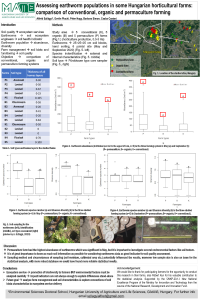
Soil is one of the most important, non-renewable natural resources of human beings. Soils are needed to produce food and thus it is crucial to maintain soil health. Earthworms are one of the best indicators of soil health. Farming systems have a tremendous impact on soil biota. This effect can be both negative and positive. Less intensive farming systems, such as organic and permaculture farming are known to be more favorable for soil life while intensive farms are widely known for their negative effects. Our aim was to compare different farming systems based on the density of earthworms. Fifteen small-scale (0.3–2 hectares) farms in North-Central Hungary with similar agroecological features were selected for comparison. All of them are horticultural farms with diverse crops in the crop rotation, the only difference is the farming systems, i.e. one intensive (conventional), and two extensive types (organic and permaculture). Earthworms were sampled in May and September 2020, six replicates on each site, by hand sorting of 25x25x25 cm soil blocks. In May, abundance of juvenile and adult earthworms were significantly higher in case of permaculture farms compared to organic and also conventional farms. However, we did not find significant differences in earthworm abundance in September. There was no significant difference in the abundance of earthworm species neither in May, nor in September. Based on our soil-wise experiences it is of great importance to know as much soil information as possible (i.e. soil thickness, soil organic matter content, texture, soil management, fertilizers used, soil moisture content at the time of the counting, soil cover etc.) for considering earthworms data as a good indicator for soil quality assessment.
Keywords
biodiversity
land use
agroecology
ecosystem service
Manuscript
sciforum_043842_original_BDEE_proceeding_soillife_ASzilagyi_EPlachi_BSimon_CsCenteri_final-done.pdf
Poster
BDEE_poster_soillife_ASzilágyi_EPlachi_BSimon_CsCenteri_final.pdf
Deep neural network recognition of shallow water corals in the Gulf of Eilat (Aqaba)
Transhumance Offers Food Pulse to Scavengers †