Event submissions
EventsThe 1st International Electronic Conference on Biological Diversity, Ecology and Evolution
Published

This submission belongs to the session h. Phylogeny and Evolution of the event The 1st International Electronic Conference on Biological Diversity, Ecology and Evolution
Published date
12 Mar, 2021
Citation
Kuang-Ping Yu, Matjaž Kuntner, Ren-Chung Cheng, Taxonomic discovery in Cyphalonotus: Phylogenetic evidence for an independent origin of extreme sexual size dimorphism in the araneid spider Poltys, in Proceedings of The 1st International Electronic Conference on Biological Diversity, Ecology and Evolution, 15 March–31 March 2021, MDPI: Basel, Switzerland, doi: 10.3390/BDEE2021-09421
Share
Email
Facebook
Twitter
LinkedIn
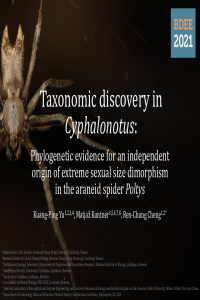
Taxonomic discovery in Cyphalonotus: Phylogenetic evidence for an independent origin of extreme sexual size dimorphism in the araneid spider Poltys
'%3e%3cpath%20d='M12.6647%2010.9104C12.4176%2010.325%2012.0589%209.7933%2011.6088%209.34485C11.16%208.89511%2010.6283%208.53653%2010.0432%208.28891C10.038%208.28629%2010.0327%208.28498%2010.0275%208.28236C10.8437%207.69282%2011.3743%206.73252%2011.3743%205.64907C11.3743%203.85423%209.92005%202.40002%208.12522%202.40002C6.33038%202.40002%204.87618%203.85423%204.87618%205.64907C4.87618%206.73252%205.40677%207.69282%206.22296%208.28367C6.21772%208.28629%206.21248%208.2876%206.20724%208.29022C5.62031%208.53783%205.09365%208.89287%204.64167%209.34616C4.19192%209.79496%203.83334%2010.3266%203.58573%2010.9117C3.34247%2011.4846%203.21128%2012.0987%203.19925%2012.721C3.1989%2012.735%203.20135%2012.7489%203.20646%2012.7619C3.21157%2012.7749%203.21924%2012.7868%203.22901%2012.7968C3.23877%2012.8068%203.25045%2012.8148%203.26334%2012.8202C3.27623%2012.8256%203.29007%2012.8284%203.30406%2012.8284H4.09012C4.14776%2012.8284%204.19362%2012.7825%204.19493%2012.7262C4.22113%2011.7148%204.62726%2010.7676%205.34519%2010.0497C6.08802%209.30686%207.07452%208.89811%208.12522%208.89811C9.17592%208.89811%2010.1624%209.30686%2010.9052%2010.0497C11.6232%2010.7676%2012.0293%2011.7148%2012.0555%2012.7262C12.0568%2012.7839%2012.1027%2012.8284%2012.1603%2012.8284H12.9464C12.9604%2012.8284%2012.9742%2012.8256%2012.9871%2012.8202C13%2012.8148%2013.0117%2012.8068%2013.0214%2012.7968C13.0312%2012.7868%2013.0389%2012.7749%2013.044%2012.7619C13.0491%2012.7489%2013.0515%2012.735%2013.0512%2012.721C13.0381%2012.0947%2012.9084%2011.4856%2012.6647%2010.9104ZM8.12522%207.90243C7.52388%207.90243%206.95792%207.66793%206.53214%207.24215C6.10636%206.81636%205.87185%206.2504%205.87185%205.64907C5.87185%205.04773%206.10636%204.48177%206.53214%204.05599C6.95792%203.63021%207.52388%203.3957%208.12522%203.3957C8.72655%203.3957%209.29252%203.63021%209.7183%204.05599C10.1441%204.48177%2010.3786%205.04773%2010.3786%205.64907C10.3786%206.2504%2010.1441%206.81636%209.7183%207.24215C9.29252%207.66793%208.72655%207.90243%208.12522%207.90243Z'%20fill='%235D1EE1'/%3e%3c/g%3e%3c/svg%3e)
Kuang-Ping Yu 1,2,3,4

Matjaž Kuntner 3,5,6,7,8
Ren-Chung Cheng 1,2
1. Department of Life Sciences, National Chung Hsing University, Taichung, Taiwan
2. Research Center for Global Change Biology, National Chung Hsing University, Taichung, Taiwan
3. Evolutionary Zoology Laboratory, Department of Organisms and Ecosystems Research, National Institute of Biology, Ljubljana, Slovenia
4. Biotechnical Faculty, University of Ljubljana, Ljubljana, Slovenia
5. University of Ljubljana, Ljubljana, Slovenia
6. Jovan Hadži Institute of Biology, ZRC SAZU, Ljubljana, Slovenia
7. State Key Laboratory of Biocatalysis and Enzyme Engineering, and Centre for Behavioural Ecology and Evolution, School of Life Sciences, Hubei University, Wuhan, Hubei Province, China
8. Department of Entomology, National Museum of Natural History, Smithsonian Institution, Washington, DC, USA
Abstract
Cyphalonotus is a poorly studied araneid spider genus with species from Africa and Asia whose phylogenetic proximity remains unknown due to the paucity of morphological and molecular data. We here report on a taxonomic and evolutionary research on these spiders with three main objectives: i) to test the taxonomic composition of Cyphalonotus; ii) to test its phylogenetic placement; and iii) to place the male and female size variation of Cyphalonotus and related genera in an evolutionary context. Our original collection and field observations from Taiwan and China facilitated description of a new and a known species, and newly provided sequence data enable species delimitation, and phylogenetic analyses. The phylogenetic results reject all four classification hypotheses from the literature, and instead recover a well-supported clade Cyphalonotus + Poltys. We review the male and female size variation in Cyphalonotus, Poltys, and related genera. These data reveal that all known species of Poltys are extremely sexually size dimorphic (eSSD = females over twice the male size) reaching values exceeding 10-fold differences, while Cyphalonotus and other genera in their phylogenetic proximity are relatively sexually monomorphic (SSD < 2.0). This confirms an independent origin of eSSD in Poltys, one of multiple convergent evolutionary outcomes in orbweb spiders.
Keywords
sexual size dimorphism
eSSD
sexual size monomorphism
Araneidae
orb-web spiders
body size evolution
Manuscript
sciforum_043675_original_2021BDEE_abstract - done.pdf
Poster
Taxonomic discovery in Cyphalonotus.pdf
Exploring diversification drivers in golden orbweavers
Changes in soil seed bank and vegetation at abandoned bait sites in a Central European hilly area