Event submissions
EventsThe 1st International Electronic Conference on Biological Diversity, Ecology and Evolution
Published

This submission belongs to the session f. Biodiversity Conservation of the event The 1st International Electronic Conference on Biological Diversity, Ecology and Evolution
Published date
12 Mar, 2021
Citation
Thabang Rainett Teffo, Bálint Halpern, Krisztián Katona, Home range patterns of the strictly protected Caspian Whipsnake (Dolichophis caspius, Gmelin, 1789): A peri-urban population in Vöröskővár, Hungary, in Proceedings of The 1st International Electronic Conference on Biological Diversity, Ecology and Evolution, 15 March–31 March 2021, MDPI: Basel, Switzerland, doi: 10.3390/BDEE2021-09431
Share
Email
Facebook
Twitter
LinkedIn
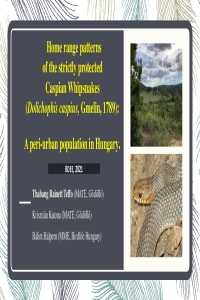
Home range patterns of the strictly protected Caspian Whipsnake (Dolichophis caspius, Gmelin, 1789): A peri-urban population in Vöröskővár, Hungary
'%3e%3cpath%20d='M12.6647%2010.9104C12.4176%2010.325%2012.0589%209.7933%2011.6088%209.34485C11.16%208.89511%2010.6283%208.53653%2010.0432%208.28891C10.038%208.28629%2010.0327%208.28498%2010.0275%208.28236C10.8437%207.69282%2011.3743%206.73252%2011.3743%205.64907C11.3743%203.85423%209.92005%202.40002%208.12522%202.40002C6.33038%202.40002%204.87618%203.85423%204.87618%205.64907C4.87618%206.73252%205.40677%207.69282%206.22296%208.28367C6.21772%208.28629%206.21248%208.2876%206.20724%208.29022C5.62031%208.53783%205.09365%208.89287%204.64167%209.34616C4.19192%209.79496%203.83334%2010.3266%203.58573%2010.9117C3.34247%2011.4846%203.21128%2012.0987%203.19925%2012.721C3.1989%2012.735%203.20135%2012.7489%203.20646%2012.7619C3.21157%2012.7749%203.21924%2012.7868%203.22901%2012.7968C3.23877%2012.8068%203.25045%2012.8148%203.26334%2012.8202C3.27623%2012.8256%203.29007%2012.8284%203.30406%2012.8284H4.09012C4.14776%2012.8284%204.19362%2012.7825%204.19493%2012.7262C4.22113%2011.7148%204.62726%2010.7676%205.34519%2010.0497C6.08802%209.30686%207.07452%208.89811%208.12522%208.89811C9.17592%208.89811%2010.1624%209.30686%2010.9052%2010.0497C11.6232%2010.7676%2012.0293%2011.7148%2012.0555%2012.7262C12.0568%2012.7839%2012.1027%2012.8284%2012.1603%2012.8284H12.9464C12.9604%2012.8284%2012.9742%2012.8256%2012.9871%2012.8202C13%2012.8148%2013.0117%2012.8068%2013.0214%2012.7968C13.0312%2012.7868%2013.0389%2012.7749%2013.044%2012.7619C13.0491%2012.7489%2013.0515%2012.735%2013.0512%2012.721C13.0381%2012.0947%2012.9084%2011.4856%2012.6647%2010.9104ZM8.12522%207.90243C7.52388%207.90243%206.95792%207.66793%206.53214%207.24215C6.10636%206.81636%205.87185%206.2504%205.87185%205.64907C5.87185%205.04773%206.10636%204.48177%206.53214%204.05599C6.95792%203.63021%207.52388%203.3957%208.12522%203.3957C8.72655%203.3957%209.29252%203.63021%209.7183%204.05599C10.1441%204.48177%2010.3786%205.04773%2010.3786%205.64907C10.3786%206.2504%2010.1441%206.81636%209.7183%207.24215C9.29252%207.66793%208.72655%207.90243%208.12522%207.90243Z'%20fill='%235D1EE1'/%3e%3c/g%3e%3c/svg%3e)
Thabang Rainett Teffo 1
Bálint Halpern 2

Krisztián Katona 3
1. PhD Candidate
Hungarian University of Agriculture and Life Sciences, Institute for Wildlife Management and Nature Conservation, Department of Wildlife Biology H-2100, Páter Károly street 1 Gödöllő, Hungary.
2. Project Leader
MME BirdLife Hungary, H-1121 Költő u. 21., Budapest, Hungary.
3. Associate Professor
Hungarian University of Agriculture and Life Sciences, Institute for Wildlife Management and Nature Conservation, Department of Wildlife Biology H-2100, Páter Károly street 1 Gödöllő, Hungary
Abstract
Green spaces can exist within and in close proximity to urban environments. These areas readily become habitats to mammals, amphibians, reptiles and other native species that may persist in confined areas within cities. Understanding the expanse of the area in which animals live, or their home range patterns, is important to better understand their ecology. In this study we investigated daily movements, seasonal home ranges and overlap of the Caspian whipsnake (Dolichophis caspius) in a peri-urban area in Budapest, Hungary. We used radio-telemetry to track 5 individual adult snakes within a total area of 125 ha consisting of different microhabitats between 2016 and 2019. Caspian whipsnakes distributed within an area of only 30 ha. We found that they cover on average daily distances of 11 - 39 m during vegetation period and less than 5 m during brumation period. The snakes used home ranges of 6 - 14 ha during vegetation periods and 0.04 - 0.28 ha during brumation periods, being the smallest for the underground localities during the brumation period. The Adaptive Kernel method gave the highest, LoCoH-R the smallest home range values. The percentage of home range overlap was found to be smaller during brumation periods when the snakes were underground than during vegetation periods when the snakes were found both, under and above ground. Caspian whipsnakes in Vöröskővár currently have room for movement but it seems that the patches providing shelter (rocky places, burrows, shrubby areas) can limit their distribution, especially during the brumation period. Increased anthropogenic activities, and disturbances mainly in the wintering hiding areas may result in significant threat to the species.
Keywords
movement
radio-telemetry
brumation
reptile
urbanization
Manuscript
sciforum_043907_original_Abstract_BDEE_2021_TT_KK-done.pdf
Poster
_BDEE_2021_Thabang-Rainett-Teffo_15-31_March-2021_-Final-Version-210301.pdf
Investigations on Bioactive Compounds and In Vitro Biological Potent of Corchorus olitorius. L from Algerian Cultivar †
Comparative Analysis of a Mediterranean Wild Medicinal Plant Parts’ In Vitro Biological Activities †