Event submissions
EventsThe 1st International Electronic Conference on Biological Diversity, Ecology and Evolution
Published

This submission belongs to the session b. Animal Diversity of the event The 1st International Electronic Conference on Biological Diversity, Ecology and Evolution
Published date
15 Mar, 2021
Citation
Carmen Nacarino-Meneses, Anusuya Chinsamy, Reconstructing the Biology of Extinct Horses from Hard-Tissue Histology: The Case of a South African Hipparionine †, in Proceedings of The 1st International Electronic Conference on Biological Diversity, Ecology and Evolution, 15 March–31 March 2021, MDPI: Basel, Switzerland, doi: 10.3390/BDEE2021-09454
Share
Email
Facebook
Twitter
LinkedIn
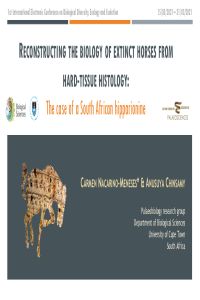
Reconstructing the Biology of Extinct Horses from Hard-Tissue Histology: The Case of a South African Hipparionine †
'%3e%3cpath%20d='M12.6647%2010.9104C12.4176%2010.325%2012.0589%209.7933%2011.6088%209.34485C11.16%208.89511%2010.6283%208.53653%2010.0432%208.28891C10.038%208.28629%2010.0327%208.28498%2010.0275%208.28236C10.8437%207.69282%2011.3743%206.73252%2011.3743%205.64907C11.3743%203.85423%209.92005%202.40002%208.12522%202.40002C6.33038%202.40002%204.87618%203.85423%204.87618%205.64907C4.87618%206.73252%205.40677%207.69282%206.22296%208.28367C6.21772%208.28629%206.21248%208.2876%206.20724%208.29022C5.62031%208.53783%205.09365%208.89287%204.64167%209.34616C4.19192%209.79496%203.83334%2010.3266%203.58573%2010.9117C3.34247%2011.4846%203.21128%2012.0987%203.19925%2012.721C3.1989%2012.735%203.20135%2012.7489%203.20646%2012.7619C3.21157%2012.7749%203.21924%2012.7868%203.22901%2012.7968C3.23877%2012.8068%203.25045%2012.8148%203.26334%2012.8202C3.27623%2012.8256%203.29007%2012.8284%203.30406%2012.8284H4.09012C4.14776%2012.8284%204.19362%2012.7825%204.19493%2012.7262C4.22113%2011.7148%204.62726%2010.7676%205.34519%2010.0497C6.08802%209.30686%207.07452%208.89811%208.12522%208.89811C9.17592%208.89811%2010.1624%209.30686%2010.9052%2010.0497C11.6232%2010.7676%2012.0293%2011.7148%2012.0555%2012.7262C12.0568%2012.7839%2012.1027%2012.8284%2012.1603%2012.8284H12.9464C12.9604%2012.8284%2012.9742%2012.8256%2012.9871%2012.8202C13%2012.8148%2013.0117%2012.8068%2013.0214%2012.7968C13.0312%2012.7868%2013.0389%2012.7749%2013.044%2012.7619C13.0491%2012.7489%2013.0515%2012.735%2013.0512%2012.721C13.0381%2012.0947%2012.9084%2011.4856%2012.6647%2010.9104ZM8.12522%207.90243C7.52388%207.90243%206.95792%207.66793%206.53214%207.24215C6.10636%206.81636%205.87185%206.2504%205.87185%205.64907C5.87185%205.04773%206.10636%204.48177%206.53214%204.05599C6.95792%203.63021%207.52388%203.3957%208.12522%203.3957C8.72655%203.3957%209.29252%203.63021%209.7183%204.05599C10.1441%204.48177%2010.3786%205.04773%2010.3786%205.64907C10.3786%206.2504%2010.1441%206.81636%209.7183%207.24215C9.29252%207.66793%208.72655%207.90243%208.12522%207.90243Z'%20fill='%235D1EE1'/%3e%3c/g%3e%3c/svg%3e)
Carmen Nacarino-Meneses 1
Anusuya Chinsamy 1
1. Department of Biological Sciences, University of Cape Town
Abstract
The microstructure of bones and teeth records individual growth and development in the form of incremental lines. In fossil bones, these features can be studied to infer important life history traits of extinct species, including growth rate and age at sexual and skeletal maturity. In fossil teeth, the analysis of incremental lines allows the estimation of rates and timings of tooth formation. Since mammalian dental development and biological events such as weaning are tightly correlated, estimations of dental formation time permits the reconstruction of the pace of life of prehistoric vertebrates.
Here, we present the results obtained from the histological analysis of bones and teeth of Eurygnathohippus hooijeri, an endemic hipparionine horse from the early Pliocene (5.2 Ma) site of Langebaanweg (South Africa). We studied 4 metapodials (two III-metacarpi and two III-metatarsi), 2 femora, as well as 3 first lower molars and 2 third lower molars to reconstruct key features of its life history, including size at birth, growth rate, age at skeletal maturity and age at reproductive maturity.
Our results revealed that this African horse followed a slow life history schedule, in which weaning and maturity occurred later as compared to similar-sized extant and extinct equids. Size at birth was comparable to that of large-bodied Miocene European equids, and newborn foals of E. hooijeri were likely smaller than those of extant and extinct Equus. Interestingly, we deduced different rates of growth from the bones and teeth, which raises the question about which of these mineralised tissues more accurately depicts the general growth rate of extinct vertebrates.
Keywords
vertebrate palaeontology
palaeobiology
life history
palaeohistology
bone histology
enamel his-tology
hipparionine
equid
Langebaanweg
Pliocene
Manuscript
sciforum_043511_original_NacarinoMeneses_Chinsamy_2021_BDEE-done.pdf
Poster
NacarinoMeneses&Chinsamy_BDEE2021.pdf
Comparative Study of Flowering Phenology of Selected Plant Life Forms Located in Urban and Rural Environments in Central Europe. Preliminary Results †
Impact of Canopy Gap Ecology on the Diversity and Dynamics of Natural Regeneration in a Tropical Moist Semi-Deciduous Forest, Ghana †