Event submissions
EventsThe 1st International Electronic Conference on Biological Diversity, Ecology and Evolution
Published

This submission belongs to the session a. Marine Diversity of the event The 1st International Electronic Conference on Biological Diversity, Ecology and Evolution
Published date
16 Mar, 2021
Citation
Alejandro Ariel Fernández, Nicolás Agustín Lemiña, Laura Schejter, Sponges (Porifera: Demospongiae) recorded at the South Shetland Islands and near the Antarctic Peninsula during the Argentinian Summer Antarctic Expedition in 2012, in Proceedings of The 1st International Electronic Conference on Biological Diversity, Ecology and Evolution, 15 March–31 March 2021, MDPI: Basel, Switzerland, doi: 10.3390/BDEE2021-09470
Share
Email
Facebook
Twitter
LinkedIn
Sponges (Porifera: Demospongiae) recorded at the South Shetland Islands and near the Antarctic Peninsula during the Argentinian Summer Antarctic Expedition in 2012

Alejandro Ariel Fernández 1
'%3e%3cpath%20d='M12.6647%2010.9104C12.4176%2010.325%2012.0589%209.7933%2011.6088%209.34485C11.16%208.89511%2010.6283%208.53653%2010.0432%208.28891C10.038%208.28629%2010.0327%208.28498%2010.0275%208.28236C10.8437%207.69282%2011.3743%206.73252%2011.3743%205.64907C11.3743%203.85423%209.92005%202.40002%208.12522%202.40002C6.33038%202.40002%204.87618%203.85423%204.87618%205.64907C4.87618%206.73252%205.40677%207.69282%206.22296%208.28367C6.21772%208.28629%206.21248%208.2876%206.20724%208.29022C5.62031%208.53783%205.09365%208.89287%204.64167%209.34616C4.19192%209.79496%203.83334%2010.3266%203.58573%2010.9117C3.34247%2011.4846%203.21128%2012.0987%203.19925%2012.721C3.1989%2012.735%203.20135%2012.7489%203.20646%2012.7619C3.21157%2012.7749%203.21924%2012.7868%203.22901%2012.7968C3.23877%2012.8068%203.25045%2012.8148%203.26334%2012.8202C3.27623%2012.8256%203.29007%2012.8284%203.30406%2012.8284H4.09012C4.14776%2012.8284%204.19362%2012.7825%204.19493%2012.7262C4.22113%2011.7148%204.62726%2010.7676%205.34519%2010.0497C6.08802%209.30686%207.07452%208.89811%208.12522%208.89811C9.17592%208.89811%2010.1624%209.30686%2010.9052%2010.0497C11.6232%2010.7676%2012.0293%2011.7148%2012.0555%2012.7262C12.0568%2012.7839%2012.1027%2012.8284%2012.1603%2012.8284H12.9464C12.9604%2012.8284%2012.9742%2012.8256%2012.9871%2012.8202C13%2012.8148%2013.0117%2012.8068%2013.0214%2012.7968C13.0312%2012.7868%2013.0389%2012.7749%2013.044%2012.7619C13.0491%2012.7489%2013.0515%2012.735%2013.0512%2012.721C13.0381%2012.0947%2012.9084%2011.4856%2012.6647%2010.9104ZM8.12522%207.90243C7.52388%207.90243%206.95792%207.66793%206.53214%207.24215C6.10636%206.81636%205.87185%206.2504%205.87185%205.64907C5.87185%205.04773%206.10636%204.48177%206.53214%204.05599C6.95792%203.63021%207.52388%203.3957%208.12522%203.3957C8.72655%203.3957%209.29252%203.63021%209.7183%204.05599C10.1441%204.48177%2010.3786%205.04773%2010.3786%205.64907C10.3786%206.2504%2010.1441%206.81636%209.7183%207.24215C9.29252%207.66793%208.72655%207.90243%208.12522%207.90243Z'%20fill='%235D1EE1'/%3e%3c/g%3e%3c/svg%3e)
Nicolás Agustín Lemiña 1

Laura Schejter 2
1. Facultad de Ciencias Exactas y Naturales, Universidad de Buenos Aires, Argentina. Intendente Güiraldes 2160 - Ciudad Universitaria.
2. Consejo Nacional de Investigaciones Científicas y Técnicas (CONICET) & Instituto Nacional de Investigación y Desarrollo Pesquero (INIDEP-ARGENTINA). Paseo Victoria Ocampo Nº1, 7600, Mar del Plata, Argentina.
Abstract
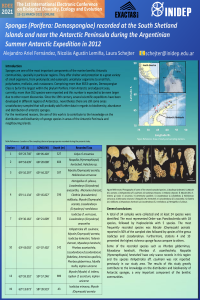
While in recent years there have been many scientific expeditions to Antarctica, there is still plenty to discover about it’s marine biodiversity, especially in certain regions, and particularly in regards to benthic organisms such as sponges (Phylum Porifera). The Argentinian 2012 Summer Antarctic Expedition took place between February and March of 2012. One of its main goals was the study of the benthic communities, considering the biodiversity and the distribution of the species around the Antarctic Peninsula and neighbouring islands. Samples were collected by bottom trawling at eight locations. Sponges were sorted from total catch, photographed, labeled and frozen onboard, while identification was carried out using classical methodology at the Instituto Nacional de Investigación y Desarrollo Pesquero (INIDEP, Argentina). In this preliminary study we provide the identification and location of the samples belonging to the Demospongiae Class. A total of 34 samples were collected and 23 species were identified. The most represented Order was Poecilosclerida with 18 species (Isodictya erinacea, I. lankesteri, I. cf. verrucosa, Mycale (Oxymycale) acerata, M. cf. tridens, Phorbas glaberrimus, P. acantochela, Lissodendoryx anacantha, L. flabellata, L. ramilobosa, Artemisina apollinis, Myxodoryx hanitschi, Clathria (Axosuberites) nidificata, Tedania charcoti, Iophon unicorne, I. cf. aceratum, Myxilla mollis, Kirkpatrickia aff. coulmani), followed by Haplosclerida with 5 species (Haliclonissa verrucosa, Haliclona sp. Calyx cf.arcuarius, Microxina charcoti, Hemigellius cf. pilosus). The most frequently recorded species was Mycale (Oxymycale) acerata followed by species of the genus Isodictya and Lissodendoryx. Some of the recorded species such as Phorbas glaberrimus, Myxodoryx hanitschi, Phorbas cf. acanthochela and Raspailia (Hymeraphiopsis) hentscheli have only scarce records in this region. The results of this study greatly contribute to the knowledge on the distribution and biodiversity of Antarctic sponges, a very important component of the benthic communities.
Keywords
Biodiversity x sponges
Demospongiae
Benthic communities
Species distribution
Antarctica
South Shetland Islands
Manuscript
Manuscript Sponges Fernandez Lemina Schejter.pdf
Poster
Poster Sponges Fernandez Lemina Schejter.pdf
Macroecological Patterns of Fruit Infestation Rates by the Invasive Fly Drosophila suzukii in the Reservoir Host Plant Sambucus nigra †
The Best of Both Worlds? Hybridization Potentiates Exotic Bohemian Knotweed’s (Reynoutria × bohemica) Impacts on Native Plant and Faunal Communities †