Event submissions
EventsThe 1st International Electronic Conference on Biological Diversity, Ecology and Evolution
Published

This submission belongs to the session i. Biodiversity Loss and Dynamics of the event The 1st International Electronic Conference on Biological Diversity, Ecology and Evolution
Published date
16 Mar, 2021
Citation
Brice Hanberry, Presenting Open Forest Ecosystems, Loss, and Consequences for Biodiversity †, in Proceedings of The 1st International Electronic Conference on Biological Diversity, Ecology and Evolution, 15 March–31 March 2021, MDPI: Basel, Switzerland, doi: 10.3390/BDEE2021-09479
Share
Email
Facebook
Twitter
LinkedIn
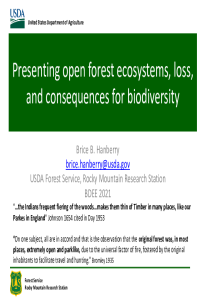
Presenting Open Forest Ecosystems, Loss, and Consequences for Biodiversity †
'%3e%3cpath%20d='M12.6647%2010.9104C12.4176%2010.325%2012.0589%209.7933%2011.6088%209.34485C11.16%208.89511%2010.6283%208.53653%2010.0432%208.28891C10.038%208.28629%2010.0327%208.28498%2010.0275%208.28236C10.8437%207.69282%2011.3743%206.73252%2011.3743%205.64907C11.3743%203.85423%209.92005%202.40002%208.12522%202.40002C6.33038%202.40002%204.87618%203.85423%204.87618%205.64907C4.87618%206.73252%205.40677%207.69282%206.22296%208.28367C6.21772%208.28629%206.21248%208.2876%206.20724%208.29022C5.62031%208.53783%205.09365%208.89287%204.64167%209.34616C4.19192%209.79496%203.83334%2010.3266%203.58573%2010.9117C3.34247%2011.4846%203.21128%2012.0987%203.19925%2012.721C3.1989%2012.735%203.20135%2012.7489%203.20646%2012.7619C3.21157%2012.7749%203.21924%2012.7868%203.22901%2012.7968C3.23877%2012.8068%203.25045%2012.8148%203.26334%2012.8202C3.27623%2012.8256%203.29007%2012.8284%203.30406%2012.8284H4.09012C4.14776%2012.8284%204.19362%2012.7825%204.19493%2012.7262C4.22113%2011.7148%204.62726%2010.7676%205.34519%2010.0497C6.08802%209.30686%207.07452%208.89811%208.12522%208.89811C9.17592%208.89811%2010.1624%209.30686%2010.9052%2010.0497C11.6232%2010.7676%2012.0293%2011.7148%2012.0555%2012.7262C12.0568%2012.7839%2012.1027%2012.8284%2012.1603%2012.8284H12.9464C12.9604%2012.8284%2012.9742%2012.8256%2012.9871%2012.8202C13%2012.8148%2013.0117%2012.8068%2013.0214%2012.7968C13.0312%2012.7868%2013.0389%2012.7749%2013.044%2012.7619C13.0491%2012.7489%2013.0515%2012.735%2013.0512%2012.721C13.0381%2012.0947%2012.9084%2011.4856%2012.6647%2010.9104ZM8.12522%207.90243C7.52388%207.90243%206.95792%207.66793%206.53214%207.24215C6.10636%206.81636%205.87185%206.2504%205.87185%205.64907C5.87185%205.04773%206.10636%204.48177%206.53214%204.05599C6.95792%203.63021%207.52388%203.3957%208.12522%203.3957C8.72655%203.3957%209.29252%203.63021%209.7183%204.05599C10.1441%204.48177%2010.3786%205.04773%2010.3786%205.64907C10.3786%206.2504%2010.1441%206.81636%209.7183%207.24215C9.29252%207.66793%208.72655%207.90243%208.12522%207.90243Z'%20fill='%235D1EE1'/%3e%3c/g%3e%3c/svg%3e)
Brice Hanberry 1
1. USDA Forest Service, Rocky Mountain Research Station
Abstract
Temperate open forest ecosystems of savannas and woodlands that were maintained by understory disturbances of fire and browsing have been lost. Here, I will describe the alternative state of open forests, which span the continuum between grasslands and forests, using structure, composition, function, and management of open pine and oak forests in the eastern United States as an example. Open forests are characterized by simple internal stand structure consisting of a single stratum of overstory trees and limited midstory, allowing co-existence of grasslands in the groundlayer. Current forests contain greater tree densities, which take growing space from herbaceous plants. Loss of open forests remains largely unrecognized due to transition to closed successional forests comprised of diverse tree species, which are the current baselines. Yet open forest loss comes at considerable conservation costs to herbaceous plants, fungi, insects including pollinators, and ‘successional’ and grassland birds and mammals. Open forests with a grasslands understory will impart another management option for forestry and wildlife. Open forest management includes maintaining the tree overstory and herbaceous understory rather than the focus of harvest and regeneration of traditional silviculture. Open old growth forests should be recognized as distinct ecosystems with unique biodiversity and associated management practices, similarly to recognition of closed old growth forests.
Keywords
fire
function
management
savanna
woodland
Manuscript
Sciforum-043026.pdf
Poster
BDDE_open_forests_Hanberry_2021.pdf
Forage Morphology and Productivity of Different Species of Tripsacum under Sub-Humid Tropical Conditions Aw2.
Trends in CITES Listed Bird’s Trade in South Asian Countries in View of Evolution of Indian Laws during Last Four Decades †