Event submissions
EventsThe 1st International Electronic Conference on Biological Diversity, Ecology and Evolution
Published

This submission belongs to the session g. Biogeography and Macroecology of the event The 1st International Electronic Conference on Biological Diversity, Ecology and Evolution
Published date
16 Mar, 2021
Citation
Brice Hanberry, Edward K. Faison, Deer as a natural disturbance that supports landscape and herbaceous plant diversity, in Proceedings of The 1st International Electronic Conference on Biological Diversity, Ecology and Evolution, 15 March–31 March 2021, MDPI: Basel, Switzerland, doi: 10.3390/BDEE2021-09481
Share
Email
Facebook
Twitter
LinkedIn
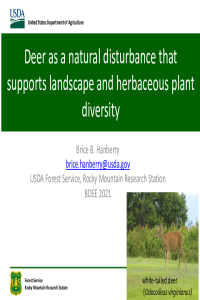
Deer as a natural disturbance that supports landscape and herbaceous plant diversity
'%3e%3cpath%20d='M12.6647%2010.9104C12.4176%2010.325%2012.0589%209.7933%2011.6088%209.34485C11.16%208.89511%2010.6283%208.53653%2010.0432%208.28891C10.038%208.28629%2010.0327%208.28498%2010.0275%208.28236C10.8437%207.69282%2011.3743%206.73252%2011.3743%205.64907C11.3743%203.85423%209.92005%202.40002%208.12522%202.40002C6.33038%202.40002%204.87618%203.85423%204.87618%205.64907C4.87618%206.73252%205.40677%207.69282%206.22296%208.28367C6.21772%208.28629%206.21248%208.2876%206.20724%208.29022C5.62031%208.53783%205.09365%208.89287%204.64167%209.34616C4.19192%209.79496%203.83334%2010.3266%203.58573%2010.9117C3.34247%2011.4846%203.21128%2012.0987%203.19925%2012.721C3.1989%2012.735%203.20135%2012.7489%203.20646%2012.7619C3.21157%2012.7749%203.21924%2012.7868%203.22901%2012.7968C3.23877%2012.8068%203.25045%2012.8148%203.26334%2012.8202C3.27623%2012.8256%203.29007%2012.8284%203.30406%2012.8284H4.09012C4.14776%2012.8284%204.19362%2012.7825%204.19493%2012.7262C4.22113%2011.7148%204.62726%2010.7676%205.34519%2010.0497C6.08802%209.30686%207.07452%208.89811%208.12522%208.89811C9.17592%208.89811%2010.1624%209.30686%2010.9052%2010.0497C11.6232%2010.7676%2012.0293%2011.7148%2012.0555%2012.7262C12.0568%2012.7839%2012.1027%2012.8284%2012.1603%2012.8284H12.9464C12.9604%2012.8284%2012.9742%2012.8256%2012.9871%2012.8202C13%2012.8148%2013.0117%2012.8068%2013.0214%2012.7968C13.0312%2012.7868%2013.0389%2012.7749%2013.044%2012.7619C13.0491%2012.7489%2013.0515%2012.735%2013.0512%2012.721C13.0381%2012.0947%2012.9084%2011.4856%2012.6647%2010.9104ZM8.12522%207.90243C7.52388%207.90243%206.95792%207.66793%206.53214%207.24215C6.10636%206.81636%205.87185%206.2504%205.87185%205.64907C5.87185%205.04773%206.10636%204.48177%206.53214%204.05599C6.95792%203.63021%207.52388%203.3957%208.12522%203.3957C8.72655%203.3957%209.29252%203.63021%209.7183%204.05599C10.1441%204.48177%2010.3786%205.04773%2010.3786%205.64907C10.3786%206.2504%2010.1441%206.81636%209.7183%207.24215C9.29252%207.66793%208.72655%207.90243%208.12522%207.90243Z'%20fill='%235D1EE1'/%3e%3c/g%3e%3c/svg%3e)
Brice Hanberry 1
Edward K. Faison 2
1. USDA Forest Service, Rocky Mountain Research Station
2. Highstead
Abstract
Abstract – Natural disturbances are critical ecosystem processes, with both ecological benefits and detriments. Herbivory by deer and other large wild herbivores often is considered a forest health problem, rather than a natural disturbance that results in a broad range of ecological outcomes including many important advantages. Here, we present that deer may be considered a natural disturbance helpful in controlling increased tree and shrub densities during the past century and thereby favoring a diversity of habitats and herbaceous plants. Ecological disadvantages of large herbivores include additional pressure on already declining herbaceous plant species and an increase in some invasive plant species via selective herbivory. We also discuss socioeconomic costs and benefits because society determines whether a species is a problem. Large herbivores are natural disturbances that have been removing plant biomass and altering landscape and vegetation structure for millions of years; similar to other disturbances, deer ‘regimes’ vary in severity. From a perspective of historical ecology rather than current baselines, deer as a disturbance provide many ecological benefits while socioeconomic effects range from troublesome to enjoyable for society.
Keywords
fire
forest health
herbivory
open forests
Manuscript
sciforum-043025.pdf
Poster
BDEE_deer_Hanberry.pdf
Trends in CITES Listed Bird’s Trade in South Asian Countries in View of Evolution of Indian Laws during Last Four Decades †
Taxonomic significance of leaf morpho-anatomical markers in identifying Ficus exasperata Roxb., Ficus mucuso Welw. ex Ficalho and Ficus thonningii Blume in Nigeria