Event submissions
EventsThe 1st International Electronic Conference on Biological Diversity, Ecology and Evolution
Published

This submission belongs to the session c. Plant Diversity of the event The 1st International Electronic Conference on Biological Diversity, Ecology and Evolution
Published date
16 Mar, 2021
Citation
Attila Rigó, Zoltán Barina, The Urban Anthropogenic Flora of Budapest (Hungary) †
, in Proceedings of The 1st International Electronic Conference on Biological Diversity, Ecology and Evolution, 15 March–31 March 2021, MDPI: Basel, Switzerland, doi: 10.3390/BDEE2021-09484
Share
Email
Facebook
Twitter
LinkedIn
The Urban Anthropogenic Flora of Budapest (Hungary) †
'%3e%3cpath%20d='M12.6647%2010.9104C12.4176%2010.325%2012.0589%209.7933%2011.6088%209.34485C11.16%208.89511%2010.6283%208.53653%2010.0432%208.28891C10.038%208.28629%2010.0327%208.28498%2010.0275%208.28236C10.8437%207.69282%2011.3743%206.73252%2011.3743%205.64907C11.3743%203.85423%209.92005%202.40002%208.12522%202.40002C6.33038%202.40002%204.87618%203.85423%204.87618%205.64907C4.87618%206.73252%205.40677%207.69282%206.22296%208.28367C6.21772%208.28629%206.21248%208.2876%206.20724%208.29022C5.62031%208.53783%205.09365%208.89287%204.64167%209.34616C4.19192%209.79496%203.83334%2010.3266%203.58573%2010.9117C3.34247%2011.4846%203.21128%2012.0987%203.19925%2012.721C3.1989%2012.735%203.20135%2012.7489%203.20646%2012.7619C3.21157%2012.7749%203.21924%2012.7868%203.22901%2012.7968C3.23877%2012.8068%203.25045%2012.8148%203.26334%2012.8202C3.27623%2012.8256%203.29007%2012.8284%203.30406%2012.8284H4.09012C4.14776%2012.8284%204.19362%2012.7825%204.19493%2012.7262C4.22113%2011.7148%204.62726%2010.7676%205.34519%2010.0497C6.08802%209.30686%207.07452%208.89811%208.12522%208.89811C9.17592%208.89811%2010.1624%209.30686%2010.9052%2010.0497C11.6232%2010.7676%2012.0293%2011.7148%2012.0555%2012.7262C12.0568%2012.7839%2012.1027%2012.8284%2012.1603%2012.8284H12.9464C12.9604%2012.8284%2012.9742%2012.8256%2012.9871%2012.8202C13%2012.8148%2013.0117%2012.8068%2013.0214%2012.7968C13.0312%2012.7868%2013.0389%2012.7749%2013.044%2012.7619C13.0491%2012.7489%2013.0515%2012.735%2013.0512%2012.721C13.0381%2012.0947%2012.9084%2011.4856%2012.6647%2010.9104ZM8.12522%207.90243C7.52388%207.90243%206.95792%207.66793%206.53214%207.24215C6.10636%206.81636%205.87185%206.2504%205.87185%205.64907C5.87185%205.04773%206.10636%204.48177%206.53214%204.05599C6.95792%203.63021%207.52388%203.3957%208.12522%203.3957C8.72655%203.3957%209.29252%203.63021%209.7183%204.05599C10.1441%204.48177%2010.3786%205.04773%2010.3786%205.64907C10.3786%206.2504%2010.1441%206.81636%209.7183%207.24215C9.29252%207.66793%208.72655%207.90243%208.12522%207.90243Z'%20fill='%235D1EE1'/%3e%3c/g%3e%3c/svg%3e)
Attila Rigó 1
Zoltán Barina 2
1. Department of Nature Conservation and Landscape Ecology, Szent István University, Gödöllő, Hungary
2. H-1095, Budapest, Ipar utca 3.
Abstract
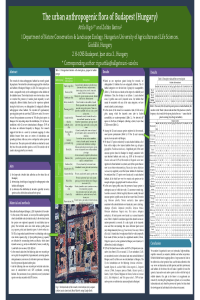
The research of urban anthropogenic habitats has recently gained big emphasis. We started the systematic mapping of the urban flora and habitats of Budapest, Hungary in 2018. Our main goal was to create a comparable study on the anthropogenic urban habitats of the inhabited areas. The territorial units were street sections, where we recorded the presence of vascular plants separately in each ecologically habitat. Based on the experience gathered during the field survey, we distinguished 18 ecologically anthropogenic urban habitats. We recorded 647 spontaneously plant species in more than 27,000 survey units. Our survey evinced the spontaneous occurrence of 193 alien plant species in Budapest. Our knowledge about the distribution of 81 of them is insufficient, while 10 are new introductions in Hungary. 53.9% of the aliens are cultivated frequently in Hungary. Our research suggests that there is a need for systematic mapping of urban habitats because these areas are centers of introduction and spreading of aliens, while may serve as refuges for native species at the same time. The most species-rich habitats are attached to roads, they bear the most adventive species as well. The corridor role of roads is also supported by our research.
Keywords
adventive species
anthropogenic habitats
habitat preference
introduction
invasive species
urban ecosystems
Manuscript
sciforum-043038 .pdf
Poster
sciforum-043038.pdf
Assessment of Changes in Patterns of Human—Brown Bear Conflicts over a Decade in Ladakh, India †
Current Vegetation of Danube Islands Refers to Historical Land Uses and Recent Human Interventions †