Event submissions
EventsThe 1st International Electronic Conference on Biological Diversity, Ecology and Evolution
Published

This submission belongs to the session f. Biodiversity Conservation of the event The 1st International Electronic Conference on Biological Diversity, Ecology and Evolution
Published date
16 Mar, 2021
Citation
Alfred Szilágyi, Fanni Mészáros, Róbert Kun, Miklós Sárospataki, Pollinator Communities in Some Selected Hungarian Conventional, Organic and Permaculture Horticultures, in Proceedings of The 1st International Electronic Conference on Biological Diversity, Ecology and Evolution, 15 March–31 March 2021, MDPI: Basel, Switzerland, doi: 10.3390/BDEE2021-09492
Share
Email
Facebook
Twitter
LinkedIn
Pollinator Communities in Some Selected Hungarian Conventional, Organic and Permaculture Horticultures
'%3e%3cpath%20d='M12.6647%2010.9104C12.4176%2010.325%2012.0589%209.7933%2011.6088%209.34485C11.16%208.89511%2010.6283%208.53653%2010.0432%208.28891C10.038%208.28629%2010.0327%208.28498%2010.0275%208.28236C10.8437%207.69282%2011.3743%206.73252%2011.3743%205.64907C11.3743%203.85423%209.92005%202.40002%208.12522%202.40002C6.33038%202.40002%204.87618%203.85423%204.87618%205.64907C4.87618%206.73252%205.40677%207.69282%206.22296%208.28367C6.21772%208.28629%206.21248%208.2876%206.20724%208.29022C5.62031%208.53783%205.09365%208.89287%204.64167%209.34616C4.19192%209.79496%203.83334%2010.3266%203.58573%2010.9117C3.34247%2011.4846%203.21128%2012.0987%203.19925%2012.721C3.1989%2012.735%203.20135%2012.7489%203.20646%2012.7619C3.21157%2012.7749%203.21924%2012.7868%203.22901%2012.7968C3.23877%2012.8068%203.25045%2012.8148%203.26334%2012.8202C3.27623%2012.8256%203.29007%2012.8284%203.30406%2012.8284H4.09012C4.14776%2012.8284%204.19362%2012.7825%204.19493%2012.7262C4.22113%2011.7148%204.62726%2010.7676%205.34519%2010.0497C6.08802%209.30686%207.07452%208.89811%208.12522%208.89811C9.17592%208.89811%2010.1624%209.30686%2010.9052%2010.0497C11.6232%2010.7676%2012.0293%2011.7148%2012.0555%2012.7262C12.0568%2012.7839%2012.1027%2012.8284%2012.1603%2012.8284H12.9464C12.9604%2012.8284%2012.9742%2012.8256%2012.9871%2012.8202C13%2012.8148%2013.0117%2012.8068%2013.0214%2012.7968C13.0312%2012.7868%2013.0389%2012.7749%2013.044%2012.7619C13.0491%2012.7489%2013.0515%2012.735%2013.0512%2012.721C13.0381%2012.0947%2012.9084%2011.4856%2012.6647%2010.9104ZM8.12522%207.90243C7.52388%207.90243%206.95792%207.66793%206.53214%207.24215C6.10636%206.81636%205.87185%206.2504%205.87185%205.64907C5.87185%205.04773%206.10636%204.48177%206.53214%204.05599C6.95792%203.63021%207.52388%203.3957%208.12522%203.3957C8.72655%203.3957%209.29252%203.63021%209.7183%204.05599C10.1441%204.48177%2010.3786%205.04773%2010.3786%205.64907C10.3786%206.2504%2010.1441%206.81636%209.7183%207.24215C9.29252%207.66793%208.72655%207.90243%208.12522%207.90243Z'%20fill='%235D1EE1'/%3e%3c/g%3e%3c/svg%3e)
Alfred Szilágyi 1
Fanni Mészáros 2
Róbert Kun 1
Miklós Sárospataki 3
1. Hungarian University of Agriculture and Life Sciences, Doctoral School of Environmental Sciences
2. Hungarian University of Agriculture and Life Sciences
3. Hungarian University of Agriculture and Life Sciences, Institute of Wildlife Management and Nature Conservation
Abstract
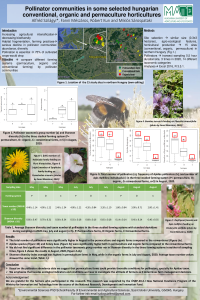
Increasing agricultural intensification can have a large impact on pollinating communities in terms of number and diversity, which often show a declining trend these days. Pollination is an important regulating ecosystem service, providing about 84% of fruit and vegetable production. The diversity of pollinators and the appropriate number of individuals are key to efficient pollination. In study, we examined the impact of three farming systems (organic, permaculture, and conventional) on the temporal, average farm-level number and diversity of pollinator species groups. We sampled all together fifteen small-scale (0.3-2 hectares, 5-5 in all three types) farms in North-Central Hungary with similar agroecological features. All of them have horticultural production with diverse crop rotation. We used visual sampling method to register individual number and taxa of pollinators in 14 categories in May, July and August, 2020. Our results show that the abundance of some pollinator taxonomic groups was highest in case of permaculture farms and in some cases even significant differences were found (e.g. Apidae and Total number of pollinators taxonomic groups). On the other hand regarding taxonomic group Shannon diversity of the pollinator communities, we could not detect any significant difference between the farming types. Our results show that permaculture farms could maintain a diverse and abundant pollinator community during the studied period but we have to consider the farm management factors like plant protection measures, flower resources and biodiversity management on the farm also natural habitats around the farms and the attitude of the farmers towards protection of pollinators.
Keywords
agro-ecosystem
agroecology
pollination
ecosystem service
land use
Manuscript
Sciforum 043841-BDEE_Proceeding_ASzilágyi_FMészáros_RKun_MSárospataki_revised.pdf
Poster
BDEE_Poster_ASzilágyi_FMészáros_RKun_MSárospataki_revised.pdf
Phytochemical Study and In Vitro Biological Assays on Zingiber officinal: A Widely Used Spice †
Russian Red Data Book Orchids: What Anthropogenic Factors are Leading to their Extinction in Regions?