Event submissions
Published
 10.3390/ECA2021-09525 (registering DOI)
 This submission belongs to the session F. Poster of the event The 1st International Electronic Conference on Antibiotics
Published date
22 Mar, 2021
Citation
Catarina S. Miranda, Joana C. Antunes, Natália C. Homem, Helena P. Felgueiras, Cinnamon leaf oil release from chitosan microcapsules embedded within a sodium alginate-gelatin hydrogel-like film for the inhibition of multi-drug resistant bacteria, in Proceedings of The 1st International Electronic Conference on Antibiotics, 8 May–17 May 2021, MDPI: Basel, Switzerland, doi: 10.3390/ECA2021-09525
Share
Email
Facebook
Twitter
LinkedIn
Cinnamon leaf oil release from chitosan microcapsules embedded within a sodium alginate-gelatin hydrogel-like film for the inhibition of multi-drug resistant bacteria
'%3e%3cpath%20d='M12.6647%2010.9104C12.4176%2010.325%2012.0589%209.7933%2011.6088%209.34485C11.16%208.89511%2010.6283%208.53653%2010.0432%208.28891C10.038%208.28629%2010.0327%208.28498%2010.0275%208.28236C10.8437%207.69282%2011.3743%206.73252%2011.3743%205.64907C11.3743%203.85423%209.92005%202.40002%208.12522%202.40002C6.33038%202.40002%204.87618%203.85423%204.87618%205.64907C4.87618%206.73252%205.40677%207.69282%206.22296%208.28367C6.21772%208.28629%206.21248%208.2876%206.20724%208.29022C5.62031%208.53783%205.09365%208.89287%204.64167%209.34616C4.19192%209.79496%203.83334%2010.3266%203.58573%2010.9117C3.34247%2011.4846%203.21128%2012.0987%203.19925%2012.721C3.1989%2012.735%203.20135%2012.7489%203.20646%2012.7619C3.21157%2012.7749%203.21924%2012.7868%203.22901%2012.7968C3.23877%2012.8068%203.25045%2012.8148%203.26334%2012.8202C3.27623%2012.8256%203.29007%2012.8284%203.30406%2012.8284H4.09012C4.14776%2012.8284%204.19362%2012.7825%204.19493%2012.7262C4.22113%2011.7148%204.62726%2010.7676%205.34519%2010.0497C6.08802%209.30686%207.07452%208.89811%208.12522%208.89811C9.17592%208.89811%2010.1624%209.30686%2010.9052%2010.0497C11.6232%2010.7676%2012.0293%2011.7148%2012.0555%2012.7262C12.0568%2012.7839%2012.1027%2012.8284%2012.1603%2012.8284H12.9464C12.9604%2012.8284%2012.9742%2012.8256%2012.9871%2012.8202C13%2012.8148%2013.0117%2012.8068%2013.0214%2012.7968C13.0312%2012.7868%2013.0389%2012.7749%2013.044%2012.7619C13.0491%2012.7489%2013.0515%2012.735%2013.0512%2012.721C13.0381%2012.0947%2012.9084%2011.4856%2012.6647%2010.9104ZM8.12522%207.90243C7.52388%207.90243%206.95792%207.66793%206.53214%207.24215C6.10636%206.81636%205.87185%206.2504%205.87185%205.64907C5.87185%205.04773%206.10636%204.48177%206.53214%204.05599C6.95792%203.63021%207.52388%203.3957%208.12522%203.3957C8.72655%203.3957%209.29252%203.63021%209.7183%204.05599C10.1441%204.48177%2010.3786%205.04773%2010.3786%205.64907C10.3786%206.2504%2010.1441%206.81636%209.7183%207.24215C9.29252%207.66793%208.72655%207.90243%208.12522%207.90243Z'%20fill='%235D1EE1'/%3e%3c/g%3e%3c/svg%3e)
Catarina S. Miranda 1

Joana C. Antunes 1

Natália C. Homem 1

Helena P. Felgueiras 1
1. Centre for Textile Science and Technology (2C2T), University of Minho
Abstract
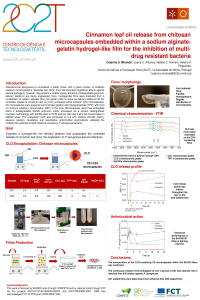
Pseudomonas aeruginosa-derived infections are considered a public health problem once that P. aeruginosa is stated as a human pathogen highly resistant to antibiotics. Recently, essential oils (EOs) have been reported as an alternative to antibiotics. Polymeric microcapsules can include antimicrobial agents at the core and be surrounded by a polymeric shell, usually containing polysaccharides like chitosan (CS), aiming to work as drug carriers and protecting the encapsulated biomolecule from the surrounding environment. Hydrogel-like films are commonly produced to incorporate microcapsules because of their high porosity, that enables a high permeability of oxygen, nutrients and metabolites. Sodium alginate (SA) and gelatin (GN) are polymers that are frequently applied in the production of films. In this study, a delivery platform was developed for the controlled release of cinnamon leaf oil (CLO) entrapped in CS microcapsules produced via ionotropic gelation. CS solution was prepared without pH adjustment (CS1) and with pH adjusted to 5.0 (CS4), which according to the literature improves the polymer stability for microencapsulation. The microcapsules were then incorporated in hydrogel-like films, composed of a combination of SA and GN. Results confirmed an effective incorporation of CS microcapsules, containing CLO, within SA/GN films, as well as a continuous release of the entrapped CLO during 24h. Time kill kinetics tests showed that during the first hour of interaction with the CLO-containing films bacteria continued to grow. However, as the CLO release from the films increased, its action against the bacteria also improved with a >99% elimination. CS1 microcapsules were deemed more effective, due to their enhanced CLO release profile and antimicrobial action. All qualitative and quantitative antimicrobial tests proved the potential of CLO loaded films for the inhibition of multi-drug resistant bacteria.
Keywords
bio-based polymers
drug delivery platform
natural extracts
trigger-based release
bactericidal effects
Manuscript
sciforum-043576.pdf
Poster
Poster ECA.pdf
ANTIMICROBIAL RESISTANCE GENES PREVALENCE OF UROPATHOGENS IN MOSCOW CENTER FOR CHILDREN'S HEALTH
Phytochemical, Antimicrobial and Antioxidant Profile of Solidago virga-aurea, Phyllanthus niruri, Epilobium angustifolium, Peumus boldus and Ononis spinosa Extracts