Event submissions
EventsMOL2NET'21, Conference on Molecular, Biomed., Comput. & Network Science and Engineering, 7th ed.
Published

This submission belongs to the session 03. NANOBIO.MAT-07: Nanotech., Biomed. Eng., & Mat. Sci. Congress, Birmingham & Portsmouth, UK-Jackson & Fargo, USA, 2021. of the event MOL2NET'21, Conference on Molecular, Biomed., Comput. & Network Science and Engineering, 7th ed.
Published date
13 Apr, 2021
Citation
Sondes Mechri, Khelifa Bouacem, Mouna Kriaa, Alif Chebbi, Sami Sayadi, Mohamed Chamkha, Amel Bouanane-Darenfed, Hocine Hacene, Bassem Jaouadi, Protease production from Lysinibacillus fusiformis strain C250R: Statistical optimization and compatibility study for use in detergent formulations, in Proceedings of MOL2NET'21, Conference on Molecular, Biomed., Comput. & Network Science and Engineering, 7th ed., 25 January–30 December 2021, MDPI: Basel, Switzerland, doi: 10.3390/mol2net-07-09542
Share
Email
Facebook
Twitter
LinkedIn
Protease production from Lysinibacillus fusiformis strain C250R: Statistical optimization and compatibility study for use in detergent formulations
'%3e%3cpath%20d='M12.6647%2010.9104C12.4176%2010.325%2012.0589%209.7933%2011.6088%209.34485C11.16%208.89511%2010.6283%208.53653%2010.0432%208.28891C10.038%208.28629%2010.0327%208.28498%2010.0275%208.28236C10.8437%207.69282%2011.3743%206.73252%2011.3743%205.64907C11.3743%203.85423%209.92005%202.40002%208.12522%202.40002C6.33038%202.40002%204.87618%203.85423%204.87618%205.64907C4.87618%206.73252%205.40677%207.69282%206.22296%208.28367C6.21772%208.28629%206.21248%208.2876%206.20724%208.29022C5.62031%208.53783%205.09365%208.89287%204.64167%209.34616C4.19192%209.79496%203.83334%2010.3266%203.58573%2010.9117C3.34247%2011.4846%203.21128%2012.0987%203.19925%2012.721C3.1989%2012.735%203.20135%2012.7489%203.20646%2012.7619C3.21157%2012.7749%203.21924%2012.7868%203.22901%2012.7968C3.23877%2012.8068%203.25045%2012.8148%203.26334%2012.8202C3.27623%2012.8256%203.29007%2012.8284%203.30406%2012.8284H4.09012C4.14776%2012.8284%204.19362%2012.7825%204.19493%2012.7262C4.22113%2011.7148%204.62726%2010.7676%205.34519%2010.0497C6.08802%209.30686%207.07452%208.89811%208.12522%208.89811C9.17592%208.89811%2010.1624%209.30686%2010.9052%2010.0497C11.6232%2010.7676%2012.0293%2011.7148%2012.0555%2012.7262C12.0568%2012.7839%2012.1027%2012.8284%2012.1603%2012.8284H12.9464C12.9604%2012.8284%2012.9742%2012.8256%2012.9871%2012.8202C13%2012.8148%2013.0117%2012.8068%2013.0214%2012.7968C13.0312%2012.7868%2013.0389%2012.7749%2013.044%2012.7619C13.0491%2012.7489%2013.0515%2012.735%2013.0512%2012.721C13.0381%2012.0947%2012.9084%2011.4856%2012.6647%2010.9104ZM8.12522%207.90243C7.52388%207.90243%206.95792%207.66793%206.53214%207.24215C6.10636%206.81636%205.87185%206.2504%205.87185%205.64907C5.87185%205.04773%206.10636%204.48177%206.53214%204.05599C6.95792%203.63021%207.52388%203.3957%208.12522%203.3957C8.72655%203.3957%209.29252%203.63021%209.7183%204.05599C10.1441%204.48177%2010.3786%205.04773%2010.3786%205.64907C10.3786%206.2504%2010.1441%206.81636%209.7183%207.24215C9.29252%207.66793%208.72655%207.90243%208.12522%207.90243Z'%20fill='%235D1EE1'/%3e%3c/g%3e%3c/svg%3e)
Sondes Mechri 1
Khelifa Bouacem 2
Mouna Kriaa 1
Alif Chebbi 3
Sami Sayadi 3
Mohamed Chamkha 3
Amel Bouanane-Darenfed 2
Hocine Hacene 2

Bassem Jaouadi 1
1. Laboratory of Microbial Biotechnology, Enzymatic, and Biomolecules (LMBEB), Centre of Biotechnology of Sfax (CBS), University of Sfax, P.O. Box 1177, Sfax 3018, Tunisia
2. Laboratory of Cellular and Molecular Biology (LCMB), Microbiology Team, Faculty of Biological Sciences, University of Sciences and Technology of Houari Boumediene (USTHB), P.O. Box 32, El Alia, Bab Ezzouar, 16111 Algiers, Algeria
3. Laboratory of Environmental Bioprocesses (LEBP), LMI COSYS-Med, Centre of Biotechnology of Sfax (CBS), University of Sfax, Road of Sidi Mansour Km 6, P.O. Box 1177, Sfax 3018, Tunisia
Abstract
In this study, we aimed to optimize the cultural and nutritional conditions for protease production by Lysinibacillus fusiformis strain C250R in submerged fermentation process using statistical methodology. The most significant factors (gruel, wheat bran, yeast extract, and FeSO4) were identified by Plackett-Burman design. Response surface methodology (RSM) was used to determine the optimum levels of the screened factors and their interaction. Under the optimized conditions, protease yield 3045 U/mL was 4.5 folds higher than those obtained by the use of the initial conditions (680 U/mL). Additionally, this research demonstrated that the protease activity of strain C250R has a high detergent compatibility and an excellent stain removal compared to Alcalase Ultra 2.5 L; which offers an interesting potential for its application in the laundry detergent industry.
Keywords
Protease
Lysinibacillus fusiformis
Statistical methodology
Detergent formulations.
Manuscript
Manuscript_Mol2net 2021.pdf
Poster
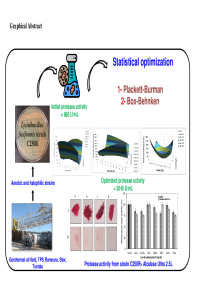
Graphical Abstract_Mol2net 2021.pdf
Protein Corona on Hydroxyapatite Nanoparticles
UHPLC-HRMS analysis of Coccoloba cowellii, an endemic endangered plant from Cuba